





 Portuguese
  English
  Spanish
  9 min of reading
  5 comments





Natural Building Technology: Learn How Natural Air Conditioning Can Cool Your Home Efficiently, Sustainably, and Economically, Providing Thermal Comfort
Canadian wells, also known as provensals (for their use in the French region of Provence), are simple geothermal climatization construction systems. They consist of networks of pipes located in the external underground of residences, connected to them and operating under the principle of thermal inertia to adjust the temperature of the air used in the house.
This construction system does not consume electric energy, so after its installation, the climatization of our house will be more economical. A natural technology of low cost, ecological, efficient, and sustainable.
Installation of a Canadian Well Building System
There are places where they are more effective in winter and others where they are more effective in summer. Now you will discover the difference.
-
The lack of welders, electricians, and operators becomes a structural threat in 2025, with the construction industry and manufacturing already suffering from delays, cost pressures, and labor shortages in Brazil.
-
Brazil and Paraguay are just 46 meters away from a historic union on the bioceanic bridge that promises to revolutionize trade between the Atlantic and the Pacific.
-
With 55 km over the sea, a cost of US$ 20 billion, and enough steel to build 60 Eiffel Towers, China’s largest project has connected Hong Kong, Zhuhai, and Macau in a colossal bridge that defies the logic of engineering.

-
A trick with joint compound transforms a Styrofoam ceiling into a plaster-like ceiling: leveled panels, wires and mesh at the joints, sand, paint, and change the environment while spending little today.

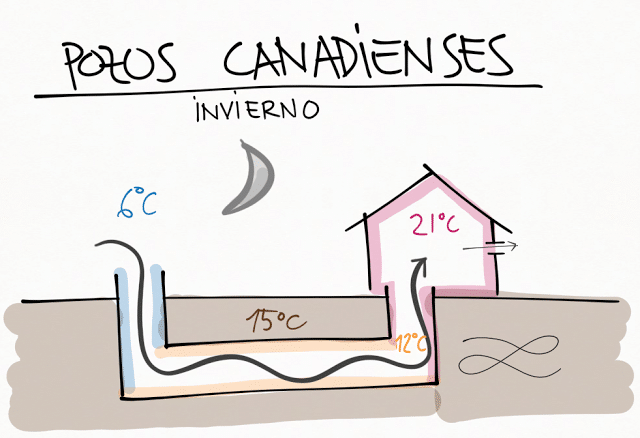
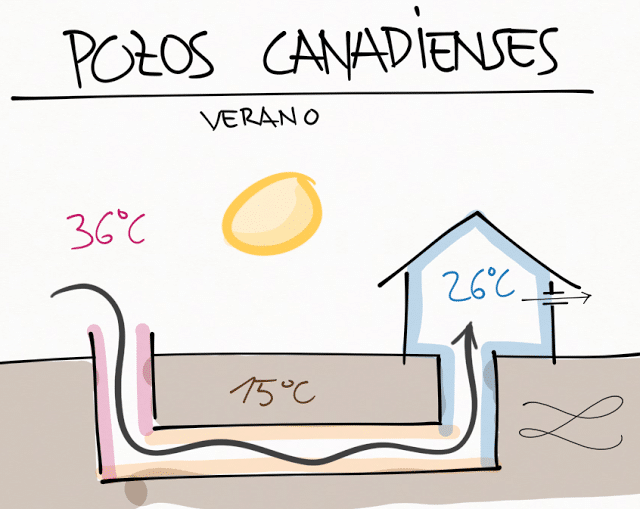
Its principle of operation is simple: the air that accumulates in the buried pipes is cooler than the air inside the house in summer, but warmer in winter. We have, without any electric consumption, a heat exchange that we will use to heat in winter and cool in summer.
The most effective and economical way is to install the Canadian well during the construction of the residence, as later installation can be costly.
This system significantly reduces energy demand. It is a very effective bioclimatic strategy to improve the energy efficiency of a building.
Thermal Inertia
This property indicates the amount of heat that a body can retain and how quickly it releases or absorbs it. It is a property used in construction to maintain the temperature inside environments throughout the day. During the day, the walls heat up and at night release heat to the area; in summer, they absorb heat from the environment through a ventilation system and at night cool down with a similar system.
In the case of Canadian wells, its principle of operation is simple. The surface temperature presents a difference from the ambient temperature, and this difference intensifies and remains stable at approximately two meters deep, where the temperature generally remains between 18ºC and 24ºC. This variation intensifies depending on the geographical location and climatic conditions. This temperature is known as average temperature, and if it is pleasant, it will be suitable for connecting the building to the ground. At 15 meters deep, the temperature is constant throughout the year.
A Canadian well consists of a series of pipes placed at a determined depth – heat exchanger, which run a certain number of meters underground. In these pipes, air circulates, causing a heat exchange between the circulating air and the surrounding ground.
Operation
Operation in Winter
In winter months, the outside air is colder. The temperature at two meters depth is higher than the surface temperature, so when the cold outside air circulates through the underground pipes, it heats up. The warm air reaches the house, reducing the temperature gradient, allowing the heating to connect at a lower temperature or not be used at all.
Operation in Summer
During summer, the air temperature is higher than the temperature underground. Therefore, when the air passes through the pipes, it releases heat to the ground and cools down, arriving at the house several degrees cooler, creating a comfortable environment.
Thermal Behavior of Soil
The subsoil, due to its large mass, maintains a much greater thermal stability than the atmosphere throughout the year, which prevents peaks of cold and heat. Thus, in summer, when it is hot outside, the subsoil remains at cool temperatures. On the other hand, in winter, when the outside temperature drops significantly, the subsoil remains warm or at least warmer than the outside.
This stability, however, is not uniform. It increases progressively, with smaller differences between summer and winter as depth increases. It is estimated that at around 10 to 15 meters deep, the temperature is practically constant throughout the year. At depths of about 2 meters, functional temperature values close to the comfort values (18ºC – 24ºC) of residences are already found.
Another thermal characteristic of the subsoil is its lag concerning the outside air temperature. Thus, after the warm months, when cold days begin, much of the subsoil will still retain a higher relative amount of heat than the air. Similarly, when hot days begin, the subsoil still maintains greater coolness, a result of winter. This is due to the large mass that the subsoil has, which makes it take much longer to gain or lose heat compared to the air. This is the characteristic of a large thermal storage that the provensal or Canadian wells take advantage of.


Parts of the Canadian Well Building Systems
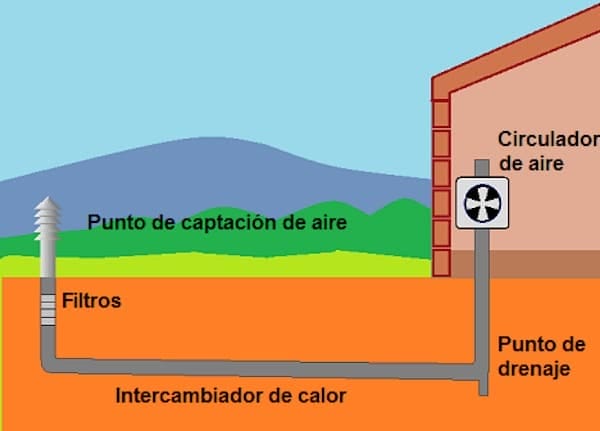
Provensal or Canadian wells have the following parts:
Air Capture Point
This is the point where the system takes in air from outside. This capture should be slightly elevated (1m or 1.5m) to avoid capturing contaminated air. For this same reason, areas where the air remains in motion are chosen, avoiding depressions where air can become stagnant.
These two measures are taken to avoid, above all, capturing radon gas. Radon gas is a radioactive gas that is naturally generated throughout the Earth’s crust, although more intensely in volcanic and granite areas. At high concentrations, it is harmful to health, so it must be avoided. Since it is heavier than air, it tends to accumulate in depressions and holes when there are no air currents to disperse it. Proper placement of the external air capture, along with system sealing that prevents this gas from infiltrating the pipes, avoids the contamination of this type of gas from affecting provençal or Canadian wells.
The entrance should also have a grate that prevents access to the system by insects, rodents, or any other animals that may nest inside or deposit excrement and dirt that may contaminate the system.
Filters
They are responsible for purifying the air and thereby preventing dust and dirt from entering the ducts.
Heat Exchanger
This is the element that transfers heat from the subsoil to the air. It is ultimately the buried piping. The length and diameter of this conduit can vary due to factors such as depth and soil nature, power of the element that sucks in the air, thermal needs, etc. Of capital importance is the nature of the soil and its ability to transmit heat (thermal conductivity). For example, dry sandy soils transmit heat worse than clayey ones. Soil moisture is also very important, as water-saturated soil, regardless of its composition, will have a high capacity to transmit heat, since water itself has this capacity.
The longer the pipe, the more thermal transfers between air and soil will occur. The most commonly used values range between 10 and 100 meters in length. For the diameter of the piping, the recommended values range between 20 and 40 cm in diameter.
The pipe or tubing must be watertight and sealed, smooth, resistant mechanically to pressure and ground deformation. It should also be resistant to corrosion. Finally, it should have good thermal conductivity (i.e., allow heat to pass through it or, in other words, be the least thermally insulating possible) so as to allow heat transfers between the ground and the air within the tubing.
This tubing should also have a slight incline. This is necessary because, at certain times of the year, condensation can occur inside the tubing. For example, in summer, just before a storm, warm and humid air may enter the heat exchanger tube. In the exchanger, when there is a drop in air temperature, condensation will inevitably occur. To prevent water from accumulating in the piping, these are placed with a certain degree of inclination, which will cause the water to drain by gravity to a drainage point. If this element is not considered, nor are filters included, the accumulation of dust with organic matter and moisture would lead to the proliferation of fungi and bacteria.
The shape of the heat exchanger can also be varied, adapting to the available terrain and thermal needs. Thus, there are various designs, such as the one where the exchanger conduit surrounds the residence, taking advantage of its perimeter, or those that are located concentrated in a square area of a plot adjacent to the house, where the tubes acquire different arrangements (parallel tubes in a grid shape, serpentine tubes, etc.).
Drain Point
The condensed water in the pipes, due to the incline, directs to the drain point where it is eliminated from the system.
Air Circulation Element
The air needs an element to push it and make it circulate through the buried pipes. At this point, depending on what is intended to be achieved, active (mechanical) or passive (solar chimney) elements can be used.
As an active element, it can be a small fan or extractor of adequate power that sucks the air from the pipes and makes it circulate.
As passive, there is the possibility of using domestic solar chimneys. In this mechanism, the sun heats the chimney and the air inside, causing it to become lighter, rise, and exit to the outside through the top opening. This creates a depression at the base of the solar chimney, or a “lack of air” that causes a current towards the chimney. If the solar chimney is placed appropriately, it is possible to make this suction effect cause the circulation of air in the buried pipes of the provensal well. This system can be effective for the hot months, during which the provensal well is used for cooling. However, its use may not be convenient in winter under this scheme.
In any case, mechanical extractors and the solar chimney do not exclude each other, and can perfectly complement each other for greater savings.
The tempered air from the Canadian provensal wells can be connected to the ventilation system of the residence. In this case, the exit of the well is connected to the air intake of the same. Its use is also compatible with dual-flow systems and heat recovery systems.
Advantages of Canadian Wells
Canadian and provensal wells, being an ecological, natural, and low-consumption system, have a series of advantages that can be summarized in the following points:
- Lower Investment: Require a much lower investment than a conventional reversible climatization system. Additionally, if installed at the time of the house construction, costs are further reduced.
- Low Energy Operation: Its operation requires very little energy, limiting expenditure to the operation of the air extractor, when available.
- Reduced Maintenance: Maintenance of the provensal or Canadian well construction systems is limited, only requiring cleaning of the piping with appropriate cleaners if necessary, periodic filter replacement, draining of the condensate tank, if applicable, and minimal maintenance of the air propulsion system.
- Natural and Ecological System: By using a local, abundant, and completely natural resource, it avoids triggering the entire chain of impactful acts that would involve bringing an artificial climatization equipment from afar, as well as, above all, the energy or fuels needed to operate it, all to achieve the same effect that can be achieved with a provensal well.
- Healthy for Inhabitants: Maintains a good level of air renewal while keeping a healthy humidity level (unlike many climatization systems that excessively dry the air).
Performance of Canadian Wells in Summer and Winter
Provensal/Canadian well construction systems are very efficient in cooling during summer, perfectly replacing conventional air conditioning systems. The comparison of energy expenditure between provensal wells (a low-consumption extractor when the extraction system is mechanical) and the high consumptions of conventional air conditioners clearly tips the balance in favor of the former.
In winter, however, the wells may be insufficient by themselves to provide the necessary heat for the climatization of a building, depending on latitude. However, they can offer very important pre-heating of the air, resulting in substantial savings, as the thermal jump that the artificial climatization system will have to provide will be reduced. In high-altitude tropical areas, for example, where nights are cold and days are mild or hot, the situation may be different. In winter, in areas near the poles, they are effective by themselves for keeping buildings that are unoccupied during winter thawed.
The images in this article were taken from: angelsinocencio.com.










qual material pode ser usado como intercambiador de calor?
Com a combinação de arvores aumenta a eficiência, pois no processo de fotossíntese há maior evaporação e aumenta a dispersão ao meio externo do solo.
Se realmente cumprir o que promete, vale sim o investimento.