





 Portuguese
  English
  Spanish
  5 min of reading
  0 comments


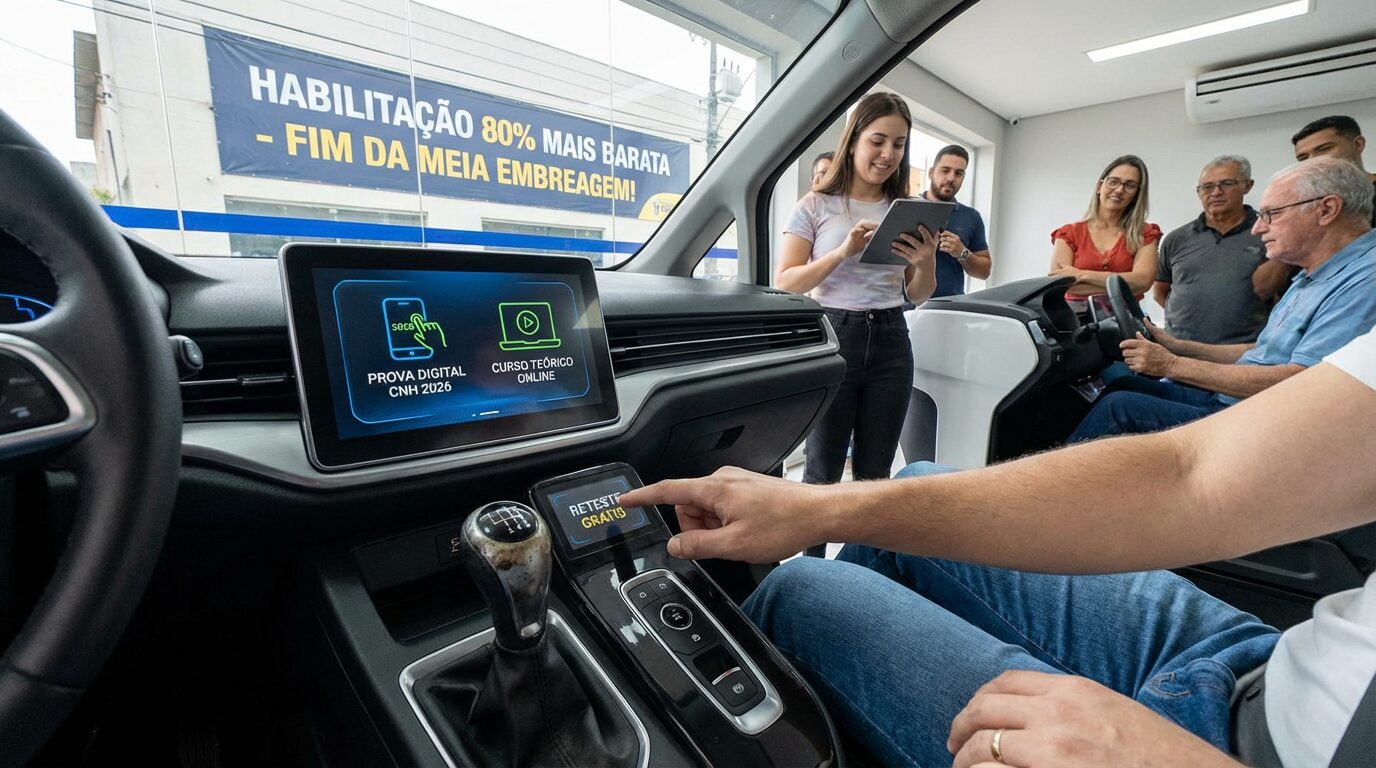
Changes to the 2026 Driver’s License Eliminate Half Clutch and Hill Start, Open Free Retesting and Ease Training with Digital Theory Course
The practical test for the 2026 Driver’s License will undergo one of the largest recent revisions. The half clutch and hill start maneuvers will no longer be required, according to a resolution by the National Traffic Council (Contran) approved on December 1, 2025 and announced by the Minister of Transport, Renan Filho, on December 10, 2025. This measure is part of a simplification package aimed at reducing rejections and costs.
According to the Ministry of Transport, the test should focus more on real driving, traffic circulation, and respect for rules, rather than a single point of tension. The government also confirmed a free retest for those who fail once and expanded options for theoretical preparation, including in digital format and without the requirement for driving schools.
Currently, obtaining a license can cost around R$ 5,000, depending on the region and the package chosen. With the new guidelines, the total cost of the Driver’s License may decrease by up to 80%, according to official estimates.
-
The government requests the Federal Revenue Service for a new system to automate the income tax declaration, reducing errors, time, and bureaucracy for millions of Brazilians.

-
Pix in installments, international Pix, and contactless payment without internet: the Central Bank revealed the new features coming to the tool that is already used by almost every adult in Brazil.

-
Mercado Livre has just started selling medications with delivery in up to three hours to your door, and this move could completely change the way Brazilians buy medicines on a daily basis.

-
In Dubai, rising tensions from the war in the Middle East are causing super-rich individuals to leave the Gulf and direct their fortunes to a new financial refuge in Asia.


The ministry states that the previous test design encouraged some candidates to drive without a license, due to rejections considered excessive. The change aims to break this cycle and bring training closer to real traffic conditions.
Practical Test for the 2026 Driver’s License, End of Half Clutch and Hill Start
In the new configuration, the requirement for the half clutch test and the hill start is removed from the test itinerary. Until now, the maneuver required keeping the car stopped on an incline only at the clutch point, which concentrated the evaluation on a moment of high tension.
Minister Renan Filho reported receiving complaints about instructors who would alter the tire pressure to facilitate the vehicle “stalling” on the hill, raising the chances of disqualification. For many candidates, simply stalling the car would result in immediate failure of the exam.
Free Retesting and Focus on Real Driving
The government will implement a free retest for the first failure. The candidate will be able to retake the practical exam once without paying another fee, according to the Ministry of Transport, reducing the financial impact of a single mistake.
In the official view, failing the test will no longer be a definitive barrier and will encourage quick corrections of errors. The goal is to evaluate the overall driving performance throughout the course, rather than just a technical detail under pressure.
The package also criticizes the so-called summary test, where minor faults, such as forgetting to signal, resulted in immediate disqualification. The proposal is to consider the error within the overall performance.
Digital Theory Course and End of Driving School Requirement
The resolution from the National Traffic Council simplifies steps, removes the requirement for driving schools, and authorizes a free digital theory course. The candidate will be able to prepare with more flexibility, without compromising the required content.
According to the federal government, the combination of online training and the revision of requirements considered excessive should broaden access, especially for those with limited time or income.
Driver’s License Costs May Drop by Up to 80 Percent
Currently, the license can cost around R$ 5,000, depending on the location and services contracted. With the new regulations, official calculations indicate a decrease of up to 80% in the total cost of the process.
For thousands of Brazilians who depend on the Driver’s License to work, the financial reduction and the end of traumatic maneuvers may unlock access to the document and reduce informality in traffic.
Automatic Cars and Candidate-Owned Vehicles Under Study
According to Minister Renan Filho, the practical test may, in the future, be conducted in automatic cars and even in the candidate’s own vehicle. Those who learn in automatic will not need to take the manual test, bringing the exam closer to the fleet that circulates on the streets.
The possibility of using their own car is likely to reduce anxiety and improve performance due to familiarity with the vehicle. The measure, according to the ministry, aligns the evaluation with real driving conditions.
Government Goals, Road Safety, and Reviewing the Failure Environment
According to the Ministry of Transport, the previous model did not contribute to road safety as expected and created a series failure environment. Minor errors turned into definitive sentences, without considering the rest of the driving.
With the change, the test will begin to emphasize rules, defensive posture, and decision-making in traffic. The government argues that this reduces dropout from the formal process and combats the practice of driving without a license.
The approved changes on December 1, 2025 are part of a broader simplification package. The intention is to make the assessment less bureaucratic and more connected to real traffic, without compromising safety criteria.
At the same time, the ministry claims that combating potential distortions in the process—such as pressure over specific maneuvers—should reduce unfounded failures and repeated costs.
Impact on Workers and Easing Requirements for Good Drivers
The rules for the 2026 Driver’s License complement recent measures such as automatic renewal for good drivers and criteria for exemption in specific cases, according to the government. The logic is to reward those who respect the rules and simplify life for those who need the license to work.
For professional and freelance drivers, the reduction in costs and the elimination of unnecessary obstacles may accelerate regularization. The expected gain is in inclusion and formalization, focusing on effective training and fewer financial barriers.
What do you think about the end of half clutch and the free retest—an advancement in safety and access or excessive flexibility in the practical test? Leave your comment and share how the changes may influence the training of new drivers in your city.









-

2 pessoas reagiram a isso.