





 Portuguese
  English
  Spanish
  5 min of reading
  0 comments


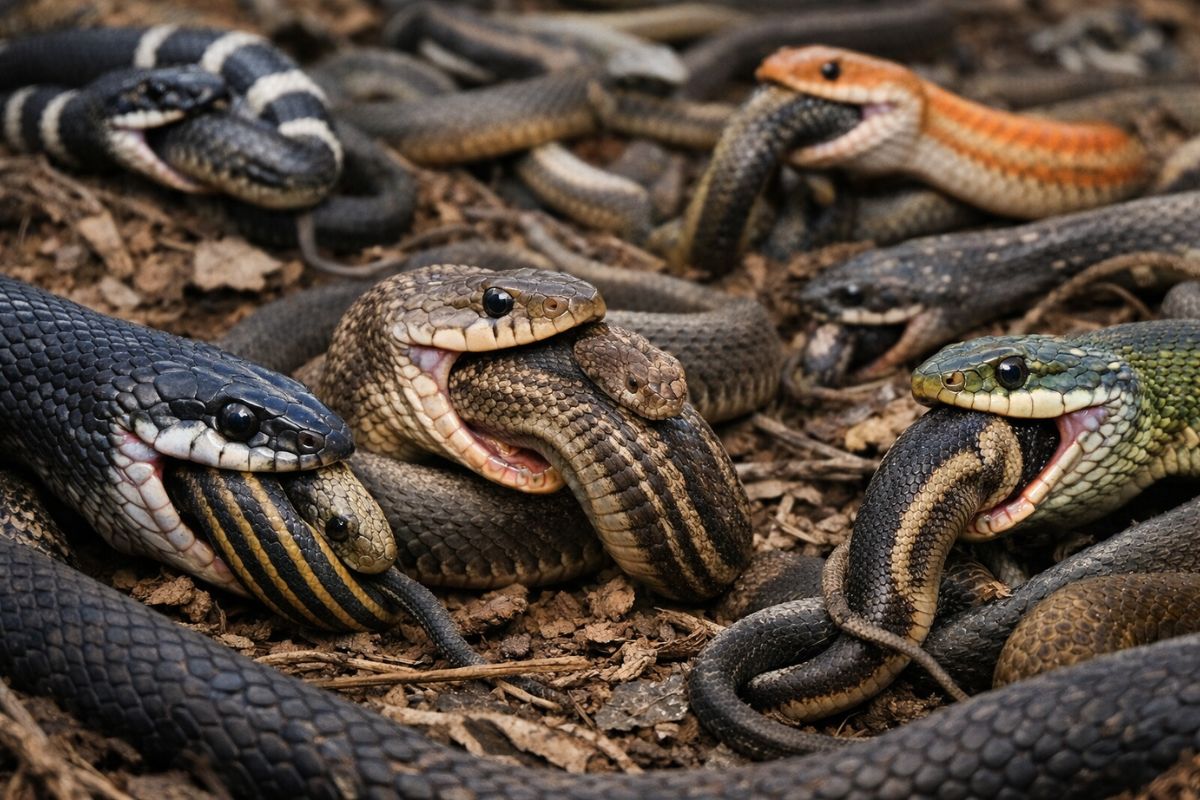
Researchers Compiled 503 Records of Cannibalism in Snakes, Covering 207 Species, and Concluded That the Phenomenon Is Ecologically Relevant and Underestimated. The Family Colubridae Concentrates 29% of the Reports. Forty-Three Percent Occurred in Captivity. Blind Snakes Do Not Appear. The Behavior May Have Emerged 11 Times in the Evolutionary Tree.
Snakes are widely studied, but a recent survey showed that cannibalism among snakes occurs on a much larger scale than previously thought. The compilation includes 503 documented events in at least 207 species, changing the perception that they would be rare and isolated incidents.
Bruna Falcão, a master’s student at the University of São Paulo, who conducted the research while she was an undergraduate at the Federal University of São Carlos, described the transition from isolated reports to hundreds of records as surprising and emphasized that cannibalism in snakes is a widespread and ecologically relevant behavior.
What the Research Found About Cannibalism in Snakes

The core data is straightforward: there were 503 reported cases of cannibalism in snakes, distributed across at least 207 species. These events were not confined to a single type of situation, appearing in different contexts within the lives of snakes.
-
Brazilian city neighboring Paraguay becomes a ‘magnet’ for people seeking quality of life and high standards with exceptional growth and commutes of up to 15 minutes.

-
A rare storm transformed part of the Gulf into an unlikely scene of hail, extreme rain, and tornado risk in the middle of the desert, with volumes that exceeded the annual average in a single day.

-
Brazil catches the world’s attention with ships powered by ethanol and biodiesel that have lower emissions, an unprecedented certification with advantages in chartering, and a revolution in cabotage.

-
A couple who only has Sundays free has built a hand-dug pool, a hamburger joint, a dance hall, and a playground in their own home without hiring a mason, and even with breaks due to accidents and the pandemic, the work has never truly stopped.


The records were classified by types, including occurrences associated with mating pairs, related individuals, and males in combat.
The diversity of scenarios suggests a more flexible behavior than “an addiction” of a specific species, appearing in multiple circumstances.
Why 503 Cases Change the Way Snakes Are Perceived
Transitioning from “a few reports” to over 500 documented events changes the scale of the phenomenon.
This helps to understand why cannibalism among snakes may have been systematically underestimated, even with the amount of research on snakes.
The reading that emerges is that cannibalism is not merely an extreme or folkloric case, but something that can occur frequently enough to have ecological impact, especially when it involves reproduction, competition, and food availability.
The Snakes Most Associated with Cannibalism and the Significance of Colubridae

According to the study, the snakes with the most reports of cannibalism belong to the family Colubridae, which accounted for 29% of the total records. The group includes species such as venomous boomslangs.
The authors suggest that many cases in this group may be linked to stressful factors, such as a lack of other food sources, as Colubridae typically do not feed on other snakes.
When the environment tightens, the diet may become more opportunistic than the traditional feeding habits of snakes.
A Large Group Without Records and the Clue of Blind Snakes’ Jaw

One notable point is the only large group without records of cannibalism: blind snakes. The explanation raised in the study is both anatomical and behavioral.
Omar Entiauspe-Neto, a doctoral student at the University of São Paulo and co-author, pointed out that this is likely due to the fact that these snakes never developed the unfused lower jaw, a characteristic that allows most snakes to swallow larger prey than they could chew.
Without this adaptation, the “mechanism” that facilitates large intakes is limited, which may reduce the occurrence or detection of cannibalism.
Maternal Cannibalism in Snakes and Hypotheses to Explain the Behavior
Among the most common forms of cannibalism is maternal, when mothers consume some of their own eggs. The study highlights that it is difficult to pinpoint a single reason but lists plausible hypotheses.
One possibility is to eliminate unviable eggs, reducing the risk of disease and decreasing the chance that the odor of dead and decomposing eggs attracts predators that would also eat viable eggs.
Other hypotheses include energy gain from eating part of the litter or simply hunger in a scenario where the cost of maintaining the brood is high.
Siblings, Captivity, and the Bias That Can Distort the Portrayal of Snakes
Cannibalism among siblings also appears, with the idea of reducing competition, but most of these records were observed in captivity. This matters because it can influence the perception of frequency and context.
The survey indicates that 43% of cannibalism reports involved snakes in captivity, while nearly a third of the context was undetermined. If captivity generates more observation and more records, it may also inflate certain patterns, requiring caution when comparing with fully wild life.
Evolution and Recurrence: 11 Independent Emergence in Snakes
Omar Entiauspe-Neto also stated that cannibalism may have emerged independently in the evolutionary tree of snakes at least 11 times. This reinforces the idea of a behavior that may appear repeatedly when similar conditions recur.
Instead of a fixed trait that was born once and spread, the indication is that cannibalism can emerge as an opportunistic response to ecological pressures, depending on the group and context.
A Case That Became a Strong Image and What It Symbolizes About Snakes

An episode cited as rare and recorded on video in nature in 2023 shows a black-headed python in Australia devouring another of its kind, with photo credit to Nick Stock, of the Australian Wildlife Conservancy.
Even as a specific case, it helps illustrate why the topic draws public attention: seeing snakes devouring snakes confronts the notion of predator and prey within the same group.
What Experts Highlight and Why There May Still Be “Iceberg Tips”
Harvey Lillywhite, a retired ecologist from the University of Florida, who did not participate in the research, described the study as comprehensive and well-executed but expressed caution in calling cannibalism a fixed evolutionary characteristic.
For him, it seems more like an opportunistic and flexible behavior that arises in multiple circumstances.
Bruna Falcão, in turn, believes that the 503 records may still be an underestimate. She points to the possibility of “hidden” records in old books, unpublished reports, museum archives, and observations from remote regions that rarely make it into scientific literature.
If this is confirmed, cannibalism among snakes may be even more common than current numbers suggest.
Do you think cannibalism in snakes happens more due to a lack of food and environmental stress, or due to competition within the same species?








-

-

-

6 pessoas reagiram a isso.