





 English
  Francês
  Alemão
  Italiano
  Japonês
  Norueguês
  Portuguese
  Spanish
  8 min of reading
  0 comments


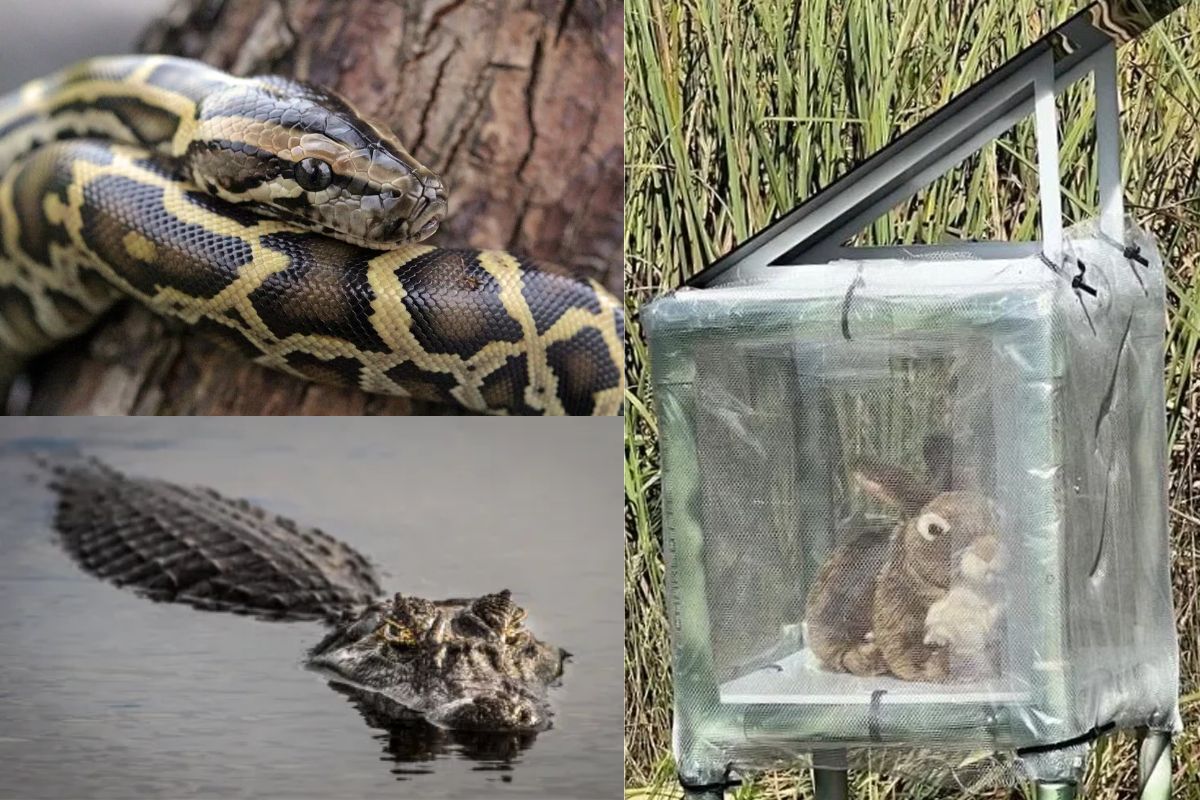
Robotic Rabbits, Alligators, and Artificial Intelligence: How Florida Declared War on the Giant Pythons That Are Devouring the Everglades from Within.
The weapons are robotic rabbits, hungry alligators, and artificial intelligence algorithms, but the enemy is one: giant pythons that have spread through the Everglades and are erasing North America’s largest subtropical swamp from within.
From pet stores destroyed by hurricanes to laboratories manufacturing electronic baits, Florida has turned the fight against invasive snakes into a silent, technological, and increasingly desperate war to save an ecosystem that is collapsing in slow motion.
When Pets Become Out-Of-Control Giant Pythons

It all starts far from the swamps. In the 1980s and 1990s, Burmese giant pythons were sold in Florida pet shops as exotic curiosities. Shiny hatchlings, the size of a forearm, seemed harmless in glass terrariums.
-
Contaminated water from uranium threatens mining areas, and Chinese scientists have created a solar-powered living filter that could change environmental decontamination.

-
Archaeologists find in Mexico a sacrifice altar over 1,000 years old, surrounded by skulls, human bones, and signs of rituals from the Toltec Empire.

-
Goodbye to the traditional oven? IKEA draws attention with a 3-in-1 microwave that combines an air fryer, grill, and heating in the same compact, affordable appliance designed for small kitchens.

-
A forgotten stone in the barn hid a rare relic from the Bronze Age, and the discovery shocked archaeologists by revealing a millennia-old mold used to manufacture war spears over 3,000 years ago.


The problem is those adorable snakes didn’t stay that size. In just a few years, the same animals grew to over 4 meters long and more than 45 kg, becoming muscular and practically impossible to manage for untrained owners.
Unable to handle the monster they had at home, many owners simply did the worst: released the giant pythons into canals and swamps. Unbeknownst to them, they were sowing an ecological crisis that would change the history of the Everglades.
Then came the definitive turning point. In 1992, Hurricane Andrew, a category 5 storm, destroyed reptile breeding facilities, directly releasing thousands of snakes into the environment, including adults ready to breed.
For the giant pythons, the Everglades seemed like paradise: warm climate, dense vegetation, and an endless buffet of prey that had never evolved to recognize that foreign predator.
A Predator Without Enemies and a Silent Swamp in Collapse


For some time, the changes were subtle. Fewer footprints in the mud, fewer nighttime noises, fewer animals crossing trails. Until biologists began to look at the numbers.
In large areas dominated by giant pythons, entire populations of mammals have virtually disappeared. Raccoons, opossums, swamp rabbits, and other small animals fell by more than 90% in some regions. It wasn’t an imbalance; it was an ecological blackout.
The evidence was shocking. A single python was found with an entire adult deer in its stomach. Another was recorded in a deadly struggle with an alligator, ending with both animals dead.
Meanwhile, the food chain was collapsing. Fewer mammals meant less food for raptors and scavengers, more rotting carcasses, chemical changes in the soil, and impacts on bacteria and microorganisms.
The giant pythons had everything they needed: a rich ecosystem and practically no natural predators capable of controlling them. The result was a swamp that was still visually beautiful but internally sick, being devoured in silence, one heartbeat at a time.
The Public Hunt That Became a Spectacle and a Failure
In the face of disaster, Florida attempted a bold response in 2013. The “Python Challenge” was born, an open public hunt. Anyone with a flashlight, courage, and a permit could enter the swamps to look for giant pythons.
There were cash prizes, TV crews, reality shows, and nationwide coverage. The hunt turned into an event, almost a sport. But nature gave the answer.
After weeks of effort, only 68 giant pythons were captured. For a population estimated in the tens or hundreds of thousands, the impact was virtually zero.
The snakes, camouflaged in the vegetation, immobile for hours, moving in absolute silence, simply “vanished” before human eyes.
The challenge made headlines but revealed a brutal truth: Florida was not only losing the war but did not even understand where and how to fight.
When Sniffer Dogs Discover the Weakness of the Giant Pythons

With human hunters failing, the state turned to an older ally: sniffer dogs. Truman, a black Labrador, and Elenor, a Dutch shepherd, were trained for an almost impossible mission.
They weren’t hunting by sight but by smell. The giant pythons leave a subtle chemical trail, imperceptible to us but readable by a trained nose.
After months of conditioning, Truman and Elenor learned to recognize the specific smell of pythons and guide their handlers to snakes that biologists had been unable to locate for weeks. When the tail stiffened and the step halted, it was a sign of a snake nearby.
The results were immediate. Several large snakes were located thanks to the dogs. But the Everglades are unforgiving: extreme heat, cutting vegetation, risk of venomous snakes, and alligators. The dogs needed cooling vests, boots, and constant monitoring.
And there was another problem: two dogs against thousands of giant pythons in a 10-mile swamp covering over 1.5 million acres.
It became clear that scenting was key, but more than muscle and smell was needed. It was time to lure the snakes rather than chase them.
From Live Bait to Ethical Shock
With smell identified as the giant pythons’ weakness, the most controversial idea emerged: using live swamp rabbits as bait.
The animals were placed in reinforced cages, physically protected but exposed as perfect targets for smell, heat, and movement. The snakes began to approach frequently, confirming the strategy’s effectiveness.
But images of trembling rabbits surrounded by giant constrictors sparked immediate public outrage. Animal protection groups accused the program of cruelty. Social media campaigns pressured authorities.
The result was inevitable: funding cut and the project shut down.
However, the lesson was learned. The experience showed that the giant pythons responded predictably to the right sensory stimuli. The problem was not the idea of bait, but the fact that it was a living animal.
The question changed form: how to build a perfect bait that didn’t breathe, didn’t feel pain, and still completely fooled a super predator?
Robotic Rabbits Enter the War Against the Giant Pythons

The answer came from an unlikely partnership between biologists and engineers. The robotic rabbits were born, artificial baits designed to deceive the brain of a Burmese python.
Each robot rabbit was coated with synthetic fur, equipped with an internal heating pad maintaining a temperature similar to that of a real rabbit, around 37 ºC.
Small motors made the nose or ears move from time to time, simulating micro-movements of a living animal.
Inside the body were compartments that slowly released a scent inspired by the real smell of rabbits, creating a convincing chemical signature. And, beneath the artificial skin, was the true brain of the operation:
- thermal cameras
- motion sensors
- wireless transmitters
- batteries and, in some cases, small solar panels
Each unit could “sense” when something large and cold approached, register the approach, and send an alert to teams positioned kilometers away.
The first tests began with dozens of robotic rabbits distributed in corridors used by giant pythons, anchored in metal enclosures. For two days, the system functioned as in the cartoons.
The images showed enormous snakes coiling around the baits, tongues flicking, bodies testing the enclosure. The alert reached the teams, they rushed in, and several snakes were quickly captured.
Then, on the third day, another type of predator appeared.
Alligators vs. Machines: The Unexpected Predator War

In one of the broadcasts, what appeared on screen wasn’t a python but a 3.5-meter alligator coming out of the water towards the bait.
Attracted by the same sensory package of heat and smell, the alligator advanced straight ahead, biting the enclosure and destroying the robotic rabbit in a single attack, crushing metal, plastic, wires, and sensors in one bite.
For the alligator, it didn’t matter whether the prey was real or not. It looked alive, smelled like food, and was in the hunting zone. That was enough.
In a matter of days, dozens of baits were attacked and destroyed by alligators and other opportunistic predators.
The Everglades turned into a chaotic battlefield where the same trap meant to attract snakes also called all the top predators.
Worse: with alligators circling the bait areas, the giant pythons began to completely avoid those zones, quickly learning that something was wrong with that “easy restaurant” that now smelled of death.
In no time, the program seemed a spectacular failure. Thousands of dollars in robotic rabbits were literally being chewed up in the wrong jaws.
But while many saw only scrap, the team realized something that would change everything.
When the Robot Failure Reveals the Secret of the Giant Pythons
Before being shredded, the robotic rabbits fulfilled their invisible mission: recording data.
Each bait had logged:
- approach times
- direction of movement
- thermal patterns
- time each animal spent in the area
- visit frequency per point
By compiling the logs from all the baits, especially those that were not destroyed, researchers realized there was a hidden map.
The giant pythons didn’t move randomly. They used repeated natural corridors, true invisible highways among tall grass, water, and bushes. Alligators also used some of these routes, creating conflict zones and escape zones.
All that data was then fed into a digital model of the Everglades and later into a machine learning system trained to find patterns in chaotic environments.
What the AI discovered surprised the team.
It began to predict where the pythons would likely appear, not just in terms of geographic location, but also in terms of time of day and temperature range.
Moreover, the system identified something that no one had quantified correctly: the pythons actively avoided areas dominated by alligators, adjusting their paths to minimize fatal encounters.
The robotic rabbits had not only attracted snakes. They had revealed the movement logic of the giant pythons, their fears, safe routes, and activity windows.
AI Transforms the Swamp into a Strategic Board
With the trained model, Florida gained something it never had before: a tactical map of the invasion, updated based on real behavior, not assumptions.
Now, instead of blindly scouring the swamp, teams can:
- prioritize regions and times with a higher likelihood of finding giant pythons
- strategically reposition patrols, boats, and traps
- use dogs, drones, and professional hunters guided by AI predictions, not by instinct
From the data of the destroyed robotic rabbits, the very landscape of the Everglades became a strategic board, where every variation in temperature, water level, and presence of alligators altered the pythons’ routes and fed new adjustments into the system.
There is no magic solution. The giant pythons are already deeply entrenched in the ecosystem and will likely never be completely eradicated.
But for the first time, Florida has stopped reacting in the dark and has begun to attack with information, transforming technology and biology into environmental defense weapons.
In the end, this war is not just about snakes and alligators. It’s about how an entire ecosystem tries to defend itself from a human error that started in a pet shop cage.
Do you believe that the combination of robotic rabbits, alligators, and artificial intelligence will be able to control the giant pythons before they completely destroy the Everglades, or do you think we’ve already passed the point of no return?







-

-

-

4 pessoas reagiram a isso.