





 Portuguese
  English
  Spanish
  4 min of reading
  0 comments


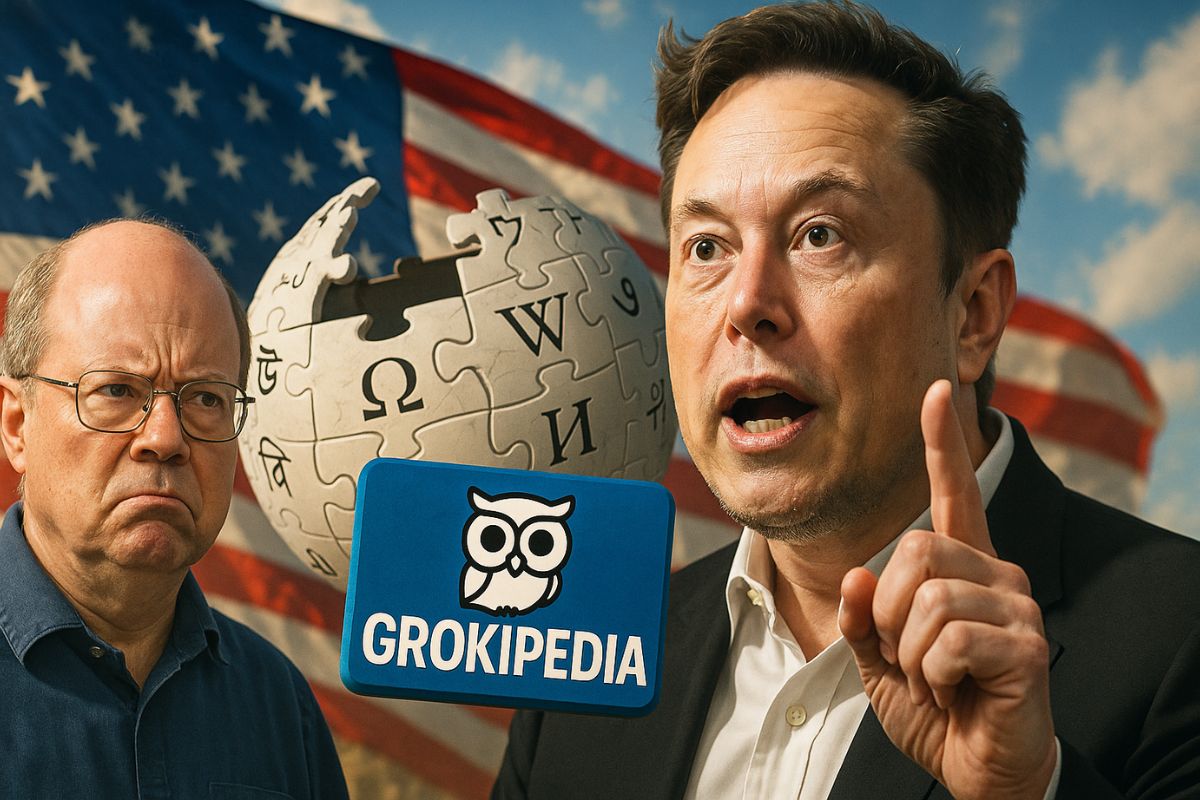
Elon Musk Announces GrokiPedia After Criticism from Larry Sanger About Wikipedia’s Political Bias, Rekindling the Debate Over Neutrality, Censorship, and the Future of Online Encyclopedias.
Businessman Elon Musk announced that he will launch a new digital encyclopedia with artificial intelligence called GrokiPedia, inspired by the criticism from Larry Sanger, co-founder of Wikipedia. Sanger, who has been distanced from the original project since 2002, returned to the center of discussions by accusing the encyclopedia of having lost its neutrality and adopted a leftist ideological bias. The billionaire described the initiative as an attempt to rebuild factual internet, at a time when trust in traditional platforms is declining.
For Musk, GrokiPedia will be a “huge improvement,” combining artificial intelligence with collaborative editing, but without what he calls “political filtering.” According to the Infomoney portal, the project arises amid growing pressure on Wikipedia, criticized by both conservatives and academics who question its editorial criteria and the influence of specific groups in content moderation.
The Criticism from the Co-Founder of Wikipedia
Larry Sanger, who created Wikipedia alongside Jimmy Wales in 2001, claims that the encyclopedia “has deviated from the original principles of neutrality.”
-
Brazilian city bets on the business environment to generate jobs and attract investments in the energy sector — secretary reveals strategy at Macaé Energy 2026.

-
50 viaducts, 4 tunnels, 28 bridges, and 40 kilometers of bike paths: BR-262 in Espírito Santo will receive 8.6 billion reais for the largest engineering project in the state’s history, inspired by the Immigrant Highway in São Paulo.

-
Brazil produces too much clean energy and doesn’t know what to do with it: over 20% of solar and wind capacity was wasted in 2025 while investors flee and 509 renewable generation projects were abandoned in the last year.

-
Piauí will produce a new fuel that replaces diesel without needing to change anything in the truck’s engine and reduces pollutant gas emissions by half: truck drivers from all over the Northeast are already celebrating the news that will arrive later this decade.


According to him, the articles exhibit consistent leanings in favor of progressive perspectives, especially on topics such as politics, religion, crime, and climate change.
In his words, “wikipedia has become a runaway bus going down the road and running over innocents.”
Sanger argues that the project, once a symbol of openness, has come to operate as an information control space, favoring certain sources and excluding others.
He proposes a series of reforms, such as revealing the identities of key editors, eliminating blacklist of “unreliable” sources, and reinforcing absolute neutrality policy.
These ideas, gathered in the so-called “Nine Theses,” circulated among conservative figures and reached even Elon Musk, who publicly declared support for the proposals and shared the theses on social media.
Elon Musk Joins the Digital Truth Debate
Elon Musk, who had previously dubbed Wikipedia “Wokipedia” in reference to the term woke used by conservatives to criticize progressive agendas, sees the creation of GrokiPedia as a way to combat the perceived ideological bias in major information platforms.
According to Musk, the new encyclopedia will use AI to cross-reference data from multiple sources and signal inconsistencies, allowing readers to visualize different interpretations of the same fact.
He claims that the system will seek “algorithmic transparency,” avoiding opaque editorial filters and prioritizing historical and statistical contexts over opinions.
GrokiPedia will be developed by the team at xAI, Musk’s artificial intelligence company, integrated into the X ecosystem (formerly Twitter).
The proposal is to allow users to correct, cite, and contextualize information with the help of language models, creating what the billionaire calls a “living and auditable encyclopedia.”
Political Dispute and Wikipedia’s Reaction
Sanger’s criticisms echoed among conservative politicians. Senator Ted Cruz sent a letter to the Wikimedia Foundation asking for explanations about what he called “systemic ideological bias,” while commentator Tucker Carlson publicly advocated for creating alternatives to the platform.
The case even reached the U.S. House Oversight Committee, which opened an investigation into alleged content manipulation by “hostile state actors.”
The executive director of Wikimedia, Maryana Iskander, rebutted the accusations, stating that Wikipedia “is a source-based encyclopedia that is corrected in real-time.”
She emphasized that the editing process is public, reviewed by thousands of volunteers, and if there is bias, “the system self-corrects.”
Iskander also reminded that 99.9% of Wikipedia’s content deals with neutral topics, such as sports, fauna, and culture, and that ideological disputes represent only a fraction of the total articles.
Still, the foundation acknowledges the challenge of maintaining plurality among editors, especially on political and social topics.
The Role of Artificial Intelligence in the New Era of Encyclopedias
The discussion of bias is not limited to Wikipedia. Language models such as ChatGPT and Gemini also face accusations of ideological bias, as AI systems begin to dictate what is visible and what is considered “truth”.
Musk claims that GrokiPedia aims to use AI in a decentralized way, without “centralized editorial control,” which would allow multiple interpretations to coexist.
For critics, this approach could lead to misinformation disguised as plurality. Defenders see it as a legitimate attempt to restore diversity of perspectives in an increasingly concentrated digital environment.
Sanger, for his part, states that the “great mistake of Wikipedia was to believe that consensus is synonymous with truth.”
For him, the new generation of encyclopedias should be “open, plural, and verifiable by public algorithms,” rather than relying on a small group of anonymous moderators.
The creation of GrokiPedia places Elon Musk at the center of yet another dispute over who defines truth in the digital age.
The clash between Sanger and Wikipedia reveals a broader dilemma: is it possible to maintain neutrality in an environment built by people, algorithms, and political interests?
While some see Musk as a restorer of informational transparency, others accuse him of using the rhetoric of freedom to rebuild the internet through his own ideological lens.
What do you think, can GrokiPedia really offer a more neutral view of information or will it just be another battleground in the war of narratives?









Seja o primeiro a reagir!