





 Portuguese
  English
  Spanish
  3 min of reading
  48 comments


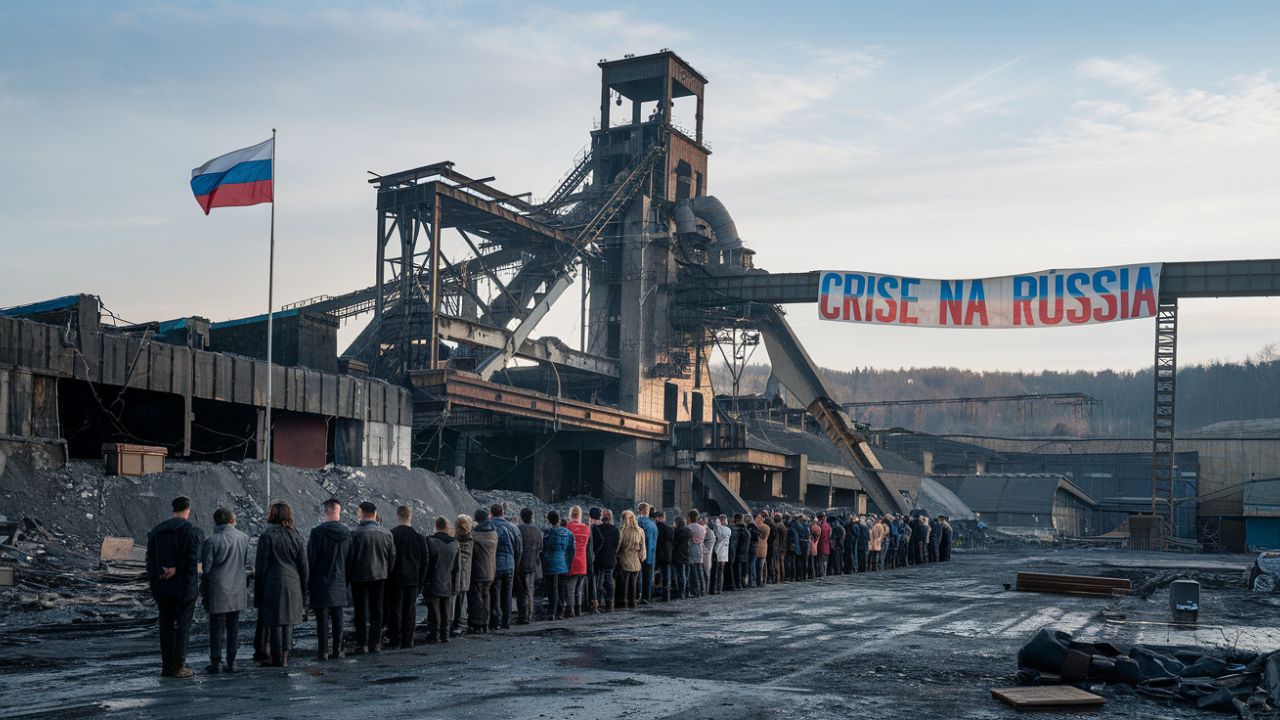


With More Than 1,000 Mass Layoffs in Russia’s Mining Sector Already Announced and Salaries Delayed Amounting to 46 Million Rubles (US$ 2.3 Million), Workers Go on Strike While Mines Close Indefinitely Amid Billion-Dollar Losses in the Coal Sector.
Living four months without a salary while watching your sector crumble like a sand castle. This is exactly what is happening in Russia, where the coal mining industry is facing one of its largest crises. Mass layoffs in Russia are already a reality in regions like Kuzbass, and desperate workers have even resorted to hunger strikes, according to the UK newspaper Express.
An Industry in Collapse
The Russian mining sector has always been a key player in the country’s economy, especially in regions like Kuzbass. However, Western sanctions have imposed a brutal barrier to coal exports, cutting access to crucial markets.
Revenue has fallen sharply, and companies like Sibcoal Management and Razrez Evtinsky Novy have announced indefinite closures. Dependence on markets like China and India has not brought the expected relief. Exports to China fell by 8%, while shipments to India plummeted by 55% in just the first half of 2024.
-
Brazilian city bets on the business environment to generate jobs and attract investments in the energy sector — secretary reveals strategy at Macaé Energy 2026.

-
50 viaducts, 4 tunnels, 28 bridges, and 40 kilometers of bike paths: BR-262 in Espírito Santo will receive 8.6 billion reais for the largest engineering project in the state’s history, inspired by the Immigrant Highway in São Paulo.

-
Brazil produces too much clean energy and doesn’t know what to do with it: over 20% of solar and wind capacity was wasted in 2025 while investors flee and 509 renewable generation projects were abandoned in the last year.

-
Piauí will produce a new fuel that replaces diesel without needing to change anything in the truck’s engine and reduces pollutant gas emissions by half: truck drivers from all over the Northeast are already celebrating the news that will arrive later this decade.


Mass Layoffs in Russia: A Blow to Workers

In Kuzbass, the heart of coal mining, the reality is harsh. More than 1,000 miners have received layoff notices, and the number may grow. To make matters worse, the Inskaya mine, the site of a recent hunger strike, symbolizes the despair of workers.
Without salaries for months and with unfulfilled promises from management, miners are literally fighting for their survival. The mine’s salary debt already totals an impressive 46 million rubles (US$ 2.3 million), leaving entire families without a livelihood.
The Economic Crisis in the Coal Sector
The numbers are relentless: the losses in the mining sector have increased 4.1 times compared to the previous year, reaching US$ 1.9 billion. 52% of companies in the sector are operating at a loss. The impact is also felt in public coffers. Tax revenues in Kuzbass have plummeted by 59%, and regions like Buryatia are facing similar declines. It’s a perfect storm, where each falling piece directly affects the others, creating a devastating domino effect.
The economic crisis quickly transformed into a humanitarian crisis. Whole communities, previously dependent on the mines, are now facing mass unemployment and a lack of prospects. The workers who have gone on strike are the most visible symbol of this despair, but the impact goes beyond that. Schools, hospitals, and local small businesses are also feeling the blow.
The Future of Mining in Russia
Is there a way out of this crisis? Some experts believe that diversifying markets and investing in renewable energy sources could be a long-term solution. However, in the short term, the government needs to act to avoid a social collapse. What is clear is that the Russian mining sector is at a crossroads.
The mining crisis in Russia goes beyond numbers and graphs. It is a story of people fighting to survive, while an entire sector faces an unprecedented challenge. The mass layoffs in Russia are just the tip of the iceberg of a crisis that could redefine the country’s future.








Com um louco no comando, a bomba está literalmente caindo no colo do povo.
Isso é muito mais um desejo do articulista do que um fato concreto.
Esse modelo de governo ditatorial não funciona e nem deve funcionar mais em lugar nenhum um. O Putin, assim como outros presidentes de nações acham que a **** ainda é uma boa, mas não é. Quem paga por isso é a população que vive escravizada, sem liberdade e sendo isolada, ou seja, o mundo que vivemos hoje é globalizado e a nação que não perceber e entrar na linha pode acabar colhendo frutos indesejáveis…a Rússia é um exemplo