





 Portuguese
  English
  Spanish
  8 min of reading
  0 comments


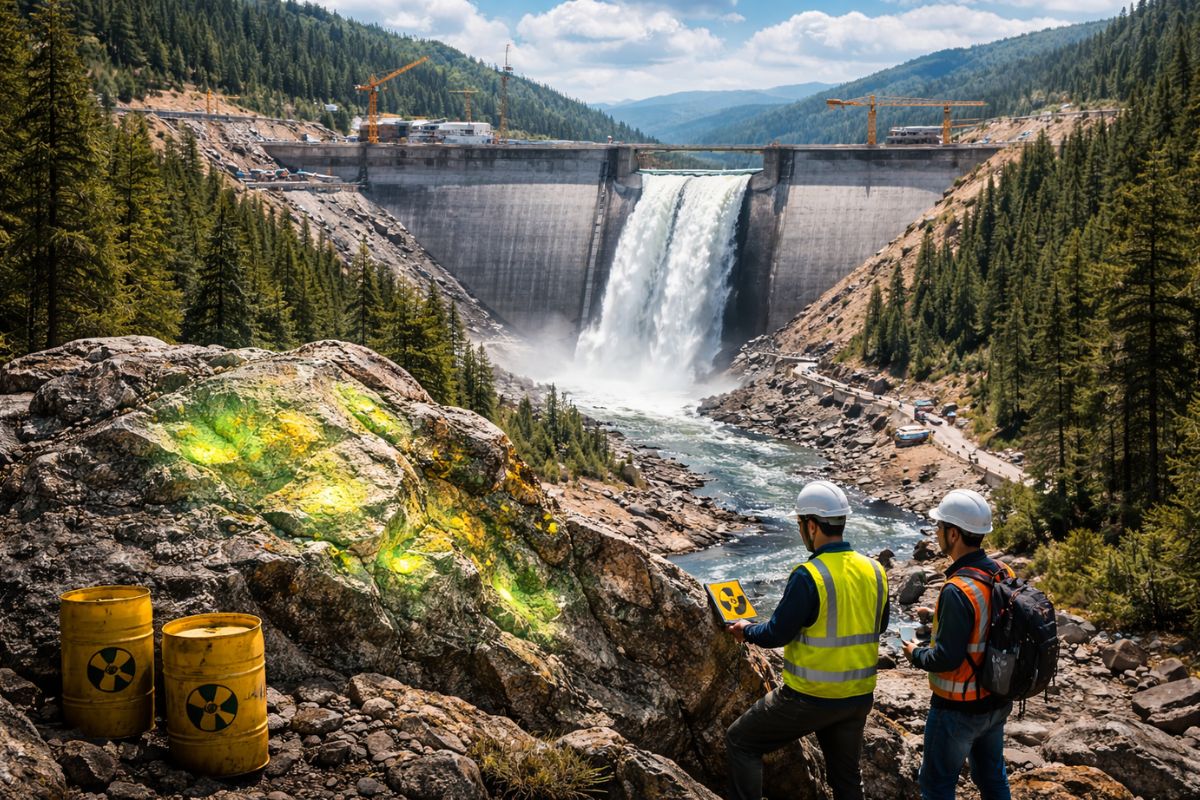
In Colorado, The 100-Meter Mega Dam At Chimney Hollow Reservoir, Part Of The Colorado Big Thompson System, Became A Case Of Uranium In Drinking Water And A Symbol Of The Water Crisis In Colorado.
In the midst of a green forest in the Rocky Mountains, Colorado is erecting a 100-meter mega dam to ensure water in dry years for up to 800,000 people. It is not a hydroelectric plant, it is not a flood control structure, and it was not conceived solely as an engineering postcard. The logic is simple and harsh: to store water from wet years to survive the periods when the snow melts too early, the rain fails, and the old reservoirs can no longer cope.
But when construction was in full swing and the inauguration was approaching, samples of rainwater accumulated behind temporary structures triggered an unexpected alert. Analyses showed that the region’s granite contains natural uranium and that this uranium can migrate into the water. Suddenly, the 100-meter mega dam ceased to be merely a solution to the water crisis and became a radioactive dilemma over whether to delay, dilute, or treat the water before delivering it to the cities.
Why Colorado Bet On A 100-Meter Mega Dam
For decades, the Rocky Mountains acted as a natural water reservoir for the western United States.
-
New CCR concrete paving technology promises roads up to 3x more durable, less maintenance, and cost reduction in Brazil.
-
Made from recycled plastic, plastic wood is gaining space in the construction industry because it does not rot, resists moisture, and reduces maintenance costs over the years.

-
Florianópolis will receive a million-dollar BRT that will begin construction in 2026 with nearly 400 million in funding from the federal government and the Inter-American Development Bank, and the map already shows the routes for the exclusive bus corridors.

-
Without a blueprint, without an engineer, and using scrap from the dump, a father spends 15 years building an 18-room castle for his daughter, featuring tram tracks, 13 fireplaces, and over 700 m², which may now be demolished.
Snow fell in large volumes in winter, accumulating at higher altitudes and melting gradually between May and June, precisely when agriculture and cities needed water the most.
This balance started to crumble. Climate studies indicate that the mountainous regions of the American West are warming faster than the global average.
Less snow, more exposed soil, and more heat mean less water being released steadily throughout the year.
The peak river flow, which used to occur in early June, now often appears in May. Water arrives too early at reservoirs that are still full at the end of winter, forcing releases to avoid overloading dams, and disappears when summer intensifies.
Meanwhile, the population continues to grow. In just a decade, Colorado saw an increase of nearly 15% in its population, with the urban corridor of Denver, Boulder, and Fort Collins expanding even faster.
Each new resident brings not just a shower and a faucet, but also houses, roads, industries, and a constant demand for water to make it all work.
Reservoirs like Carter Lake and Horsetooth, designed in the mid-20th century, were intended for a much smaller, cooler, and wetter Colorado. Today, they function more as auxiliary lungs of the system than as the “main vault” of water.
In this scenario, the Chimney Hollow project emerges: a new centerpiece, in the form of a 100-meter mega dam, built to hold the surplus from the Colorado Big Thompson system and distribute it at the right times.
Chimney Hollow: 100-Meter Mega Dam In The Middle Of The Forest

To transform a green valley into an artificial lake capable of supplying up to 800,000 people, Colorado decided to build a 100-meter mega dam in Chimney Hollow.
The main structure stands about 107 meters tall, over 300 meters long, and was designed to store approximately 110 million cubic meters of water, equivalent to tens of thousands of Olympic swimming pools.
Construction began in earnest in the early 2020s. Trees were cut down, explosives detonated, and a quarry was opened on the job site itself.
For years, over 60,000 tons of rock per day were blasted, crushed, and compacted into the dam body, turning the place into the largest mining operation in Colorado during that time. Dump trucks ran nearly 20 hours a day, six days a week.
The mega dam uses an uncommon solution in the United States: an asphalt concrete core. The region lacks sufficient quality clay in volume, and transporting this material from afar would make the project prohibitively expensive.
The asphalt brought an added benefit: flexibility. Instead of a “rigid stone wall that could crack,” the 100-meter mega dam gained a backbone capable of adapting to small ground vibrations and “self-adjusting” in micro-fissures, reducing the risk of leaks.
In addition to the main wall, a lower secondary dam closes a depression in the terrain and significantly increases the total capacity of the reservoir.
A complex system of spillways and tunnels, extending for kilometers, was built to release water in a controlled manner during periods of heavy rain or rapid snowmelt.
In theory, the equation was alluring. In wet years, the 100-meter mega dam would store the excess water from the Colorado Big Thompson.
In dry years, it would return that volume to the system, ensuring a stable supply for cities and part of agriculture. In practice, a nearly forgotten geological detail became the biggest obstacle.
When Granite Delivers The Bill: Natural Uranium At The Base Of The Mega Dam

For about three decades, Chimney Hollow was redesigned on paper, recalculated, discussed, and delayed. Geologists, hydrologists, and engineers reviewed maps, rainfall volumes, system capacity, ideal height of the 100-meter mega dam, seismic vibrations, and structural risks. In all these studies, one point was overlooked: the radioactive content of the local rocks.
Only in the final phase of construction, when rainwater began to accumulate behind temporary structures of the dam and the first analyses were performed, strange results emerged. The samples showed signs of uranium above what was expected for a source of drinking water.
Initially, it was treated as a technical observation to be monitored. But as the data repeated, Northern Water had to face the uncomfortable conclusion.
The granite in the very valley where the 100-meter mega dam was built contains natural uranium at levels that can transfer to the water. It is not industrial waste, it is not a mine leak, it is not a concrete error. It is the geology of the place.
The problem worsens when the lake fills and the water remains in prolonged contact with the base rock. Some of the uranium may leach into the water column, raising the concentration above the limits considered safe for human consumption.
Experts warn that the initial filling period is the most critical, precisely when the system is still adjusting and the water chemistry seeks a new equilibrium.
In light of this, the decision was tough: not to deliver the water from Chimney Hollow to the public until it is clearly understood how uranium behaves and a strategy approved by regulatory bodies is defined.
In practice, the physical work on the 100-meter mega dam may be nearly finished, but the reservoir does not have full authorization to operate as a source of drinking water.
Delay, Dilute, Or Treat: The Three Possible Paths
With the problem laid bare, three paths are on the table, each with its own costs and risks.
One is simply to delay the full operation of the 100-meter mega dam, filling and emptying the reservoir in controlled phases, monitoring water quality, measuring uranium behavior, and hoping that the system achieves a more stable state over time.
This reduces the chance of surprises but pushes back the delivery of water that cities are already counting on in their planning.
Another path is dilution. The idea is to mix the water from Chimney Hollow with water from other less problematic sources, so that the uranium concentration remains below the potable limits.
It is a quicker and seemingly cheaper solution, but it depends on something in short supply: excess water from other reservoirs. If the system is already living on the edge in dry years, there may not be enough volume left to dilute anything.
The third option is to build a specific treatment step to remove uranium before delivering the water to the cities.
Advanced technologies, such as certain forms of adsorption, membranes, or ion exchange, can reduce the radioactive load to safe levels.
In compensation, this solution demands high investments, energy, maintenance, and almost always more delays in the schedule of the 100-meter mega dam.
No alternative is clean and perfect. Delaying, diluting, or treating means choosing which cost Colorado is willing to pay: time, money, technical complexity, or all of the above.
Gross Reservoir And Pure Water Colorado: What The 100-Meter Mega Dam Reveals About The Rest Of The System
Chimney Hollow is not the only chapter in this story. Colorado is working on multiple fronts to avoid a water blackout, and this makes it clear that a 100-meter mega dam alone does not solve a structural water crisis.
On one side, there is the expansion of Gross Reservoir, near Boulder. The idea is to raise the existing dam by several meters, almost tripling capacity and transforming an old reservoir into a “super vault” of water for Denver and the region.
The technology used is modern, with roller-compacted concrete, and the project promises extra capacity for over a million people.
The price is high in another sense. The expansion is expected to flood a large area of forest, with hundreds of thousands of trees cut down and significant ecological impacts.
In practice, the Gross Reservoir project shows the same dilemma as Chimney Hollow: to gain water security, the state accepts a deep environmental impact, with no guarantee that the planned water will actually exist in a drier climate.
At the other end, Pure Water Colorado emerges, focused on something much less flashy than a 100-meter mega dam, but potentially more sustainable: repurposing highly treated sewage water to reach drinking water standards.
Instead of chasing “new water” that does not exist, the proposal is to close the cycle using processes such as ozone, microfiltration, reverse osmosis, and ultraviolet light.
To bring the idea closer to real life, the team even used this treated water to produce beer and wine at public events, in an attempt to overcome the prejudice of “the toilet to the faucet.”
It is the symbolic opposite of Chimney Hollow: less dynamite, less deforestation, more treatment technology, and greater dependence on social acceptance.
Does The 100-Meter Mega Dam Solve Or Postpone The Problem?
In the end, the story of Chimney Hollow exposes an uncomfortable fact: no 100-meter mega dam creates new water; it only displaces water in space and time.
In a scenario of diminishing snow, rivers with ever-shorter flow peaks, and pressured aquifers, the margin for maneuvering is shrinking.
Chimney Hollow, Gross Reservoir, Pure Water Colorado, and other projects show different paths to face the same challenge. Giant dams store water when it appears but carry environmental, and now, radiological risks.
Reusing water requires trust, cultural change, and consistent political will. In any case, Colorado still needs to address another front: making better use of every available drop.
The 100-meter mega dam in the middle of the forest became a symbol of this impasse. It can guarantee water for hundreds of thousands of people or turn into an expensive reservoir, full of restrictions, and unable to deliver all that it promised.
And you, in Colorado’s place, would you first bet on 100-meter mega dams, advanced water recycling, or a more radical consumption reduction plan before any new giant construction?








-

-

-

5 pessoas reagiram a isso.