





 Portuguese
  English
  Spanish
  6 min of reading
  3 comments


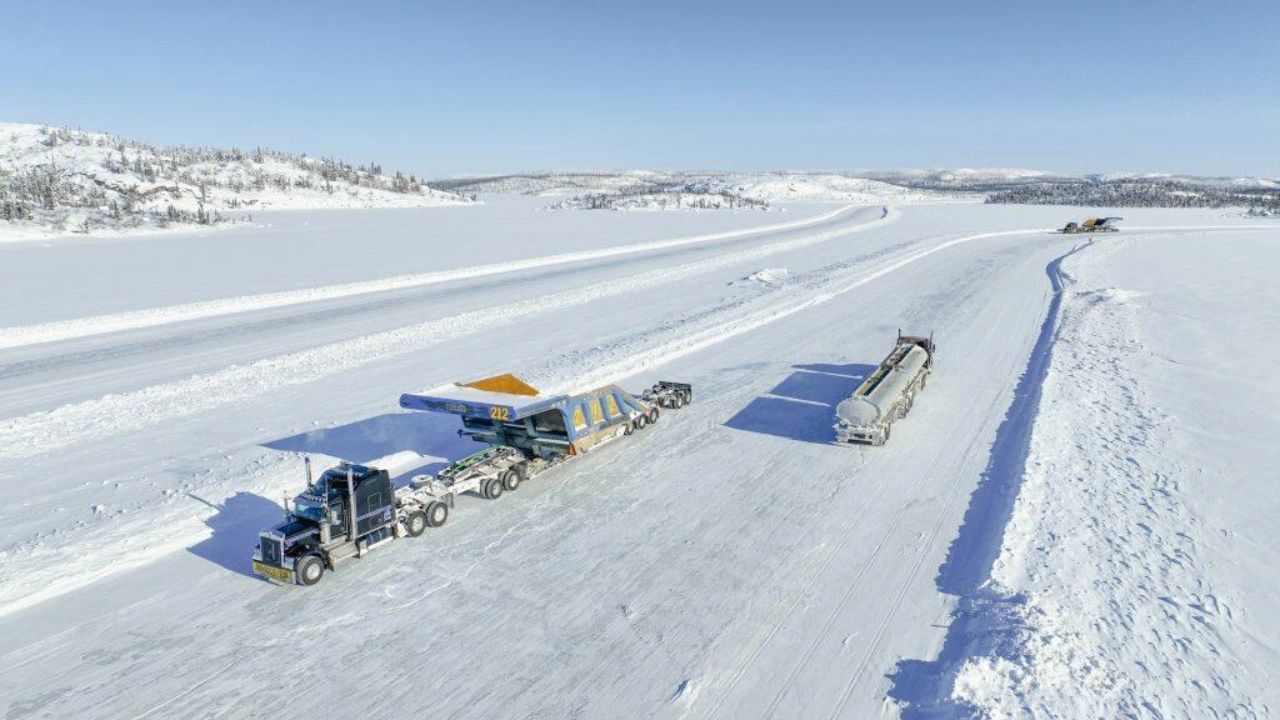


‘Crystal Road’ Tibbitt to Contwoyto Is the Vital Logistics Artery Supporting Canada’s Billion-Dollar Diamond Mines, Operating at -40°C and Now Threatened by Climate Change.
The Canadian Arctic is the stage for one of the planet’s most precarious feats of engineering and logistics: the legendary ‘Crystal Road’, officially known as Tibbitt to Contwoyto Winter Road (TCWR). For a time window varying between 45 and 80 days at the height of winter, a fleet of heavy trucks weighing 50 to 63 tons, known as “Super B-train,” travels up to 600 kilometers over vast frozen lakes to supply the isolated diamond mines of Ekati, Diavik, and Gahcho Kué. This seasonal infrastructure, 85% built on lake ice, is the only salvation for the supply of millions of liters of diesel and tons of explosives and machinery.
The TCWR, managed by the Joint Venture Tibbitt to Contwoyto Winter Road (JVTC), is only open to its maximum load capacity when the ice layer reaches a minimum and uniform thickness of 100 centimeters (39 inches), validating the description of “just 1 meter thick.”
The road is the main economic artery of a multibillion-dollar industry that has positioned Canada as one of the world’s largest diamond producers. If the road does not open or closes early, the mines face the catastrophic cost of transporting vital supplies by air freight, which can multiply operational costs by up to eight times, according to industry logistics reports.
-
Spain surprises the world by erecting 62 artificial dunes, mixing sand with natural remains of posidonia, and causing the structure to lose only 1.4% of its volume in 1 year.

-
With 16 Bulava missiles, improvements in acoustic stealth, and a design focused on silent patrols, Russia’s nuclear submarine was born to ensure Moscow’s invisible retaliation and has become one of the pillars of its maritime strength.

-
‘Populous’ city in Rio among the worst in Brazil in national ranking and exposes silent development crisis.
-
Couple buys house in the South Zone of São Paulo, opens a hidden door in the garage, and finds a secret wine cellar with dozens of old wines forgotten since the 1970s.

Cryogenic Engineering: How 1 Meter of Ice Supports 63 Tons

The construction and operation of the legendary ‘Crystal Road’ are closer to materials science than traditional road building. It is not a solid surface but a viscoelastic plate resting on water. TCWR engineers manage the phase transitions of water on an industrial scale to create a foundation capable of supporting incredibly heavy loads.
The ice, under these conditions, is not static; it experiences creep, and under a moving load, it flexes and recovers. The number one enemy in building the road is snow, which acts as an extremely effective thermal insulator, preventing the atmospheric cold from thickening the ice below.
To maximize growth, teams remove snow and use the technique of “flooding”, pumping water from beneath the ice to the surface, where it freezes quickly in ambient temperatures of up to -40°C.
This process not only accelerates the growth of high-load-bearing “blue” or “black” ice but also fills cracks, ensuring the thickness of 100+ cm required for total load traffic, as specified by the JVTC.
The Secret of Slowness: Avoiding the Hydrodynamic Wave
Safety on the TCWR depends on a strict protocol that challenges intuition: slowness. The speed limit is strictly controlled to a maximum of 25 km/h (15.5 mph) for loaded trucks, as emphasized by the Canadian Mining Journal. The speed restriction is crucial to prevent a phenomenon called hydrodynamic wave resonance.
When a heavy truck moves over the ice, it depresses the ice layer, displacing the water below and creating a “deflection basin”. This basin generates a hydrodynamic wave that travels with the vehicle.
If the truck goes too fast, that wave amplifies and can break the ice, causing a “blowout.” That’s why, in areas of shallower water, where the risk of rupture is higher, speed is reduced even further. Slowness is therefore an engineering requirement to avoid structural failure and road closure.
Strategic Logistics: Why Fuel Is the Vital Blood
The reason for the legendary ‘Crystal Road’ is purely economic and logistical. The road exists solely to supply the diamond mines in the Arctic, Ekati, Diavik, and Gahcho Kué, which are located in a region without other highways and are only accessible by air freight during the other 10 months of the year.
The logistics of the TCWR is defined by a “compression strategy”, where nearly an entire year’s worth of essential supplies must be transported in less than three months.
- Diesel Fuel: Makes up the overwhelming majority of freight. The operation of diesel generators and massive transport fleets requires millions of liters of fuel. Air transport of diesel would cost about 8 times more than land transport, making the mines unviable.
- Explosives and Machinery: Ammonium nitrate for detonation and massive spare parts like 793 transport trucks are crucial and cannot be transported by air.
The transportation operation is strictly regimented in convoys of four trucks released every 20 minutes to ensure spacing and mutual assistance.
Drivers caught speeding are immediately expelled, as a mistake threatens the entire supply chain of the JVTC and the entire season’s resupply schedule.
Arctic Warming and the Future of the ‘Crystal Road’

The road’s dependence on extreme cold makes it a “canary in the coal mine” for the impact of climate change. The Arctic is warming at a rate 2 to 3 times higher than the global average, directly attacking the foundation of the TCWR.
Historical data show a disturbing trend of shortening seasons. In critical years, such as 2006 and 2010, the road operated for only 45 to 49 days, forcing costly air transport and causing losses of tens of millions of dollars to JV companies.
Rising temperatures affect the road in two main ways: delaying the opening (the ice takes longer to reach 100 cm) and forcing early closure.
The portages (land segments) absorb heat and melt the access ramp to the lake, often forcing the road to close in March, even though the ice in the middle of the lake is still thick.
Climate models suggest that a 2°C global warming scenario could be the “tipping point” that would render the TCWR economically unviable.
The Billion-Dollar Solution: The All-Season Corridor
Recognizing the fragility of the ice, the government and partners are advancing with the proposal for the Slave Geological Province Corridor (SGPC). This project aims to replace the legendary ‘Crystal Road’ with a permanent, gravel, all-season highway that would extend to the mining region and eventually to the Arctic coast.
The SGPC, estimated at more than $1.1 billion, offers logistical resilience and would open access to vast deposits of critical minerals (cobalt, lithium, rare earths) that are currently “stranded.” Building a road to the Arctic coast is also seen as a strategic move to reinforce Canadian sovereignty in a warming, geopolitically competitive Arctic.
Until this corridor is completed, the diamond industry and the region’s economy remain chained to the ice. Truck drivers will continue to make their slow and silent journeys, driving over the fragility of frozen water, sustaining an entire economy based on an ephemeral ice ribbon.
The Future of Logistics in the Arctic
The engineering of the legendary ‘Crystal Road’ is a triumph of human adaptation, but its survival is now in jeopardy due to climate change. Is the transition to an all-season road (SGPC) inevitable? Do you believe that the billion-dollar investment in a permanent corridor is the only way to secure the future of diamond mining and critical minerals in the Arctic?
Share your thoughts and let us know: What do you think opening a permanent land route to the Arctic coast means for geopolitics and the global economy? We want to hear from those who understand logistics and infrastructure!






Essa indústria do diamante do Artico nao esta aquecendo a região?
O ser humano tem uma inteligência para se adaptar as dificuldades. É só usar essa inteligência para o bem. Com isso a natureza agradece. Não estaria acontecendo os problemas climáticos.
A façanha do homem aproveitando a natureza eo que ela pode nos proporcionar neste casa específico viveres insumos,,!