





 Portuguese
  English
  Spanish
  4 min of reading
  1 comment


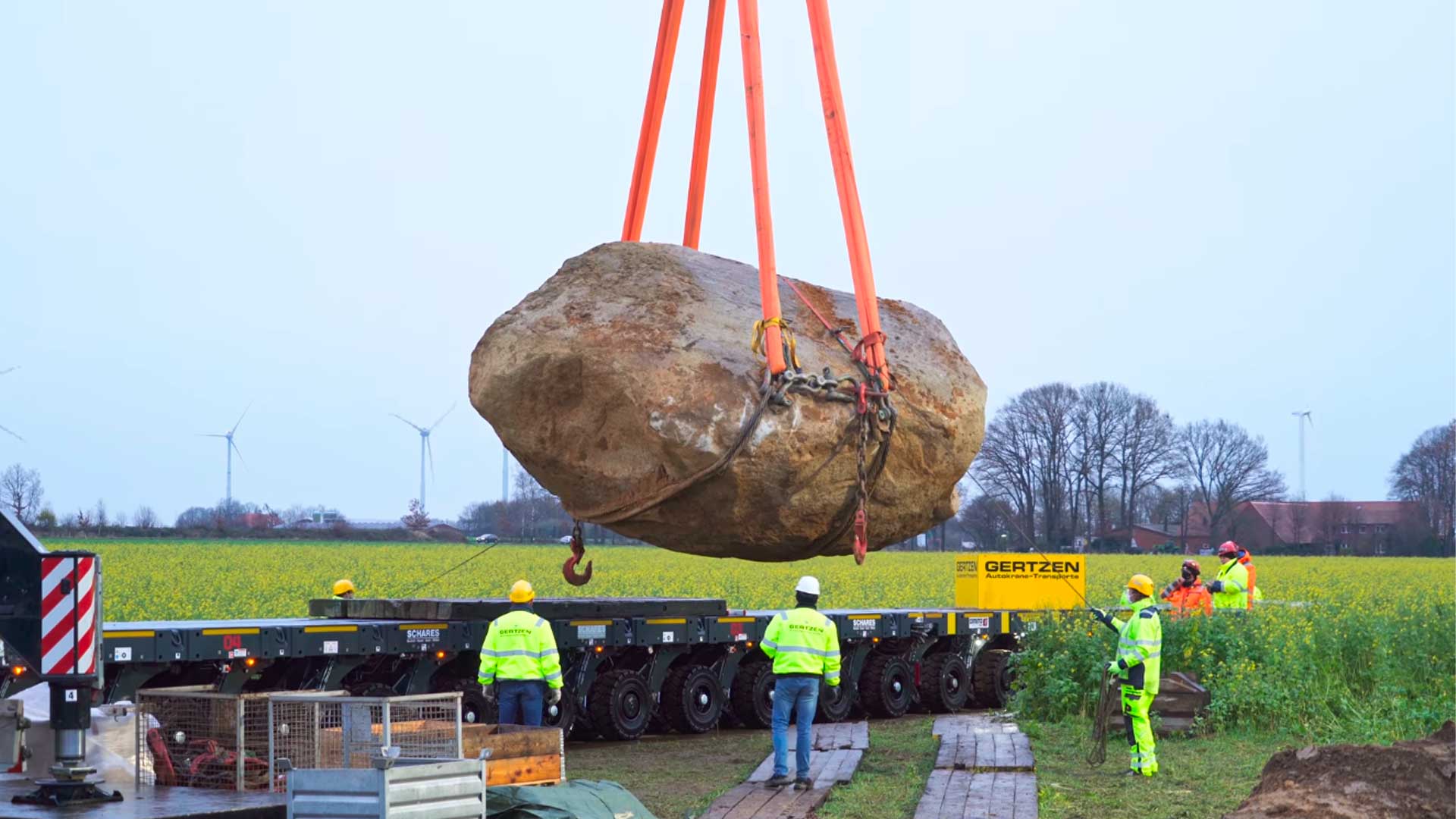


Video-Recorded Rescue Shows the Lifting and Transport of a Glacial Erratic Boulder Near Hüven Using a 9-Axis Crane and Modular Trailer. The Piece, Brought by Glaciers from Scandinavia During the Ice Age, Became a Natural Monument and Attracted Curiosities During the Removal
A rescue of heavy cargo transportation recorded on video drew attention again by showing the removal of a glacial erratic boulder weighing 102.5 tons in a field near Hüven, Germany. According to the description published with the material, the operation required a large crane and special logistics to remove the stone without damaging the surroundings.
The story begins long before. According to Liebherr, the stone obstructed agricultural work in the area since at least the 1950s, when it was noticed just below the surface and began to require constant maneuvering to navigate the obstacle.
Over time, curiosity about the actual size of the boulder and public interest grew, and state geologists visited the site to study and evaluate the find. The same source reports that initial estimates pointed to around 70 tons, but measurements and samples indicated a much larger range, between 100 and 140 tons, which changed the entire lifting plan.
-
He started running at 66 years old, broke records at 82, and is now a subject of study for having a metabolic age comparable to that of a 20-year-old, in a case that is intriguing scientists and inspiring the world.

-
Oldest tree on the planet reappears after 130 years of searches: Wattieza, 385 million years old, was 10 meters tall and had no leaves or seeds; Gilboa fossils in New York solved the mystery in 2007.

-
A 48-square-meter house assembled in hours with 4,000 bricks made of recycled plastic that does not absorb moisture, has natural thermal insulation, and costs less than 90,000 reais in a complete kit.

-
Luciano Hang revealed that Havan’s air fleet has already accumulated more than 20,000 landings, 10,000 flight hours, and 6 million kilometers traveled, and he says that without the planes, the company would never have grown so quickly.


The result was an operation that mixed engineering, safety, and preservation. The rock was removed from the field and taken to the village area, where it began to be displayed as a local landmark.
Rescue Operation and Lifting in Open Field

The removal began with the excavation of a large trench around the boulder to expose its shape and allow for the passage of securing devices. Liebherr describes that the work involved excavators, techniques for routing cables underneath the rock, and the use of chains and straps to stabilize an irregular and heavy body inside a deep hole.
The main tension was not just the force but the uncertainty. The team planned the lifting for a limit of up to 148 tons and only discovered the actual weight when the rock was suspended on the hook, with a reading of 102.5 tons reported by the operator via radio.
Another relevant detail was the protection of the material itself. According to Liebherr, the rock had already been classified as a natural monument, which prohibited drilling and required more careful handling during the securing and removal processes.
Where the Rock Came From and Why It Is Erratic
Erratic boulders are blocks transported by glaciers and deposited far from their original location, often on a different type of soil or rock than would be expected. The National Park Service of the United States explains that glaciers can break off fragments and carry them over long distances, and these boulders help reconstruct the “route” of ice in the past.
In the case of Hüven, Liebherr reports that the geological service identified that the boulder was pushed from Scandinavia by ice during the Saalian glaciation, the penultimate major ice age in the region, over 150,000 years ago.
This type of find often gains scientific and cultural value by linking a point on the map to geological processes that occurred long before any modern human occupation. This is also why preservation comes into the conversation, even when the object seems just like “a giant rock” in a field.
9-Axis Crane and Logistics for Heavy Cargo Transport
To lift the boulder from the ground, a Liebherr LTM 1750-9.1 was used, a mobile crane with 9 axes and a maximum specified capacity of 800 tons in the standard configuration, in addition to reach and boom systems designed for infrastructure and industrial work.
The choice of equipment is not limited to the number of tons on paper. Liebherr itself highlights that the model can transport the complete telescopic boom on public roads and is configured for mobility and relatively quick assembly, something crucial when the lifting occurs in an open field and needs to be completed safely.
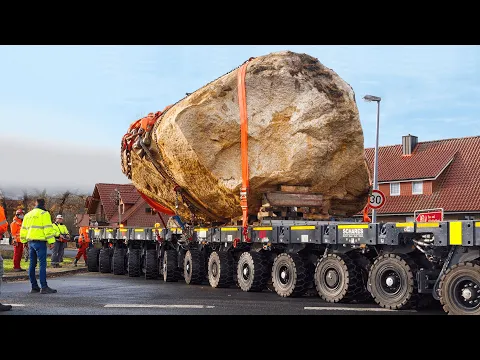
After the lifting, came the part that many underestimate: the movement. Liebherr describes that the rock was placed on self-propelled transport modules, the SPMT, forming a set of 18 axes to respect axle load limits and allow for controlled maneuvers.
The trajectory combined a temporary road set up in the field, about 380 meters long, and several kilometers on the road to the village. Along the way, the long vehicle had to execute a tight 90-degree turn at an intersection, a type of maneuver that relies on remote control, coordination, and calculated space.
According to the record, the disassembly of the crane in the field and reassembly in the village also drew attention for its speed, and the final placement of the boulder at its destination was completed in a few minutes, concluding an operation that mixed public spectacle with technical precision.
When Heritage Becomes Spectacle and Discussion
The case also exposes a common dilemma in special works. On one side, there is the argument to preserve and provide public access to a rare geological asset, especially after its classification as a monument.
On the other, the question of cost, priority, and impact always arises, and this emerges even in discussions generated by the video itself, with people questioning why so many resources should be mobilized to move an ancient rock.
And you, would you have left the rock in the field, or do you think it is right to turn this kind of find into a local attraction and heritage? Comment on what weighs more in your view, scientific preservation or cost and practicality, and say if this type of operation should happen more often.








Sim.tem que deixar a mostra paraque seja vista e estudada.merece o tratamento de coisa rara. Foi correta a remoção.