





 Portuguese
  English
  Spanish
 5 min of reading
  0 comments


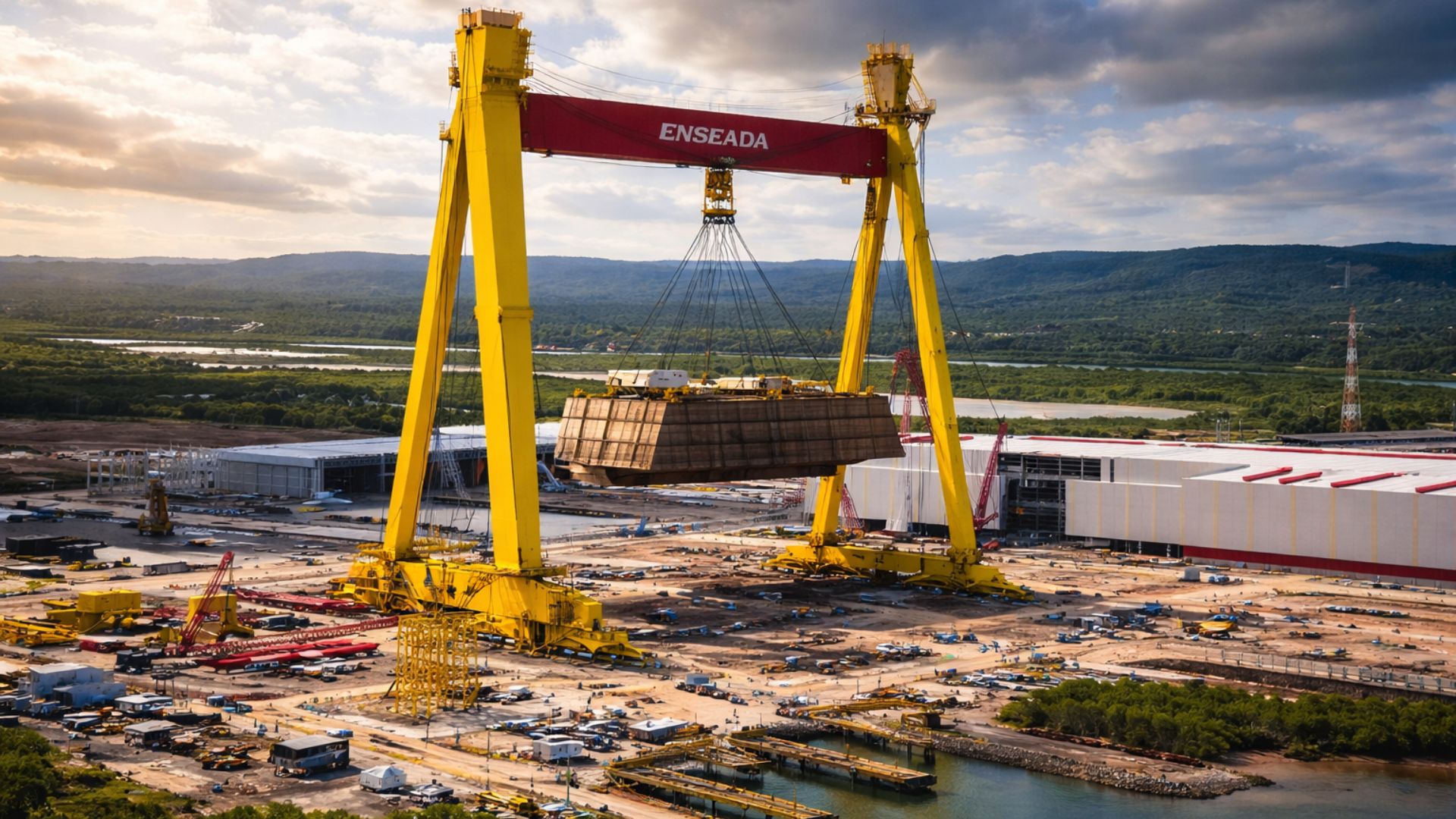
Monumental Structure in Recôncavo Baiano Brings Rare Dimensions to Heavy Industry and Helps Translate, in Concrete Scale, the Complexity of a Naval Complex Designed to Move Megablocks, Giant Loads, and Large-Scale Operations in Brazil.
Installed at the Enseada Shipyard, in Maragogipe, in Recôncavo Baiano, the Goliath concentrates rare dimensions even for the heavy industry.
The equipment is 150 meters tall, has a 143-meter span, weighs 7,000 tons, and was designed to lift loads of up to 1,800 tons in a single maneuver, according to information released by the government of Bahia when the structure was assembled in the naval complex.
The scale helps to understand why the gantry has become one of the most visible elements of the shipyard.
-
Italian researchers have detected what appears to be a second Sphinx buried under the sands of Egypt, and satellite scans reveal a gigantic underground megastructure hidden beneath the Giza Plateau for over 3,000 years.

-
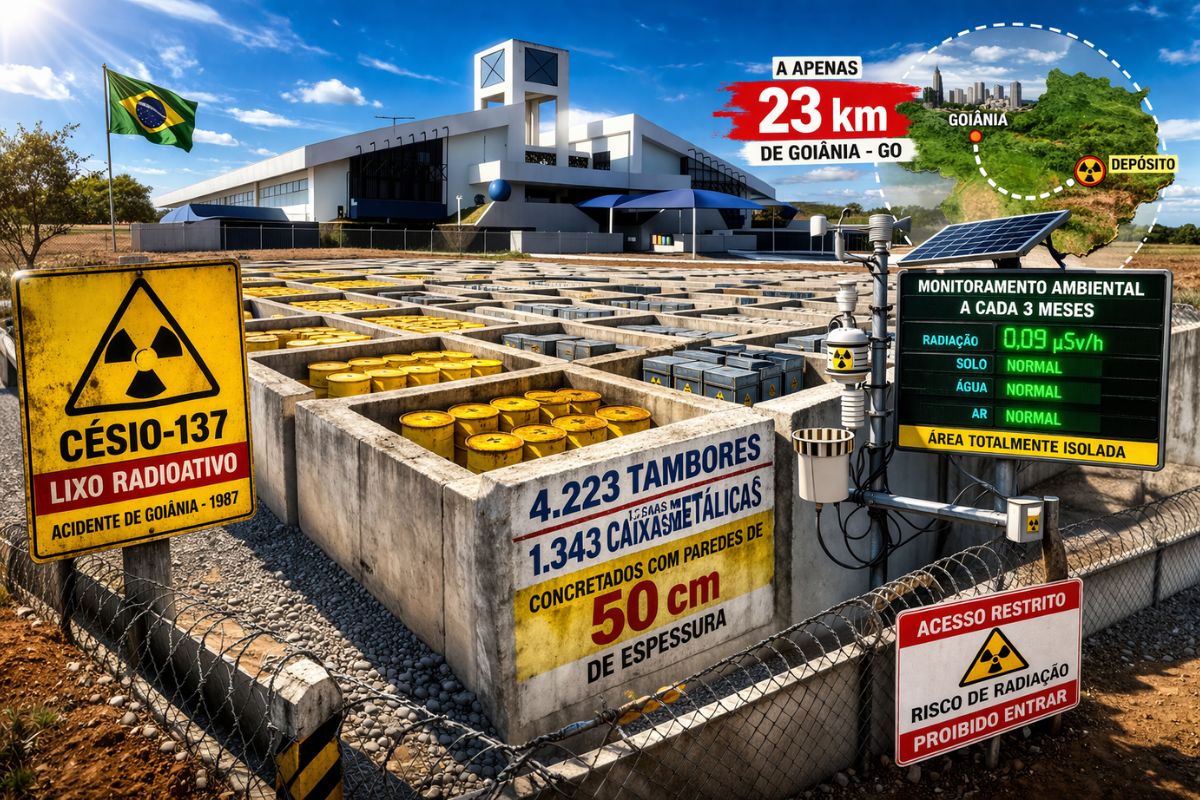
There are 4,223 drums and 1,343 metal boxes concreted with 50-centimeter walls that store the radioactive waste from Cesium-137 in the worst radiological accident in Brazil, just 23 kilometers from Goiânia, with environmental monitoring every three months.
-
Giant Roman treasure found at the bottom of Lake Neuchâtel in Switzerland reveals an advanced trade system, circulation of goods, and armed escort in the Roman Empire about two thousand years ago.
-
He buried 1,200 old tires in the walls to build his own self-sufficient house in the mountains with glass bottles, rainwater, and an integrated greenhouse.


In a comparison used by the Bahia government itself, the height is equivalent to a building of about 50 stories, a reference that better conveys the size of the equipment beyond the technical vocabulary of shipbuilding.
Function of the Goliath Crane at the Enseada Shipyard
More than a landmark in the industrial landscape along the banks of the Paraguaçu River, the Goliath was designed to fulfill a central function in the shipyard’s assembly line.
This type of crane is regarded by Konecranes, a manufacturer specialized in solutions for shipyards, as the key piece in the assembly of hulls and large structural blocks, a decisive stage in the construction of ships and offshore units.
In practice, its relevance lies in its ability to move naval megablocks, which are large sections produced separately and then joined in the integration phase.
The Bahia government reported, at the time of assembly, that the equipment could lift at once even the drilling tower of drill ships, a direct indication of the type of operation for which it was designed.
How the Goliath Was Assembled in Maragogipe
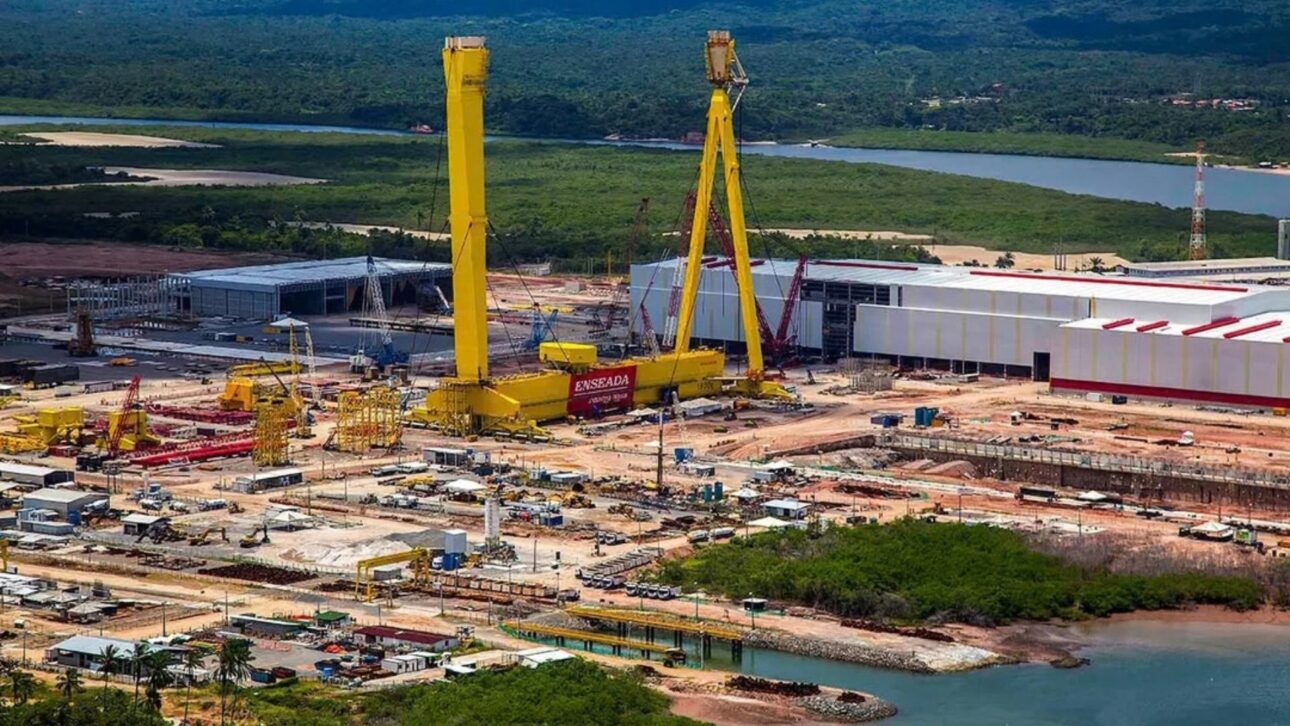
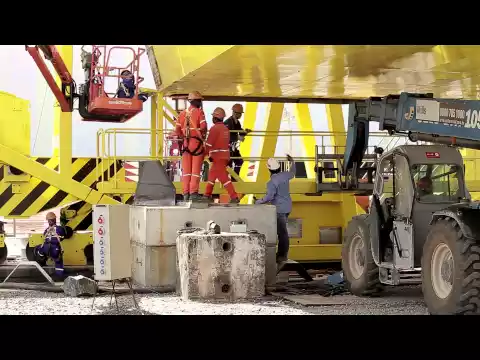
The installation of the Goliath also required engineering beyond standard.
According to the State of Bahia, the structure was formed by modules of up to 500 tons, in an operation conducted by 64 professionals from five nationalities.
The pieces arrived in Recôncavo in stages, by sea, after being produced in Finland and in industrial plants located in China and South Korea.
This size makes even more sense when observed within the context of the Enseada Paraguaçu Shipyard.
Documents from the company’s judicial recovery indicate that the unit occupies 1.6 million square meters, of which 400,000 square meters are allocated for environmental preservation.
The same records state that, at full capacity, the complex can process up to 100,000 tons of steel per year.
Structure of the Shipyard and Industrial Capacity in Recôncavo Baiano
The crane, therefore, was not conceived as an isolated piece nor as a symbol of an ambitious project that remained only in discourse.
In the addenda of the judicial recovery plan, it is identified as “Goliath Crane 1,800 ton,” associated with a dock infrastructure designed for large-scale operations.
One of these documents records that, when extended, the docks can form a section of 575 meters under the Goliath, reinforcing the integration between equipment and port-industrial system.
The presence of the equipment remains relevant even after the reconfiguration of the group’s activities.
In the management report for the year 2023, published in May 2024, Enseada stated that it maintained port services at its private use terminal and reiterated its strategy to position itself as a port, naval, and industrial complex.
The same document states that the customs-approved area of the terminal is 750,000 square meters.
This data helps explain why the Goliath continues to be a strategic asset even outside the more frequent news about naval orders.
The company declared that, throughout 2023, it signed contracts for storage and handling of cargo aimed at export and import operations of bulk solids and general cargo, keeping the complex active in logistics while seeking new industrial business.

Why the Goliath Grabs Attention Beyond the Naval Sector
In this scenario, there is an important difference between the visual impact of the equipment and its real function.
To the general public, the Goliath may just seem like a gigantic crane cutting across the shipyard’s horizon.
Within the production logic, however, it represents the possibility of reducing the fragmentation of assembly, moving much larger structural sets with precision and in fewer steps.
This operational gain is one of the reasons why cranes of this size occupy a central position in large shipyards.
Instead of relying on the assembly of smaller blocks and a greater number of internal transfers, the yard now works with more robust modules.
In a sector where weight, volume, time, and precision go hand in hand, the ability to lift up to 1,800 tons redefines the limit of what can be integrated within the shipyard itself.
Still, what most draws attention outside the technical field is the ability of the Goliath to transform an abstract industrial scale into something immediately comprehensible.
When talking about shipbuilding, one usually thinks of ships, platforms, and billion-dollar contracts.
The crane in Maragogipe translates this dimension into a concrete image: a machine as tall as a 50-story building, designed to move pieces weighing as much as large metal structures that are already partially assembled.
Also for this reason, the equipment arouses curiosity even among readers without ties to the sector.
Urban and port cranes are more familiar to everyday sight, but the Goliath operates in a less visible range of heavy engineering, where enormous structural sections need to be positioned with millimetric accuracy to form hulls, modules, and offshore units.
The aesthetic impact usually comes first; the technical complexity appears soon after, supported by numbers and the function of the equipment.
In the case of Maragogipe, this combination of extreme scale, industrial vocation, and permanence as an operational asset helps explain why the Goliath remains surrounded by interest.
It does not alone summarize the story of the shipyard, nor does it itself solve the challenges of the Brazilian naval sector, but it clearly materializes the size of the infrastructure that has been implemented in Recôncavo Baiano to meet projects of high complexity.








Seja o primeiro a reagir!