





 Português
  Inglês
  Espanhol
  6 min de leitura
  0 comentários


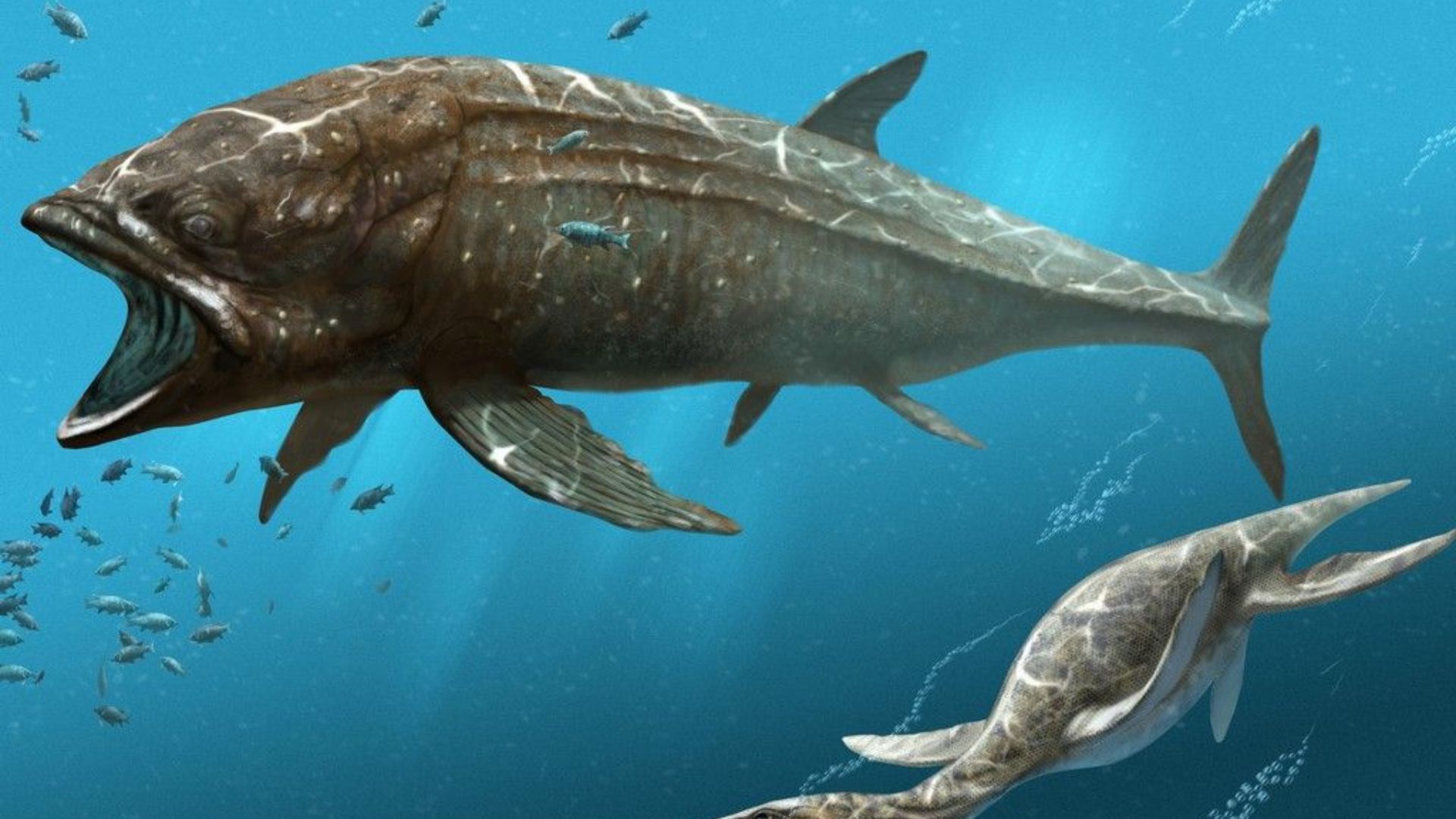
Jurassic Giant, Leedsichthys Impresses with Measurements Associated with Up to 16.5 Meters, Fragmentary Fossils, and Scientific Debates on How to Estimate Size and Growth Without a Complete Skeleton, Keeping the Animal as a Reference of Marine Gigantism.
A bony fish from the Jurassic period, with an estimated length of up to 16.5 meters, has become a reference when it comes to gigantism in the fossil record.
This is Leedsichthys problematicus, a marine animal described from fossils found mainly in the United Kingdom, in deposits of the Oxford Clay Formation, and cited in scientific studies as the largest known bony fish among living and extinct species when the criterion is length.
The highest size estimate, used in recent works, was calculated from anatomical comparisons and analyses of preserved structures that help approximate the animal’s size even without a complete skeleton.
-
The world’s first octopus farm wants to open in the Canary Islands and is already provoking an international reaction: the plan aims to produce 3,000 tons per year.

-
Drought may be creating stronger superbugs in the soil and helping antibiotic resistance reach hospitals, warns a study highlighting a problem that could grow alongside extreme weather.

-
The biggest scam in history: Napoleon’s France deceived the United States by selling them a territory that was Spanish.

-
Why is the Danakil Desert so dangerous? It has unstable terrain and how extreme temperatures and toxic gases turn the region into one of the most hostile environments on Earth.


The dimension attributed to Leedsichthys stands out because it comfortably exceeds the size of a standard city bus, usually around 12 meters, and because it refers to a bony fish, a group that includes most current species.
In today’s sea, the largest fish in length and mass belong to another group, the cartilaginous fish, such as the whale shark.
Among living bony fish, the spotlight usually goes to the sunfish when it comes to weight.
The case of Leedsichthys, therefore, differs by gathering the label of “giant” with a biological group that is currently associated with much smaller sizes.
Fragmentary Fossils and the Meaning of “Problematicus”

What science has on hand, however, is far from being a “perfect fossil.”
One of the central points in understanding why Leedsichthys gained the surname problematicus lies in its preservation.
Researchers describe that its osteology remained poorly understood for a long time because the materials are fragmentary and because the animal had a skeleton with limited ossification, which reduces the chance of fossilizing important parts.
In practical terms, this means that pieces like fin elements and structures of the gill apparatus are more common than a complete sequence of vertebrae or a whole skull.
This gap helps explain why older estimates circulated with much larger numbers and why more recent works focused on constraining the size to ranges more sustainable by the available data.
Estimate of 16.5 Meters and How Scientists Calculated It
One of the studies frequently cited when discussing 16.5 meters is an academic chapter published by researchers associated with the University of Glasgow, which reviewed known material of Leedsichthys, described important specimens, and presented methods for estimating age and growth.
In this work, the team analyzed growth marks on preserved elements, such as gill traces and fin rays, in a sample of five individuals.
Age was estimated from growth rings observed in sections of these structures, considered as years in the context of the study, and the result indicated ages ranging from 19 to 40 years, with estimated lengths between 8.0 and 16.5 meters for these individuals.
The study itself also notes that, around the first year, analyzed individuals would have been about 1.6 meters in length, a data point that reinforces the discussion about growth rate in a large fish.
Mass Models and Limits of What Can Be Asserted

The estimate of 16.5 meters, besides appearing as the upper limit in the study of growth and age, was also used as a basis in research attempting to model the body and discuss biological size constraints in bony fish.
An article published in the journal Palaeontology, for example, used the maximum length of 16.5 meters attributed in previous works and calculated a maximum estimated body mass of 44.9 tons for Leedsichthys, within a model that relates length and mass and from there discusses the energetic cost of swimming and physiological viability in different scenarios.
It is important to note that, in this type of approach, mass is presented as model-derived estimate, not as a direct measure obtained from a complete fossil, precisely because this material does not exist.
Filtration Feeding and Comparison with Current Giants
Leedsichthys is also described as a large marine filter feeder, that is, an animal that obtained food by retaining small particles in the water.
Studies associate this interpretation with anatomical features reported in preserved material, such as the absence of teeth and the presence of highly developed gill structures, the so-called gill traces, which in modern fish can act to retain suspended food.
The academic chapter on growth and age mentions comparisons with current filter feeders, such as hammerhead sharks and whale sharks, when addressing sizes and food acquisition strategies.
These comparisons are used as an ecological parameter, without suggesting that the groups are close from an evolutionary standpoint.
Where It Lived and Why the Discovery Still Draws Attention
Another aspect that contributes to the interest around Leedsichthys is the historical trajectory of discoveries.
The genus was described in the 19th century, during a period when collections of Jurassic fossils from Britain fueled debates about what was actually preserved in the rocks.
The material from Leedsichthys was associated with marine deposits of the Oxford Clay, known for preserving a diverse range of vertebrates and invertebrates from the Middle Jurassic.
The same academic chapter that deals with size and growth records occurrences of the genus in different regions and ages of the Jurassic, including locations in England, France, northern Germany, and also records in Chile, indicating a wide distribution in seas of the period.
Scientific Caution and What Is Still Missing to Discover

Even with the weight of a “record”, the status of Leedsichthys is presented with caution in technical literature.
The study of growth and age emphasizes the need to avoid creating “giants of mythical proportions” from fragile identifications or excessive extrapolations based on scarce pieces.
In other words, the size attributed to Leedsichthys is not a “closed” number, but an estimated range based on the best specimens and available methods, and it can be refined if new and more complete materials are found and described.
The point, still, is that the ranges proposed by recent works place the animal at a rare level for bony fish, exceeding in length many of the largest current marine vertebrates and making it a central case for understanding how gigantism can arise under certain environmental and ecological conditions.
The absence of a complete skeleton remains the main limiter to answering questions that the public often asks, such as what the exact body shape would be, how much the animal could maneuver, and what its actual weight was outside of theoretical models.
Still, the set of fossils and analyses already supports what the title summarizes: a bony fish around 16.5 meters, larger than a bus in length, occupied the seas of the Jurassic and became a reference when talking about the upper size limit for this group.







Seja o primeiro a reagir!