





 Portuguese
  English
  Spanish
  6 min of reading
  18 comments


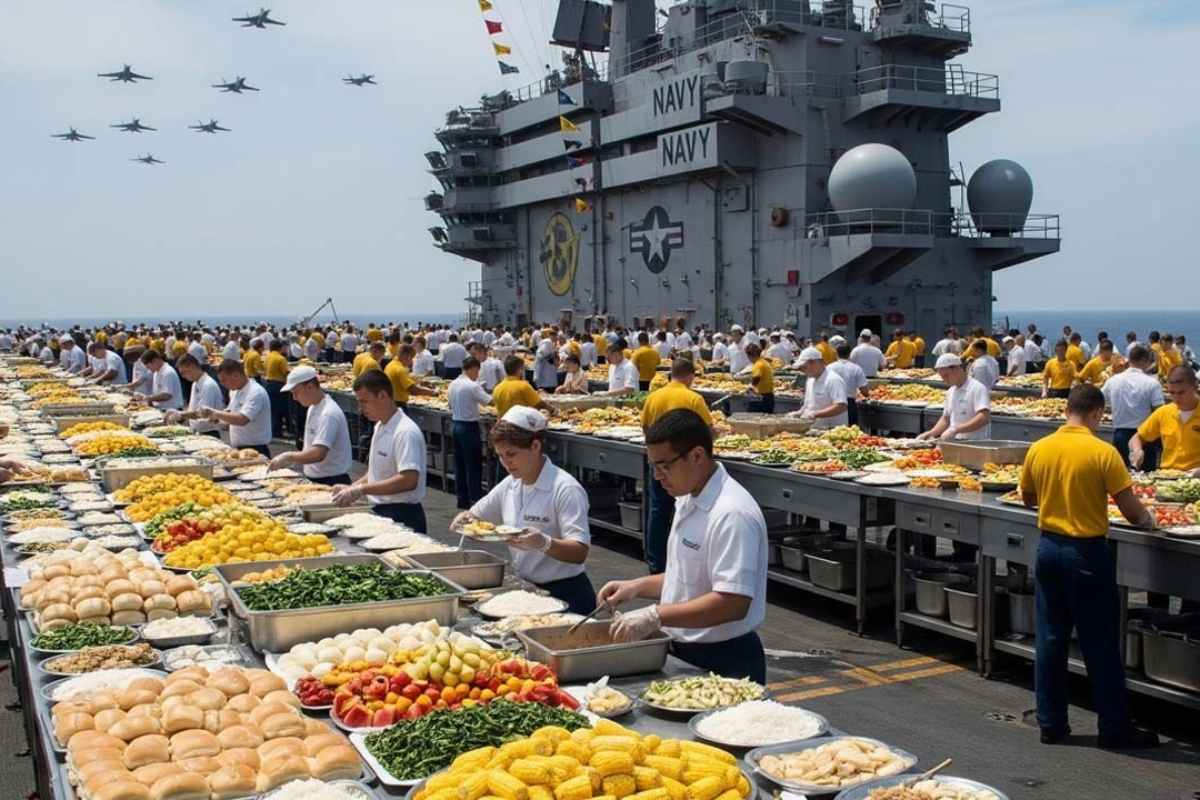


Among Narrow Corridors, Industrial Caldrons and Stocks That Must Last Up to 70 Days, the Food Operation of the Military at Sea Combines Metric Planning, Calorie-Calculated Menus, Replenishment on Partner Ships and Decisions in Seconds to Prevent a Failure from Interfering with Combat Readiness in Any Ocean in the World
On a modern American aircraft carrier, feeding around 6,000 military personnel at sea is not just a kitchen routine; it’s a critical combat operation. There can be up to 17,000 meals per day, distributed across breakfast, lunch, dinner, and the overnight shift, in tight environments, vibrating with the movement of the ship and the constant noise of planes taking off and landing. Each dish needs to deliver energy, predictability, and regularity so that the crew operates like a machine.
The pressure is comparable to that of a large restaurant operating on the day of a decisive game, only this time at sea, with no neighbors, no delivery, and no second chances. If one step is delayed, the entire ship’s schedule gets misaligned. Therefore, menus, stocks, schedules, and teams are planned weeks in advance. In a scenario where an aircraft carrier costs about 8.3 million reais per day to operate, the kitchen transforms from a supporting role to the central cog in the machinery of military operations at sea.
Industrial Kitchen in the Middle of the Ocean

Today, the United States Navy operates 11 aircraft carriers, true floating cities with 5,000 to 6,000 people on board.
-
Archaeologists find a colossal 2,000-year-old vessel at the bottom of the sea near Alexandria linked to the elite of Egypt and reveal a pleasure barge from the last dynasty of the pharaohs that the sea has hidden for centuries.

-
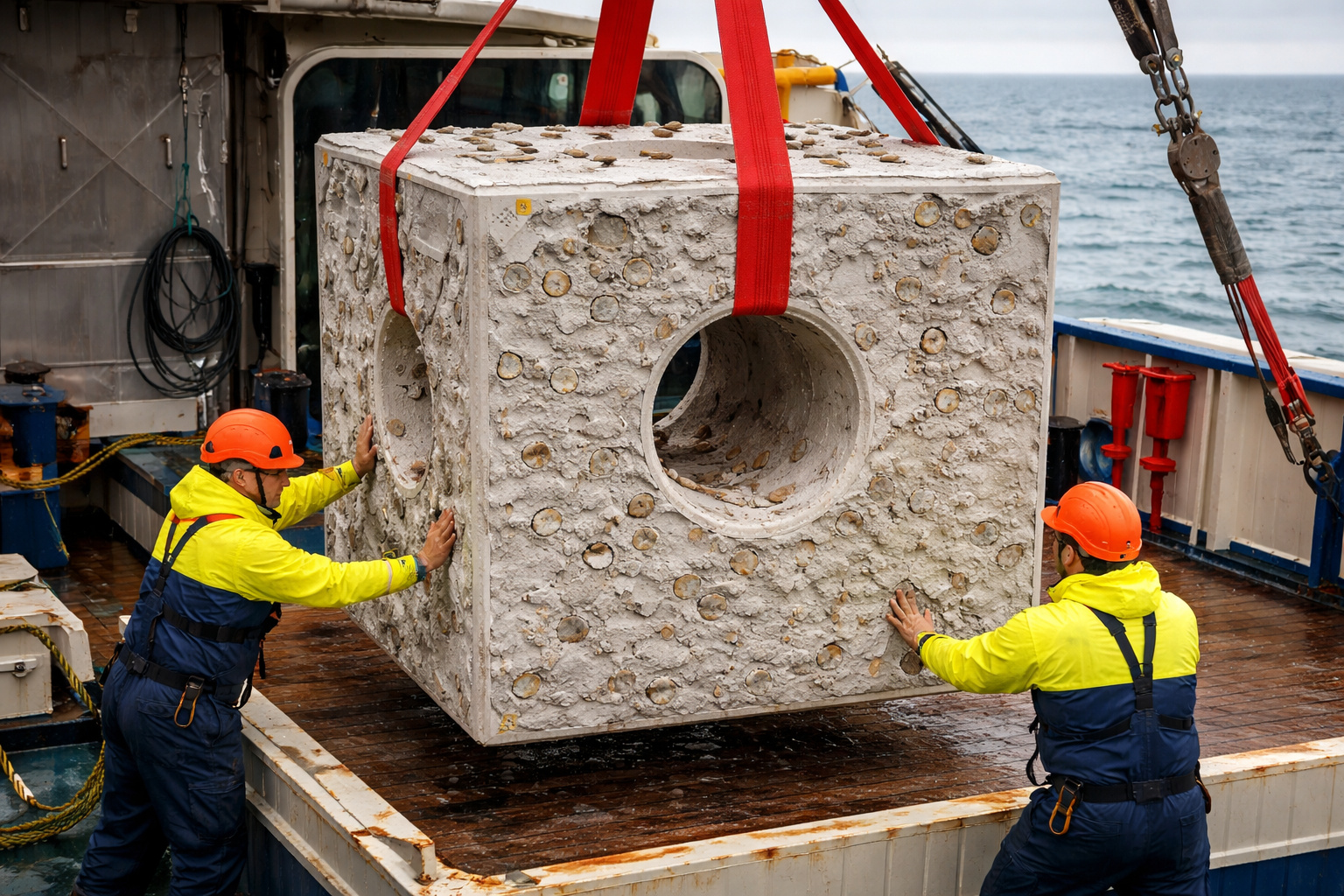
United Kingdom clears 40 tons of shells and concrete into the sea in an innovative project that promises to restore a marine ecosystem lost for over 200 years and improve water quality.
-
With emergency diversion to abandoned mining craters, engineers save villages from a devastating flood that was advancing through the desert and threatening to destroy entire communities in a matter of hours.

-
It seems simple, but it enriches: from R$ 500 to R$ 6,000 per piece and up to 10 days of handcrafted production, how is the couple from Praia Grande making a high income with hyper-realistic miniatures and turning a hobby into a money-making machine?


On ships like the USS Harry S. Truman, about 114 cooks are responsible for up to 17,398 daily meals.
In practice, each cook delivers nearly 150 dishes per day, in an environment that never closes.
The main kitchen operates 24 hours a day, divided into shifts that fit within the flight operations, maintenance routines, and service schedules.
The military personnel at sea receive three main meals, in addition to the overnight snack, known as Midrats, aimed at those working during hours when the ship seems to never sleep.
Pots of up to 80 gallons, multi-tier industrial ovens, and tilt skillets are used in continuous flow production.
Meals are prepared in large batches, with frequent replacements to keep food hot throughout the service period.
There are no à la carte dishes, but rather a menu designed to balance volume, standardization, and nutritional value.
Calories Counted, Morale Monitored

The Navy sets clear energy goals: about 2,850 daily calories for men and 2,100 for women on board.
Nutritionists design the menu, and chefs convert these calculations into rice, meat, vegetables, pasta, fruits, and desserts.
In a single day, as much as 158 kilograms of lettuce, 725 kilograms of meat, 20,000 cups of coffee, 160 gallons of milk, and dozens of boxes of cereal may be consumed.
Nothing is determined by feel; everything goes through spreadsheets and procedures.
Menus are planned with cycles of 14 to 21 days, considering allergies, religious restrictions, and the psychological need to vary dishes even with high repetition.
Food is also a tool for morale. A service member who spends weeks in lower decks without seeing daylight finds rare relief in the mess hall.
On special occasions, such as Christmas or Thanksgiving, the menu changes: roasted turkey, traditional desserts, and themed decorations help reduce the distance from home.
For military personnel at sea, a good menu is worth as much as a few extra hours of rest.
Deep Stocks and Surgical Replenishment
The cold holds of an aircraft carrier store stocks planned for weeks.
On Nimitz-class ships, for instance, there’s capacity to feed 6,000 people for about 70 days.
The most perishable items, such as fruits, fresh vegetables, and bread, are placed in the quickest turnover stock area, while canned and frozen goods occupy the largest portion of storage space.
When the safety level drops, the replenishment logistics at sea come into play.
Support ships or specialized aircraft can transfer from 181,000 to 317,000 kilograms of food at once.
Meanwhile, the two ships need to sail at stable speed and position, side by side, often in rough seas.
It’s a millimetric operation, executed with ropes, cranes, and elevators, while the internal routine of the kitchen cannot stop.
For military personnel at sea, this replenishment is almost invisible: they continue on schedule, enter the mess hall, and find a ready meal on time.
Behind the scenes, however, any delay in the transfer of food can jeopardize entire menus, leading to the premature use of reserves or increased reliance on long-lasting items.
Inhumane Pace, Extreme Training
Military cooks start their day when the ship still seems asleep.
Times like 3:30 AM are common, especially in land-based facilities like military academies, where kitchens can serve between 10,000 and 13,200 meals daily.
At West Point, preparing a single lunch can mean dealing with over 22,000 meatballs, nearly two tons of pasta, and hundreds of liters of tomato sauce.
Before reaching an aircraft carrier, many of these professionals undergo heavy training.
They study food safety, prevention of poisoning, cutting techniques, and the use of cauldrons ranging from 220 to 380 liters, as well as learning to cook under stress, intense heat, and strict schedules.
Newcomers describe the first weeks as a shock, with a workload far beyond what one might expect in a conventional kitchen.
Equipment breaks, pots burn, entire batches of food sometimes need to be discarded.
The difference is that instead of a few irritated customers, there are thousands of military personnel at sea waiting in line.
The rule is clear: detect the error quickly, adjust the recipe, use contingency stocks, and ensure the mess hall opens at the exact minute.
Waste, Environment, and Clean Plate Discipline
Serving thousands of meals daily generates mountains of waste.
For years, much of the organic waste was simply dumped into the sea.
With rising environmental pressure, many ships have begun to incorporate composting and waste processing systems, reducing direct dumping into the water.
Even so, discipline starts on the plate. Waste is a recurring theme in internal messages, and portion planning aims to balance satiety and minimal leftovers.
The challenge is particularly sensitive on long missions, where any miscalculation exceeds the replenishment capacity and may force a cut in menu items.
Outside the Aircraft Carrier: Schools and Field Kitchens
The logic that sustains military personnel at sea is repeated, with adaptations, in training schools and field exercises.
In academies, mess halls serve over 4,000 students in tight time windows.
In Anápolis, for example, there are unique traditions, like buffalo chicken on Fridays, which helps set the pace for the week.
In major exercises, field kitchens mounted on trailers come into play.
A modern unit can deliver up to 2,400 meals per day, under intense heat, dust, constant lack of water, and without a fixed kitchen.
The internal temperature can exceed 49 degrees, while outside the thermometer reads around 38.
Even so, two hot meals a day are treated as a matter of morale and operational performance.
From state-of-the-art aircraft carriers to makeshift kitchens in the field, the logic remains the same: without food, there is no readiness.
The soldier piloting a fighter jet, operating a radar, or maintaining a nuclear reactor depends on the invisible work of those who measure, cut, cook, and serve.
It is this silent machinery that ensures that thousands of military personnel at sea continue functioning as if nothing could go wrong.
And you, would you take on an entire journey in the line of fire of the kitchen to keep thousands of military personnel at sea fed every day?







Reportagem sensacional!
Tudo é questão de adaptação, e sentir prazer no que faz. Sou Cozinheiro Profissional, e por anos trabalhei em Escolas Municipais, encarando um Fogão Industrial de 6 bocas e no verão o calor é infernal. Parabéns aos Bravos Guerreiros.
Amei ter esse conhecimentos não tinha noção da grandiosidade