





 Portuguese
  English
  Spanish
  6 min of reading
  6 comments


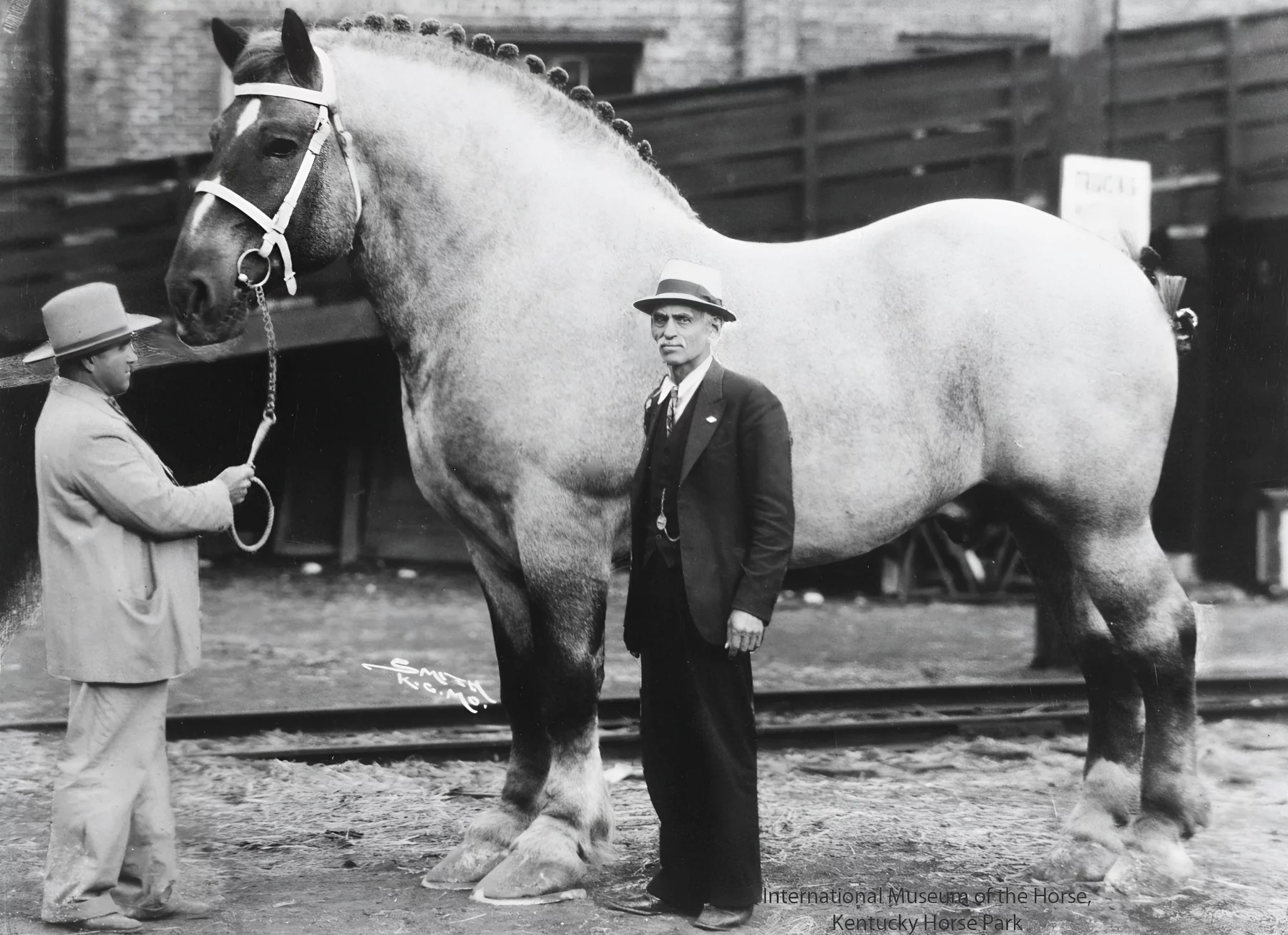


With 2.19 Meters in Height and Nearly 2 Tons, Sampson Was the Largest Horse in History and Became the Ultimate Symbol of Animal Power in the Industrial Revolution.
In the 19th century, when the world still directly depended on animal power to move cities, loads, factories, and entire commercial empires, a creature was born in England that seemed to challenge the limits of biology. Its name was Sampson, later renamed Mammoth, and its existence redefined what strength, traction, and power meant in an era prior to combustion engines. Officially recorded as the largest horse that ever existed, Sampson reached 2.19 meters in height at the withers while still young, with an estimated weight between 1,500 and 1,700 kilograms. At a time when the average horse barely exceeded 1.60 meters, the mere presence of this animal caused astonishment. It was not just big. It was a living anomaly of nature, an organism created to move the impossible.
The Birth of a Colossus in Industrial England
Sampson was born in 1846, in the Bedfordshire region, at the height of the British Industrial Revolution. England was experiencing the most explosive moment of its economic transformation. Railways spread out, ports were expanded, coal mines operated relentlessly, and factories emerged at a frantic pace. Everything needed to be transported. Everything relied on traction.
It was within this context that the Shire breed, specialized in heavy work, became the backbone of British land logistics.
-
The water that almost everyone throws away after cooking potatoes carries nutrients released during the preparation and can be reused to help in the development of plants when used correctly at the base of gardens and pots, at no additional cost and without changing the routine.

-
The sea water temperature rose from 28 to 34 degrees in Santa Catarina and killed up to 90% of the oysters: producers who planted over 1 million seeds lost practically everything and say that if it happens again, production is doomed to end.

-
An Indian tree that grows in the Brazilian Northeast produces an oil capable of acting against more than 200 species of pests and interrupting the insect cycle, gaining ground as a natural alternative in soybean, cotton, and vegetable crops.

-
The rise in oil prices in the Middle East is already affecting Brazilian sugar: mills in the Central-South are seeing their margins shrink just as ethanol gains strength.


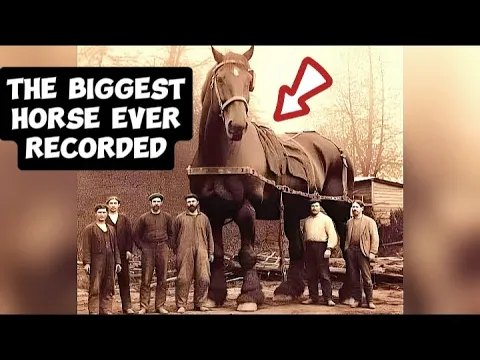

The Shires pulled brewery wagons, moved loads of ore, removed giant logs, supplied construction sites, and operated machines not yet motorized. Sampson was born precisely from this lineage of giants but quickly exceeded any known standard.
At four years old, when he was officially measured, his height already surpassed all records of the time and has never been exceeded since.
The Impossible Anatomy of the Largest Horse in History
To get a real sense of Sampson’s size, simply compare him to an average modern human. An adult at 1.75 meters would have his head at the height of the horse’s chest.
His skeletal structure housed limbs capable of supporting nearly two tons in continuous motion. His chest was so wide that it required custom harnesses. His legs had a diameter comparable to that of wooden posts.

More impressive than the isolated size was the combination of mass, endurance, and prolonged traction ability. Sampson was not a showcase horse. He was bred for work. And work, at that time, meant moving loads that today would only be possible with forklifts, cranes, or trucks.
Animal Power in an Era Without Engines
In the mid-19th century, steam still dominated factories, but terrestrial traction mainly relied on animals.
Locomotives depended on tracks, but everything outside of them needed horses. An average Shire could already pull between 5 and 8 tons over short distances on iron tracks. An animal the size of Sampson raised this standard to an undocumented limit.
The economic value of a horse of this size during the Industrial Revolution was enormous. It represented logistical speed, reduced human labor, increased load capacity, and direct productivity enhancements. Sampson was worth the equivalent of a large industrial machine, only alive.
From Sampson to Mammoth: When the Name Was No Longer Enough
Over time, it became clear that the original name did not do justice to his size. He came to be called Mammoth, in reference to prehistoric colossi. It was not a promotional exaggeration. It was a biological observation.
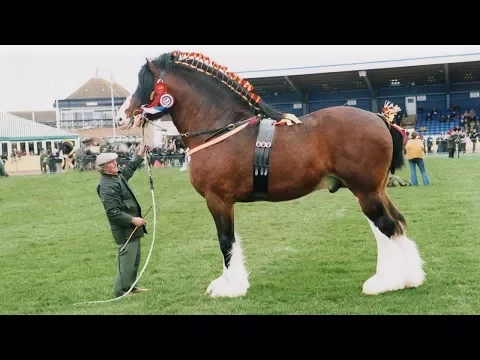
Historical records indicate that his mere presence drew attention at fairs, farms, and urban centers. People traveled miles just to see him. In a society without television, the internet, and cinema, an animal of this size was a natural spectacle.
The Record That Spanned Centuries
To this day, no officially measured horse has surpassed Sampson’s 2.19 meters. The record is recognized by historical institutions and by the Guinness World Records as the largest horse in history with reliable measurement.
Several modern giants have come close, such as the American Big Jake, who reached about 2.10 meters. Nevertheless, Sampson remains unreachable. His record has endured for over 170 years without being surpassed.
The Peak and the End of the Era of Animal Traction
Sampson was born at the peak of animal traction… and died at the start of its replacement. A few decades later, the steam engine applied to vehicles, followed by the combustion engine, began to completely redefine the logic of land transport.
Trucks took the place of horse-drawn wagons. Cranes replaced brute traction. The giants of flesh and bone were retired.
In this sense, Sampson symbolizes the final peak of a millennia-old era, in which the entire economy of the world directly depended on animal power. He was the greatest representative of a system that sustained empires for centuries and was suddenly replaced by machinery.
Real Gigantism or Extreme Genetic Exception
Scientifically, Sampson’s size is explained by the combination of:
– extremely selected genetics of the Shire breed
– breeding focused exclusively on traction
– highly caloric diet
– growth in a favorable environment
– absence of limiting diseases
Still, specialists consider his size an extreme statistical exception, something that is unlikely to be repeated at the same level. The larger the animal, the greater the impact on joints, heart, and metabolism. Keeping an organism weighing nearly two tons alive and functional is a monumental physiological challenge.
The Cost of Keeping a Colossus Alive
A horse the size of Sampson consumed absurd amounts of food per day. Estimates suggest dozens of kilos of hay, grains, and supplements to maintain muscle mass, bone structure, and energy. His operational cost was extremely high but fully justified by the volume of work he could perform.
Today, the cost of keeping a horse of this magnitude would be unfeasible outside contexts of exhibition, genetics, or research.
Sampson in the Memory of Engineering and Biology
More than just a record, Sampson remains a milestone at the intersection of biology, engineering, and economics. He was not only a large animal. He was an extreme productive asset of an era that relied solely on the strength of muscles and tendons to move tons.
His existence proves that, before steel, diesel, and electricity, humanity built entire cities powered by living organisms trained to support the impossible.
Why No Modern Horse Attempts to Surpass Sampson
Today, the genetic selection of horses prioritizes sports performance, speed, aerobic endurance, and longevity. Extreme gigantism has become undesirable because:
– it overloads joints
– it increases cardiac risk
– it reduces mobility
– it raises maintenance costs
– it limits longevity
Sampson belonged to an era in which the only objective was to pull more weight than any other domesticated terrestrial being. This objective simply stopped making economic sense.
The Largest Horse in History as the Final Symbol of Organic Power
Sampson did not leave heirs of his height. He left no descendants that repeated his feat. What remained was the record that, for a few decades, the Earth housed a horse that surpassed all known biological limits of its species.
In the era of machines, he remains a brutal reminder that, once, the most powerful force in the world was still made of flesh, bones, and tendons.










Isso é fantástico
Toda vez ouço histórias assim me encando e me rendo a criação divina
É simplesmente tudo maravilhoso
O cavalo **Sampson** (também conhecido como **Mammoth**) viveu **cerca de 36 anos**.
* **Nascimento:** 1846
* **Morte:** 1882
* **Idade ao morrer:** aproximadamente **36 anos**
Ele é famoso por ser considerado o **maior cavalo da história**, da raça **Shire**, chegando a medir cerca de **2,19 m de altura** na cernelha.
O cavalo **Sampson** (também conhecido como **Mammoth**) viveu **cerca de 36 anos**.
* **Nascimento:** 1846
* **Morte:** 1882
* **Idade ao morrer:** aproximadamente **36 anos**
Ele é famoso por ser considerado o **maior cavalo da história**, da raça **Shire**, chegando a medir cerca de **2,19 m de altura** na cernelha.