





 Portuguese
  English
  Spanish
 6 min of reading
  6 comments


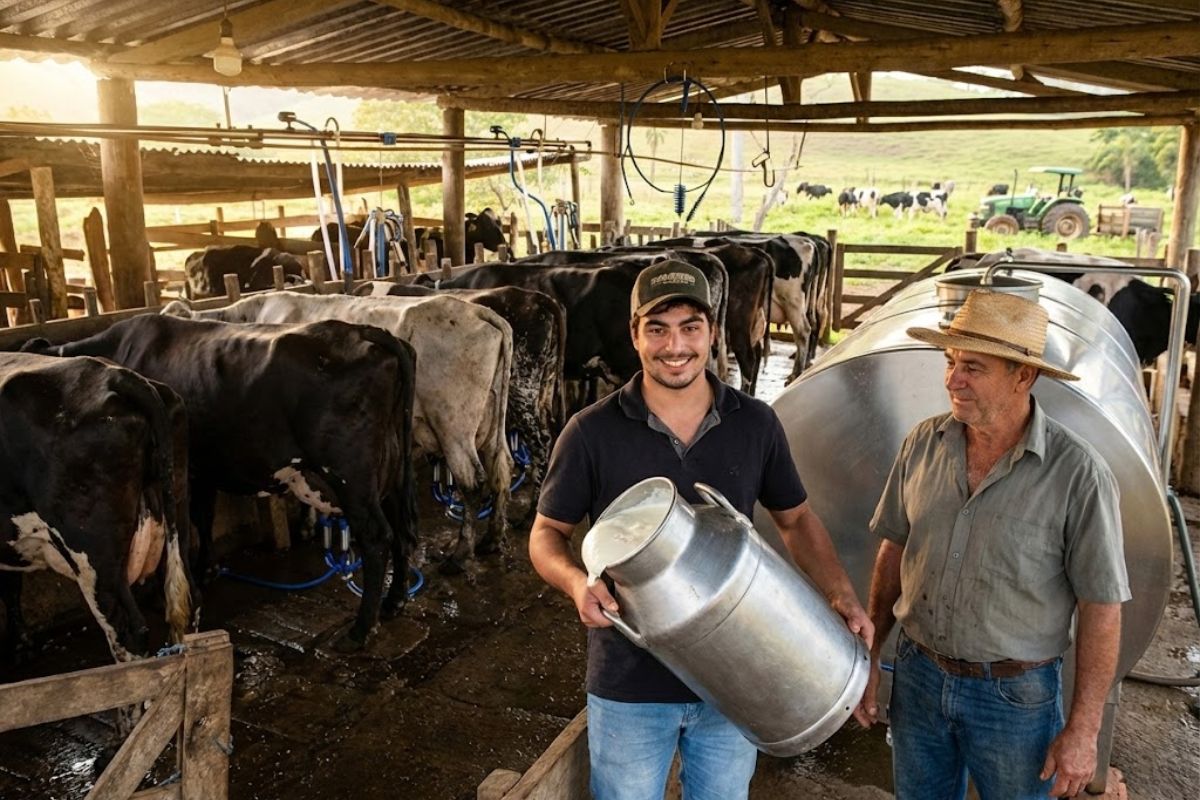


At 26, Young Cattle Rancher Luiz Adriano Rents Land in Paiva MG, Transforms 10 Cows Given by His Father into a Genetic Herd of 38 Animals, Produces About 900 Liters Daily of Milk and Structure, in One Year, a Long-Term Professional Project in Modern Dairy Cattle Farming in Minas Gerais
At 26, young cattle rancher Luiz Adriano decided to forge his own path in dairy farming: about a year ago, he rented a rural area in Paiva, in the Zona da Mata region of Minas Gerais, and began milking 10 cows that his father had given him. Today, the same structure houses a herd of 38 productive cows, responsible for an average of between 880 and 900 liters of milk per day.
In this approximately 12-month interval, the producer transitioned from being an assistant in his father’s cattle buying and selling activities to managing his own business, with a permanent employee, a daily milking routine, and an intensive feeding system in the trough. The young cattle rancher’s declared goal is simple yet ambitious: to live off milk and, from his high-producing cows, “feed Brazil.”
From the Initial 10 Animals to the Herd of 38 Producing Cows

The starting point for the young cattle rancher was a classic family arrangement in the countryside.
-
They said no to 26 million dollars and would do it all over again: mother and daughter from Kentucky reject a million-dollar offer from a mysterious company that wants to build the largest data center in the state on more than 2,000 acres of rural land.

-
While corn requires rain and is expensive, sorghum produces almost the same volume per hectare at a cost up to 80% lower and uses less water, and it is revolutionizing dairy farming in the Triângulo Mineiro, where producers save hundreds of reais per hectare.
-
A rural producer from Urubici cries as he shows 50 tons of plums thrown on the ground because no one wanted to buy them, and in desperation, he records a video asking anyone to come to the property to pick the fruits before they rot.
-
Unable to pass through Hormuz, Brazil activated a plan B that uses Turkey as a gateway to the Middle East: the route through Gibraltar and the Mediterranean is longer and more expensive but ensures that chicken, beef, and corn continue to reach Arab markets.


His father, Adriano, a cattle trader, invested in 15 cows, of which 10 were already calved and five were still heifers in development.
With this initial nucleus, Luiz Adriano set up the first batch of lactating animals and began forming his own herd.
In about a year of work, the number of cows in production reached 38, with an individual average of 23 to 24 kilograms of milk per day per cow, a level considered high for a simplified and still consolidating system.
The herd is made up of crossbred animals, also including three-quarter and five-eighths cows, many of which come from embryos, which he refers to as “genetic cattle.”
The herd includes individuals that stand out above the average.
A three-quarter cow, bought as a common animal in a trade batch, became the highest producer in the barn, with about 50 kilograms of milk per day, according to the producer himself.
Other crossbred cows, which he classifies as “queens of the barn,” participate in municipal milk competitions and have even reached second place in regional exhibitions.
Confined System, Trough Diet, and Milking Routine
The production system adopted by the young cattle rancher is predominantly confined.
The cows have access to pasture, but their diet is based in the trough, with roughage and concentrate distributed twice a day, always after milking.
The strategy is to keep the trough always full, so that the cattle are satisfied and do not lose body condition.
For roughage, Luiz Adriano uses silage, complemented with citrus pulp.
For concentrate, he formulates the mixture himself with soybeans, corn, cottonseed, and a specific nucleus for dairy cows.
The cows are divided into three production lots within the milking area: the first lot, of highest performance, receives about 10 kilograms of feed per day; the second, 8 kilograms; and the third, 6 kilograms.
Milking occurs twice a day, in a simple but functional structure.
While the employee operates the machines, the cows consume their feed individually, which facilitates diet control.
The young cattle rancher conducts weekly weight measurements for each animal, adjusting the supply of concentrate according to performance.
The result is a daily volume of 880 to 900 liters of milk, considering the current number of lactating cows.
Rented Land, Family Support, and Risk Management
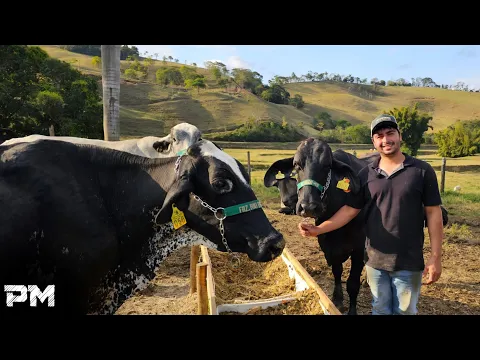

The property where the young cattle rancher works is entirely rented.
It covers about 88 to 90 hectares, with sufficient area for planting roughage, grazing paddocks, calf areas, and paddocks for dry cows.
The farm is located approximately 4 kilometers from the urban area of Paiva, allowing Luiz to live in town and commute twice a day to manage the milking routine.
His father continues to trade cattle and helps with animal selection, allowing his son to “clear the head” of purchased lots for resale.
That’s how some of the best-producing cows in the current herd appeared. Besides family, the producer has a permanent employee, Fred, who assists him in milking and daily care.
On the technical side, support comes in a piecemeal fashion. A veterinarian performs ultrasound exams, while the city hall provides inseminators and semen for some cows.
Still, the formulation of the diet, daily management, and investment decisions rest in the hands of the young cattle rancher himself, who admits to not having structured formal consulting and learns “on the job,” adjusting the system according to the herd’s response.
Dry Cows, Reproduction, and Genetic Strategy in the Herd
The dry cows are managed in their own pasture, along the banks of a watercourse that runs through the property.
When the pregnancy reaches about seven months, they are dried following a standard dry cow protocol, including the application of an intramammary product and sealant, and are moved to this rest paddock.
About 20 to 30 days before calving, the cows return to the central area of the farm and begin receiving silage and specific pre-calving feed in preparation for the new lactation.
The logic is to preserve health, reduce the risk of metabolic problems, and ensure a good start to production in the next phase.
For reproduction, Luiz Adriano mainly uses semen from high-producing dairy breeds, focusing on Holsteins, adjusting the crossings according to the blood level of each dam.
Part of the offspring is destined for sale, especially when influenced by beef breeds or industrial crosses.
For now, the young cattle rancher does not maintain a structured system for rearing all heifer calves, prioritizing cash flow and gains from selected genetics for his own dairy herd.
Milk Price, Costs, and Plans to Grow With Feet on the Ground
On the revenue side, the last payment reported by the producer was around 2.74 reais per liter of milk, a price that has already shown signs of decline from the dairy.
In a scenario of high costs for feed, silage, concentrates, and labor, this price fluctuation puts pressure on the cash flow of a business still in its early stages.
At the same time, the intensive trough system and the bet on higher-performance genetics allow some of the fixed costs to be diluted per liter produced.
The goal of the young cattle rancher is to continue increasing the scale, with more lactating cows and gradual improvement of the structure, without losing control over debt.
He mentions the desire to increase the use of high-potential crossbred animals and, in the future, advance in embryo partnerships as financial flow allows.
His personal life is also included in the long-term planning.
Married and father to a girl just over a month old, Luiz says that all investment in dairy farming is thought out “for those who will inherit it one day.”
The idea is that the project started with 10 cows given by his father will become, in the future, a productive asset capable of supporting the family and continue feeding Brazil with quality milk.
Do you think stories like that of this young cattle rancher, starting on rented land and with few animals, could become the new standard for renewing dairy farming in Brazil?








Sim, claro acho a ideia maravilhosa!
De repente se ele transforma este leite em.queijo doces. Agregaria mas valores o produto. Tipo 900×2.20 passaria de 2000 para 5000
Perfeito , grande pecuarista