





 Portuguese
  English
  Spanish
  8 min of reading
  5 comments


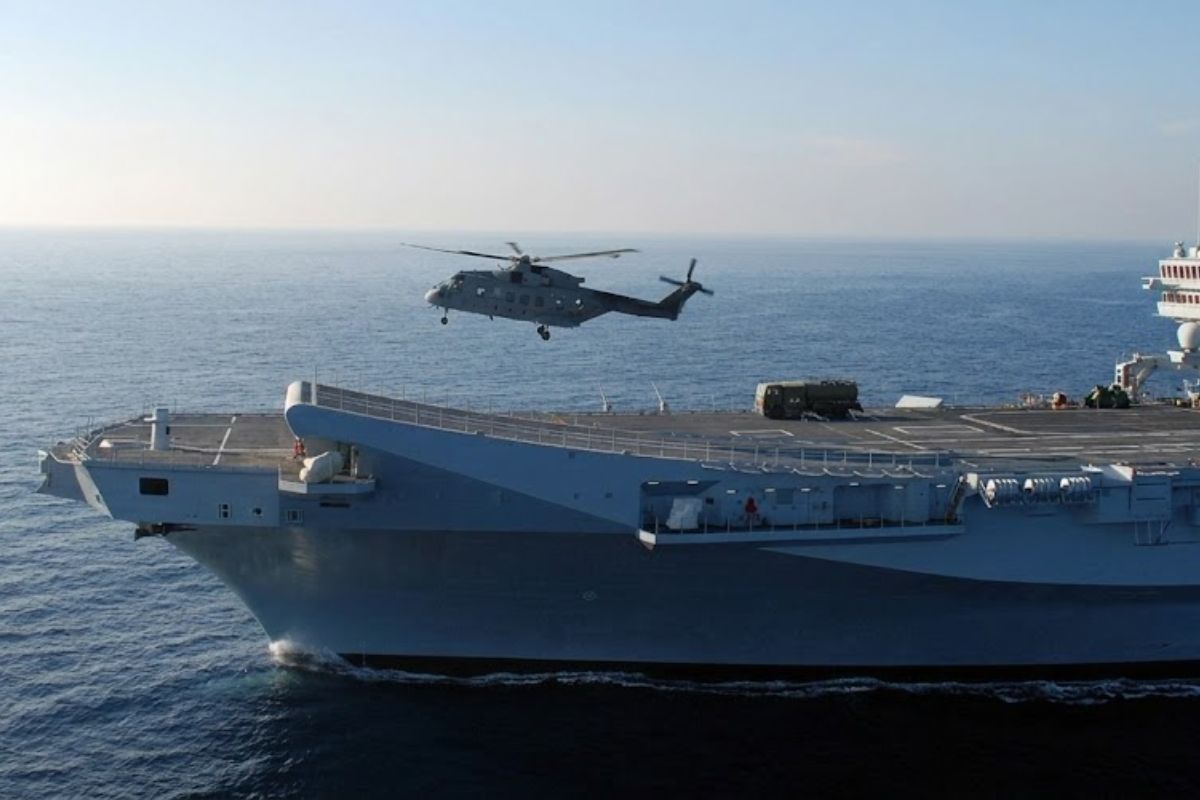


Delivered After Project NAVARM-Fincantieri, the Cavour Was Born Between Riva Trigoso and Muggiano, Joining Sections and Becoming a CV. With a Hangar of 134×21 m, Six Flight Positions, Ski-Jump Ramp, and a Range of 7,000 Nautical Miles, it Supports Joint and Humanitarian Operations Without Relying on Aircraft Carriers, While Offering Amphibious Command and Air Defense.
The Cavour Became the Flagship of the Italian Navy by Combining Dimensions of 244 Meters and a Displacement of 27,100 Tons with a Very Specific Ambition: to Operate Fixed Deck in the Mediterranean Without Renouncing Amphibious and Logistical Flexibility. This Choice Places Italy in the Group of Countries That Maintain Embarked Aviation for Short Takeoff and Vertical Landing, with a Range of 7,000 Nautical Miles at 16 Knots, Sustaining Prolonged Presence.
More Than a “Carrier” in the Traditional Sense, the Cavour Was Designed to Be Employed in Joint International Maritime Operations, with Elevated Command and Control Capabilities and Adaptable Internal Space. The Result is a Platform That Quickly Switches Between Air Projection, Vehicle Transport, Humanitarian Support, and Task Force Coordination, Depending on the Scenario and the Type of Mission.
What the Cavour Brings to the Sea and Why This Changes the Mediterranean

When a Country Starts Operating Fixed-Wing Aircraft at Sea, It Gains Not Just Symbolic Reach: It Gains Response Time and Persistence.
-
NASA issues a warning for the feared Godzilla El Niño that could change the planet’s climate in 2026 with extreme warming of the Pacific capable of causing devastating droughts in some regions and historic floods in others simultaneously.

-
Archaeologists discover a 100-meter ship graveyard in a submerged Greek city, and what has appeared on the seabed of Libya could change what was known about this ancient port.

-
You buy the refrigerator and still have to see ads: Samsung starts displaying advertising on appliances and generates negative reactions among consumers.

-
What can really trigger large volcanic eruptions? Research suggests that gas returning to the magma may be more dangerous than gas escaping from it.



In the Case of the Cavour, This Presence Comes from a Ship with a 183-Meter Takeoff Runway, Ski-Jump Ramp, and a Deck with Six Operation Points for Helicopters, Plus a Dedicated Point for Search and Rescue (SAR).
This Allows for Airborne Activities to Be Maintained in an Area Where the Distance Between Shore, Sea Routes, and Land Bases Can Be Politically Sensitive.
The “how much” Also Explains the “why.” Weighing 27.1 Thousand Tons, with a 39 Meter Beam and a Draft of 8.80 M, the Cavour Fits Within the Concept of a “Light” Aircraft Carrier with High Utility: Large Enough to Operate a Relevant Air Group While Also Capable of Accommodating Ground Forces and Support Modules. The Logic Is Not to Compete with Super Carriers, But to Maximize Versatility Within a Single Keel, Something That Fits into Interforce Operations and International Commitments.
A Quadruple Ship: Aircraft Carrier, Amphibious, Command, and Hospital

The Very Design of the Cavour Points to an Idea of “Dual Use” That, in Practice, Becomes Multiple. It Can Operate as an Aircraft Carrier (CV), but Also as an Amphibious and Logistics Platform, Command and Control Unit, and Hospital Ship.
This Multiplicity Reduces the Need to Deploy Multiple Different Units to the Same Theater, Especially in Peacekeeping and Humanitarian Missions.
In the Amphibious Dimension, the Cavour Takes This Role Seriously: In Addition to Accommodating 325 Marines from the San Marco Regiment, the Hangar/Garage Can Receive Combinations of Vehicles Including Up to 24 Main Battle Tanks or About 50 Amphibious Assault Vehicles.
It’s Not Just About “Carrying People”: It’s About Carrying Logistics Mass with Disembarkation Capability, Changing the Ship’s Utility in Crises Where Port Infrastructure May Be Limited.
Deck, Hangar, and Logistics: How the Platform Is Organized Internally
The Flight Deck of the Cavour Was Designed for Operational Rhythm: Six Positions Allow for Concurrent Activities, and There Are Eight Parking Positions, Helping to Organize Aircraft Between Takeoffs, Landings, and Mission Reconfiguration. The Hangar of 134 x 21 m Offers Space for 12 Helicopters or 8 AV-8B Plus/JFS Aircraft, and It Can Also Accommodate Wheeled and Tracked Vehicles. The Important Detail Is the Internal Elasticity: the “Garage” is Not an Extra, It Is Part of the Employment Concept.
At the Interface with the Pier, Two RO-RO (Roll-On/Roll-Off) Ramps Facilitate the Movement of Vehicles To/From Land, with a Maximum Load of 60 Tons, Equivalent to the Weight of an Ariete Tank. In Addition, There Are Four Smaller Elevators for Ammunition and Services, Creating an Internal Flow That Supports Both Air Cycle and Amphibious Logistics. Practically, the Cavour is Not Just a Runway and Hangar: It’s a Cargo Movement and Resources System, Designed to Change “Mission Profile” Without Reinventing the Ship.
Air Wing and the Future of the Fixed Deck: From Harrier to F-35B
Embarked Aviation Defines the Strategic Role of the Cavour. The Typical Air Wing is Described as a Combination of Next-Generation Helicopters (EH101), SH90A, AB212, and V/STOL AV-8B Harrier II Plus Aircraft, Which Will Be Replaced in the Future by 5th Generation Multirole Fighters F-35B Lightning II. The Transition from Harrier to F-35B Is Not Just an Aircraft Change: It Is the Maintenance of the Fixed Deck Concept with Short Takeoff and Vertical Landing, within the Same Ship.
In Operational Numbers, the Cavour Can Operate 8 AV-8B Harrier II or JSF Aircraft, Along with Utility, Anti-Submarine, and Air Surveillance Helicopters, Including 12 EH-101, with Support Also for NH-90 and SH-3D.
A Typical Air Group Can Range Between 20 and 24 Aircraft, Combining Harrier and Helicopters, According to Need. This Directly Answers the “Who” and “Where”: It’s the Italian Navy Operating in the Mediterranean with Organic Means, Without Exclusively Relying on Land Bases.
Command and Control: The Brain of the Cavour for Joint Operations
What Distinguishes a “Useful” Platform from a “Decisive” Platform in Combined Operations is the Ability to Coordinate Diverse Means at the Right Time. The Cavour Has Been Described as Capable of Conducting Joint International Maritime Operations, with Elevated Command and Control (Joint and Combined) Capabilities. This Places the Ship in the Role of the Central Node of a Task Force, Not Just as an “Aviation Ship”.
The Command Center is Sized for This Role: More Than 150 Workstations for 230 People, Managing Naval, Air, and Amphibious Operations.
Moreover, There Are Indications of Combat Systems for Air Defense, Anti-Surface, and Anti-Submarine Warfare at a Range of 350 km. In a Real Scenario, This Type of Architecture Transforms the Cavour into a “Floating Headquarters”, Capable of Integrating Sensors, Decisions, and Execution in the Same Physical Space.
Defense and Survivability: Missiles, Guns, and Countermeasures
To Remain Useful Near Contested Areas, a Ship Needs to Survive Varied Threats. The Cavour is Armed with Two Vertical Launch Systems, Totaling 32 Aster 15 Surface-to-Air Missiles, Guided by Active Radar with a Range of 30 km.
It’s an Air Defense Layer Designed for Short to Medium Range Threats, Protecting the Ship and, by Extension, the Flight Cycle.
Point Defense and Quick Response Come with Two Oto Melara 76 mm / 62 Super Rapid Strales Guns and Three Oto Melara KBA 25 mm Guns. For Countermeasures, There Are Two Directed Launchers Breda SCLAR-H with 20 Tubes (Chaff/Flares) and an Anti-Torpedo Defense System.
The Package Doesn’t Suggest Invulnerability, But a Clear Philosophy: Keep the Ship Operating, with Reaction Layers and Protection Measures, Supporting the Primary Mission of Command and Embarked Aviation.
Propulsion, Range, and Rate of Operation: “Time on Station” as a Logistical Weapon
The Ability to “Stay” in the Theater is as Important as the Ability to “Arrive.” The Cavour Uses 4 GE/Fiat LM2500 Gas Turbines, Each Producing 22,000 hp, Manufactured Locally Under License, Driving Two Shafts with 5 Blades Each.
The Maximum Speed Exceeds 28 Knots, and the Range Reaches 7,000 Nautical Miles at 16 Knots, Estimated at About 18 Days of Continuous Navigation. In Other Words: It Was Designed to Maintain Continuous Presence, Not Just Make Short Appearances.
Fuel Consumption Gives Dimension to the Effort: About 3 Tons of Diesel Per Hour at Cruise and 25 Tons at Maximum Speed.
This Helps Understand Why the Concept of “Light Aircraft Carrier” Is So Linked to Employment Efficiency: It’s Not Enough to Have Flight Deck; It Must Sustain Fuel, Parts, Ammunition, and Personnel for Extended Periods. In the Cavour, Range and Speed Work Together to Offer Positioning Flexibility, Supporting Everything from Patrols and Presence Demonstrations to Humanitarian Missions and Peacekeeping Operations.
Chronology, Construction, and Identity: How the Cavour Was Built to Be the Flagship
The Story of the Cavour Begins with a Contract and Ends with an Operational Capability That Takes Years to Mature. The Joint Project Between the General Directorate of Naval Armament (NAVARM) and Fincantieri Was Signed in November 2000.
The Steel Cutting Took Place on July 17, 2001, and the Launching of the Keel Occurred at the Shipyards of Riva Trigoso, Genoa, on the Same Date. Modular Construction, Dividing the Bow and Stern Between Muggiano (La Spezia) and Riva Trigoso, Is Part of the “How” That Explains the Size and Complexity of the Ship.
The Joining of the Bow Section to the Hull Module, on September 15, 2004, Marked the End of the Settlement. Sea Trials Began on December 18, 2006, and Delivery to the Italian Navy Occurred on March 27, 2008, with the Battle Flag Being Received on June 10, 2009.
The Name Honors Camillo Benso, Count of Cavour, and the Coat of Arms Features the Ship’s Silhouette and the Motto “In Arduis Servare Mentem,” Along with the International Pennant 550. These Symbols Are Not Just Tradition: They Connect the Ship’s Modern Function to a Narrative of Overseas Projection and Maritime Permanence.
Who Operates, How Many Fit, and Where This Materializes Day by Day
In Everyday Life, the Operation of the Cavour Relies on People, Space, and Processes. The Listed Complement Includes 451 Military Personnel, 203 Aircrew, and a Command Task Force of 140, with Embarked Personnel Cited as 341, Along with the San Marco Regiment and 91 Soldiers.
There Is Also Reference That the Ship Can Accommodate 325 Marines, Reinforcing the Amphibious Role. The Message Behind These Numbers is Simple: The Ship Is Not “Just a Hull”; It’s a Floating City Aimed at Commanding, Flying, and Disembarking.
Where This Takes Shape Is on the Deck and in the Hangar, But Also in the Arrangement of Ramps, Elevators, and Internal Areas That Accept Aircraft, Helicopters, and Vehicles in Different Combinations. The Flight Operation Up to Sea State 6 Extends the Employment Window in More Demanding Conditions, and the Set of Sensors, Command, and Defense Supports Permanence.
In the Cavour, the “why” Is Not in a Single Attribute, but in the Sum: Fixed Deck + Command + Amphibious + Logistics, All in the Same Ship.
Ultimately, the Cavour Consolidates a Strategic Decision: To Maintain Italy as a Fixed Deck Operator in the Mediterranean with a “Light” Aircraft Carrier of High Utility, Capable of Alternating Between Combat, Command, Disembarkation, and Humanitarian Support Within the Same Project.
It’s a Ship Designed to “Do Everything,” but with a Clear Priority: Sustain Joint Operations with Embarked Aviation and Task Force Coordination.
What Do You Think Weighs More Today for a Country to Maintain an Aircraft Carrier Like the Cavour: the Ability to Operate Fighters at Sea, Amphibious and Logistical Flexibility, or the Command and Control Role in International Missions?









Estuve en ese gran barco en el 2018, fantastica ingenieria italiana, todo muy bonito, conoci a los eurofighters en su interior.
Pesa menos que un tráiler cargado, parece que Faltó multiplicar por 1000 o 10,000
El portaaviones es de poliestireno expandido? Con ése peso, y la eslora declarada debe volar casi también como los aviones o helicópteros que transporte….
Ahora sí puede recorre 7 millas…. Déjenlo bien amarrado al puerto
Por favor chequen la info antes de publicar