





 Portuguese
  English
  Spanish
  7 min of reading
  10 comments


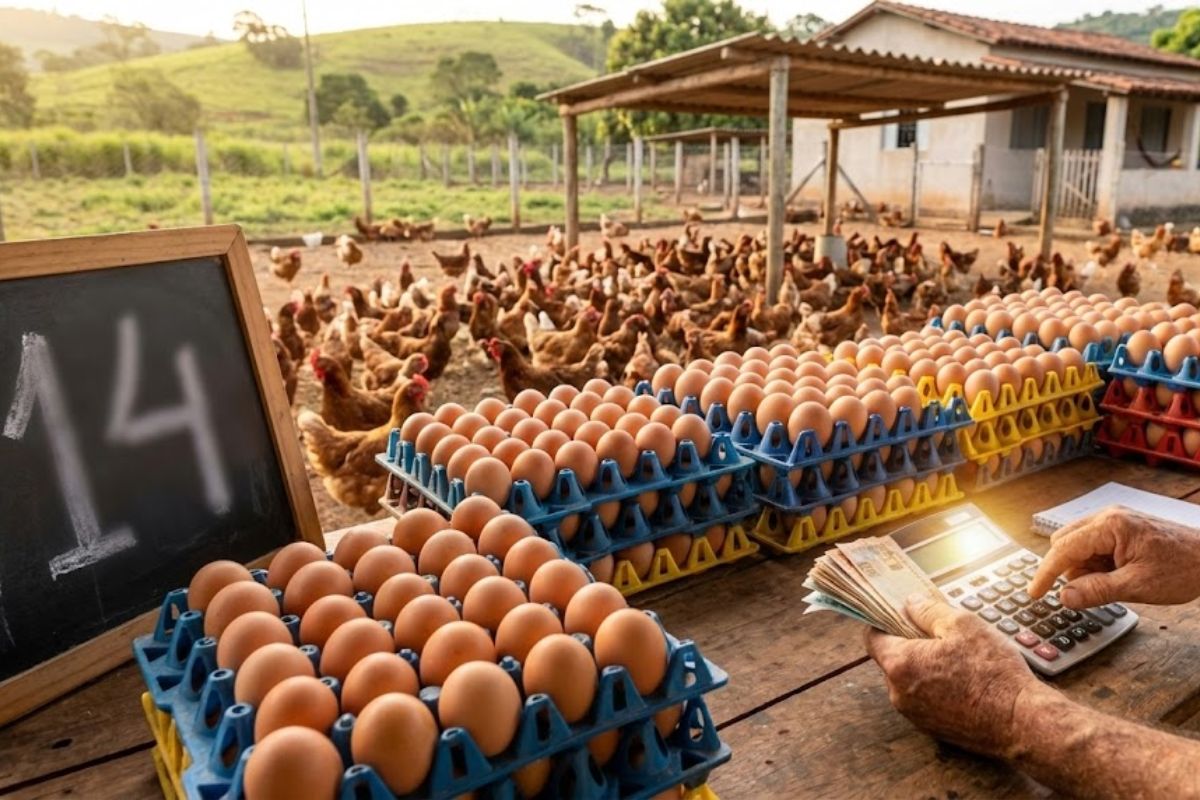


In a 300 m² farm, raising a thousand free-range chickens generates about R$ 4,000 monthly with eggs sold at R$ 14 a dozen, combining simple management, strict hygiene, a loyal end customer, and a structure designed for maximum value added in daily production and the organization of the warehouse.
Lost among hills and dirt roads, a small farm managed to transform a thousand free-range chickens into stable income of R$ 4,000 per month, occupying only a compact area of 300 m² with well-planned sheds, organized paddocks, and a disciplined management routine. No mega investments, no expensive machinery, just applied knowledge, high hygiene standards, and a focus on the end customer.
The story began with 70 birds, many mistakes, high mortality, and little profit. Then came another 100 chickens, new setbacks, and the decision that changed everything: to study free-range poultry farming in depth, adjust management, improve facilities, and treat the egg as a noble food. Today, the same farm that once “played” with breeding has professional structure, a thousand free-range chickens in production, and recurring sales of value-added free-range eggs, without relying on the market to buy cheaply.
How A Thousand Free-Range Chickens Were Distributed In 300 M²

The farm is about 24,000 m², but the financial heart of the property is concentrated in only 300 m² of structure for a thousand free-range chickens.
-
Russia cut fertilizers, China cut fertilizers, and oil prices soared with the war in the Middle East: sugarcane producers in the interior of São Paulo are seeing costs explode from all sides and warn that the effects will take months to be absorbed.

-
It does not come from flowers, is produced only every two years, and more than 90% goes straight to Europe: meet the bracatinga honeydew honey from Santa Catarina, considered one of the rarest in the world and overlooked by Brazil itself.
-
They said no to 26 million dollars and would do it all over again: mother and daughter from Kentucky reject a million-dollar offer from a mysterious company that wants to build the largest data center in the state on more than 2,000 acres of rural land.

-
While corn requires rain and is expensive, sorghum produces almost the same volume per hectare at a cost up to 80% lower and uses less water, and it is revolutionizing dairy farming in the Triângulo Mineiro, where producers save hundreds of reais per hectare.

There, two production hubs were set up, with a total of five sheds, all simple, functional, and sized for the comfort of the birds and quick management.
In the first hub were the initial three sheds, with about 300 birds altogether. They are smaller buildings, on uneven ground, making use of every available flat piece.
Ventilation, lighting, and the number of feeders and drinkers were adjusted over time, always prioritizing small batch size, low density, and healthy chickens instead of overcrowding.
In the second hub, now with more experience, the producer built two larger sheds, with high ceilings, no brick walls, and everything enclosed in mesh to ensure constant cross ventilation.
Here are 700 birds, completing the flock of a thousand free-range chickens.
The design was corrected based on past mistakes: nests positioned to avoid mess, perches kept away from walls, screens secured without gaps to prevent insect accumulation, and a structure prepared to receive gutters in the future to collect rainwater.
Shed Structure: Simplicity, Standard, and Focus on Hygiene
 ” class=”wp-image-303392″ sizes=”(max-width: 1095px) 100vw, 1095px” />
All the sheds follow the same logic: simple, repeatable, and easy to manage.
The producer works with a dry floor, good bedding, generous roof height, and an extended eave to protect the nests from rain.
In the newer sheds, there are no walls, just mesh, which reduces moisture, bad odors, and disease pressure.
Feeding is based on high-quality feed, prepared in small batches to keep it fresh.
In one of the hubs, automatic feeders programmed to dispense feed twice a day, at controlled times, avoid waste and obesity in the birds.
No miraculous additives or easy promises of increased production: the foundation is balanced feed, clean water, and management consistent with the birds’ age.
The water is always fresh, with controlled chlorination, nipple drinkers with a cup to reduce splash, and a water tank system separate from the house, dedicated only to the birds.
The producer works with batches of commercial strains adapted to the free-range system, distributing the thousand free-range chickens in intermediate groups, which facilitates management and prevents any problem from affecting the entire flock at once.
From Daily Management To Production: How Much A Thousand Free-Range Chickens Deliver


In practice, a thousand free-range chickens in five sheds allow for a light and predictable routine.
The morning management takes about a few minutes per shed, with quick feeding, water check, visual inspection of the birds, and ventilation adjustment.
The egg collection, done at multiple times during the day, reduces breakage, mess, and the time the egg stays in the nest.
In the older sheds, production averages around 115 to 120 eggs per day from a batch of about 140 birds at 50 weeks old, without forcing laying.
In another shed, with just over 120 birds and more than 60 weeks, the rate remains high, reflecting stable management, low stress, and a very clean environment.
In the new sheds, pullets start laying at about 19 weeks of age, and the production curve is built slowly, without rushing to “squeeze them” early on.
Adding up the five sheds, the producer’s goal is not simply to maximize the number of eggs per day but to maintain regular enough production to sustain income of about R$ 4,000 monthly in that block of 300 m², with a real possibility of being even higher once the entire flock of a thousand free-range chickens is at peak production.
The stated goal is clear: solid income, sustainable routine, and time for family, not just volume.
Simple Warehouse, Municipal Inspection Seal, and Professional Egg Flow
The turning point in customer value perception was the egg warehouse with a municipal inspection seal, set up efficiently while respecting all required sanitary flow.
There is a specific entrance, a changing area for clothes, boots, and aprons, a foot pedal-operated handwashing station, and a boot washer at the door.
The egg leaves the shed in buckets, undergoes a visual pre-selection, goes to a sorting table, enters the ovoscoping stage in a darkened environment, and then is weighed and classified.
Very dirty or cracked eggs never proceed to external sale; they are kept for family consumption.
The remainder is organized in trays, stored for a short time, and quickly converted into dozens for delivery or sale at fairs.
On the outside, a hatch ensures that the flow within the warehouse is unidirectional: the egg enters on one side and exits ready on the other, with no crossover of dirty and clean.
Everything is designed to minimize unnecessary handling, reduce the risk of contamination, and convey trust.
For the customer, this translates into something simple: they know where the egg comes from, how it is managed, and why it costs more than the generic product on the shelf.
Sales, Price, and The Mathematics of R$ 4,000 in 300 m²
The business model was designed to make a thousand free-range chickens generate income focused on value added, not gross volume.
The revenue base is in direct sales to the final consumer, with the producer delivering the eggs to houses and condominiums, always informing the origin, showing videos of the farm, and reinforcing the hygiene routine.
The price charged to the final customer is R$ 14 a dozen of free-range eggs, while at fairs and small local businesses, the price is a bit lower, but still rewarding.
With three smaller sheds totaling about 300 birds and an average performance exceeding a hundred eggs per day in each structure, the producer estimates a secure income of R$ 4,000 only from that first block of 300 m², being realistic when speaking with other small producers.
When the two larger sheds in the new hub have the entire flock of a thousand free-range chickens at peak laying, the revenue is expected to be well above this level, without the need to scale the structure indefinitely.
The secret, according to him, is simple: start small, test the market, maintain fair pricing, and never compete on the lowest price, but rather for customer trust and perceived quality.
Growth Strategy: Slow, Consistent, and With “Educated” Customers
The journey to reach a thousand free-range chickens was not a leap; it was a staircase.
The producer started with 70 birds, increased to 100, then to 300, and only then did he move on to a thousand.
Instead of building one large shed, he preferred medium-sized sheds that can be connected or disconnected according to the market and production moment.
If something goes wrong, he can reduce the scale without dismantling the entire business.
Another part of the strategy was to educate the customer before trying to sell volume.
At first, the first small eggs from pullets were donated to neighbors and acquaintances as a way of introduction.
Gradually, word of mouth took care of filling the order list, to the point where today eggs are frequently unavailable.
The message is clear: it is better to run out of product than to have leftover cheap eggs.
The producer also insists on a point that is often overlooked: do not lower prices to capture market.
If necessary, he prefers to donate some strategic dozens rather than sell very cheaply and devalue his own work.
In his view, those who buy a well-produced free-range egg understand that they are paying for the proper feeding of the birds, for the hygiene of the sheds, and for the care of the family that lives off that farm.
Lessons That A Small Farm Leaves For Other Producers
The case shows that well-managed thousand free-range chickens in 300 m² can sustain a firm income, provided there is cost control, high sanitary standards, and an entrepreneurial outlook on the egg business.
It is not a recipe for quick enrichment; it is a script for professionalization: study, adjust management, organize structure, obtain inspection seal, and build a loyal customer base.
Every detail of the routine reinforces the final result.
The way the producer cleans nests, positions perches, maintains paddocks, controls feed, chlorinates water, selects eggs, and organizes the warehouse explains why the eggs that come from there are worth more than an anonymous industrial farm egg.
The structure is simple, but the reasoning is industrial, with flow, standard, and repetition.
In the end, the farm proves that a profitable business does not require large areas or million-dollar investments.
It requires method, discipline, and the ability to turn a thousand free-range chickens into an organized, predictable, and trustworthy operation in the eyes of those who buy.
For you, looking at these numbers and this routine, what stands out most in the model of a thousand free-range chickens in 300 m²: the income, the simplicity of the structure, or the direct sales strategy to the final customer?







Não sei qual maior erro, mas são tantos, primeiro que para 1.000 (mil) aves caipiras precisaria: 145 m² de galpão e 500 m² de área de pastagem, então já errou ao indentificar como caipiras, IN exige, no sistema caipira no máximo 7 aves/m² no galpão e até 2 aves/m² de pastagem/Piquete. R$ 14,00 a dúzia? Onde tem esse preço, vendo a R$ 10,00 a bandeja com 15 ovos, rsrsrs…
O “mais certo”:
1.000 aves
Área total 645m²
Estimat. 85% de produção = 850 ovos/dia
Se tiver uma boa clientela vende +/- 0,80-a-1,00 o ovo, ou seja uns R$ 700,00 por dia…
Durante 30 dias terá R$ 2.100,00, aproximadamente… Considerando todos os fatores favoráveis. . .
Consumo 1.000 aves x 0,120g = 120kg/dia a R$ 2,50 = R$ 300,00
Ainda vem água, energia, medicação, mão de obra, mortalidade, transporte, impostos, e etc. . .
Errei no “700,00 X 30 = 21.000,00 reais mensais”
O conjunto da obra!
Reportagem bem grava . Onde 1000 galinhas com 120 ovos??? 4 galinha por metro quadrado. Merece e **** vocês ridículo.