





 Portuguese
  English
  Spanish
  6 min of reading
  0 comments



Monumental Underground Space Reveals How Ancient Constantinople Planned Its Water Supply on an Urban Scale, with Engineering Solutions Designed to Withstand Time, Climate, and Supply Crises, While Maintaining Strategic Reserves Hidden Beneath the Historic Center of Present-Day Istanbul.
Just a few meters below some of Istanbul’s most visited landmarks, one of the largest constructed spaces of ancient Constantinople remains out of sight for those circulating on the surface, integrated into the underground as an essential part of Byzantine urban infrastructure.
Situated in this context, the Basilica Cistern, known in Turkish as Yerebatan Sarnıcı, occupies a vast underground area of the historic center and was conceived not as a symbolic monument, but as a closed reservoir designed to ensure continuous supply on an urban scale.
By operating protected from heat, evaporation, and seasonal fluctuations, the cistern functioned as a strategic reserve, reducing the city’s vulnerability during periods of drought, aqueduct failures, or instabilities in external supply.
-
Friends have been building a small “town” for 30 years to grow old together, with compact houses, a common area, nature surrounding it, and a collective life project designed for friendship, coexistence, and simplicity.

-
This small town in Germany created its own currency 24 years ago, today it circulates millions per year, is accepted in over 300 stores, and the German government allowed all of this to happen under one condition.

-
Curitiba is shrinking and is expected to lose 97,000 residents by 2050, while inland cities in Paraná such as Sarandi, Araucária, and Toledo are experiencing accelerated growth that is changing the entire state’s map.

-
Tourists were poisoned on Everest in a million-dollar fraud scheme involving helicopters that diverted over $19 million and shocked international authorities.


Numbers That Define the Scale of the Cistern
The dimensions of the space impose themselves, above all, through the numbers and the geometric regularity adopted in its interior, elements that guide both visual reading and structural understanding of the ensemble.
Distributed in a rigorously aligned manner, 336 stone columns, each approximately 9 meters high, form continuous rows that create the sensation of an underground forest supporting the vaulted ceiling.
On top of these pillars, brick arches and vaults distribute the weight of the upper ground, creating a repetitive and efficient system designed to support large loads without requiring decorative solutions or formal differentiations between the modules.

The storage capacity associated with the reservoir is estimated at 80,000 m³, equivalent to about 80 million liters of water, a volume compatible with the needs of an ancient metropolis subject to climatic and logistical variations.
In a city situated on a peninsula with limited water resources, this volume helps explain why the cistern appears in historical sources as a central component of a supply network, rather than merely as an architectural curiosity preserved underground.
Construction in the 6th Century and Supply Strategy
The construction of the cistern is traditionally attributed to the reign of Emperor Justinian I in the 6th century, often dated to 532, a period marked by large public works aimed at consolidating the Byzantine capital.
At that moment, the expansion of closed reservoirs was part of a broader policy of water security, aimed at reducing risks associated with sieges, technical failures, or prolonged interruptions in water supply.
Records linked to the museum itself indicate that the structure served the imperial palace and neighboring buildings, integrating into systems of conduits that brought water from external regions to storage points within the city.
This role becomes clearer when observing how Constantinople organized its so-called “water economy,” based on a combination of transportation, distribution, and strategic retention in different types of reservoirs.
Instead of relying solely on a continuous flow, the city adopted a logic of redundancy, with both open and closed cisterns spread across key areas, fed by aqueducts and, in some cases, by direct rainwater collection.
Internal Dimensions and Space Organization

The most frequently cited dimensions for the main hall are approximately 138 meters long by 65 meters wide, forming a rectangle that occupies an area close to 9,800 m² beneath the current urban fabric.
Institutional materials from the museum also record the length as 140 meters, a small variation but recurring in guides and technical publications, generally associated with distinct measurement criteria or historical rounding.
Regardless of these differences, the scale of the space remains evident, as the ensemble corresponds, in terms of area, to a subterranean block entirely dedicated to water storage.
The perception of the environment changes depending on contemporary lighting, but the original structural logic remains independent of scenic effects or visual devices designed for visitation.
Without windows or upper openings, the interior is constructed in dim light, with points of illumination that highlight the alignment of the pillars and the reflection of the water surface, reinforcing the feeling of continuous depth.
The aspect often compared to a “cathedral” results from the repetition, rhythm, and precise calculation of loads, not from any religious or ornamental intention present in the original design.
Reuse of Materials and Sealing Techniques
One of the most evident characteristics of the ensemble is the reuse of materials, a common practice in late Roman and Byzantine structures, especially in large infrastructure projects.
Part of the columns and capitals was not produced as a homogeneous batch, something perceptible in the variety of styles, finishes, and proportions observed along the rows.
The effect is a visually uniform space from a distance, but marked by differences in details, as if elements from different periods had been reorganized to fulfill an essentially technical function.
In addition to support, the prolonged functioning of the cistern depended on less visible solutions related to sealing and moisture control inside the reservoir.
Historical descriptions and technical surveys point to the use of hydraulic mortar, applied to reduce leaks and limit the pressure of water on walls and flooring over time.

In structures of this scale, ensuring watertightness was as decisive as ensuring stability, since failures in this aspect would compromise continuous use and accelerate deterioration processes.
The Medusa Heads and the Rediscovery of the Space
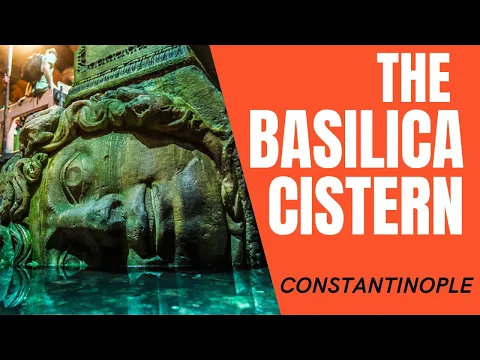
Among the most well-known elements inside are two column bases sculpted with Medusa heads, positioned in an unusual manner and frequently highlighted in photographic records.
One of these sculptures is placed sideways, while the other was installed upside down, a solution that draws attention due to the break of symmetry in a space marked by rigorous repetition.
Documents about the reopening of the site to the public associate the identification of these pieces with the cleaning and restoration works carried out by the Metropolitan Municipality of Istanbul between 1985 and 1987.
During this process, tons of sediments accumulated over centuries were removed from the bottom of the cistern, allowing for a clearer reading of elements previously submerged or partially hidden.
Although tourist materials often attribute symbolic meanings to the Medusas, what is more reliably documented is the logic of reusing sculpted blocks from other constructions.
These elements were incorporated as functional bases for columns, without requiring aesthetic coherence with the rest of the architectural ensemble.
Recent Restorations and Seismic Risk
With the transformation of the cistern into a visitation space, conservation policies began to coexist with a permanent structural challenge of the region: the seismic activity affecting Istanbul and its surroundings.
Between 2020 and 2022, a major restoration replaced deteriorated components and introduced metal reinforcements aimed at improving the structural behavior of the ensemble in the event of tremors.

In addition to technical interventions, the project included adjustments to internal circulation and the lighting system, adapting the space to contemporary safety and accessibility requirements.
A report from The Washington Post included the Basilica Cistern in the debate about the protection of historical constructions in the face of the risk of major earthquakes, highlighting measures taken during the recent cycle of works.
The text mentions lowering the water level to relieve structural loads, removing materials added in previous interventions, and installing a system with 630 structural supports.
Even with these actions, experts consulted by the report point out limits to the degree of protection possible for a monument designed almost fifteen centuries ago.
Invisible Infrastructure Beneath the City
Despite its current status as a museum, the cistern preserves the logic of an engineering project designed to operate for long periods without drawing attention, functioning as a strategic reserve during moments of instability.
As visitors descend the stairs and walk among the columns, they find a subterranean water bank, an example of how the underground was utilized as a practical solution to ensure urban survival.
In a city formed by successive layers of occupation, the Basilica Cistern highlights that a fundamental part of history is not in facades, but in the invisible structures planned to support everyday life.
If an ancient metropolis was able to maintain its supply with systems of this scale hidden beneath streets and squares, how many other essential infrastructures remain buried beneath historic centers around the world, practically invisible to those who pass over them every day?









-

-

-

-

-

15 pessoas reagiram a isso.