





 Portuguese
  English
  Spanish
 5 min of reading
  0 comments


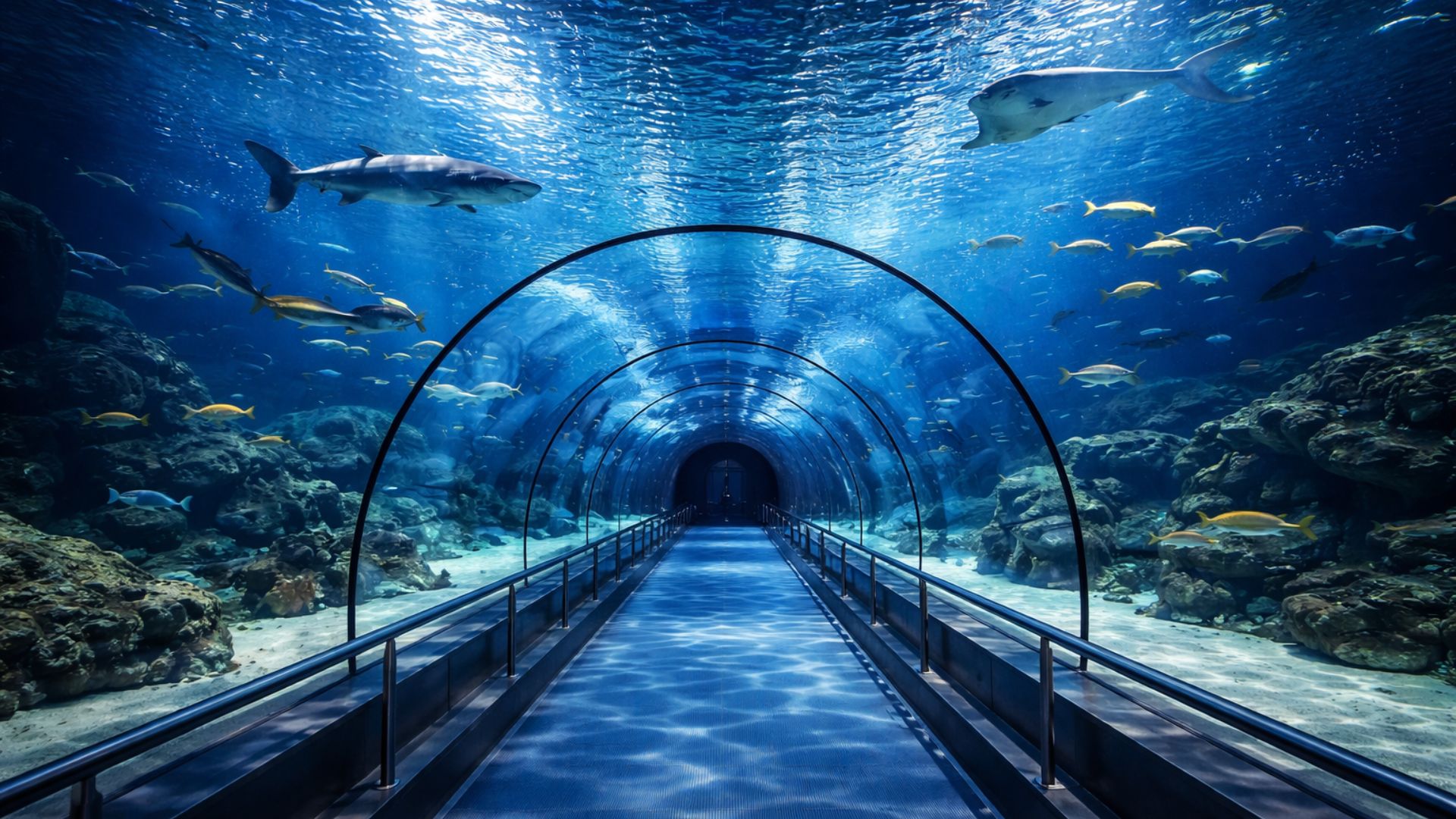
Mega Aquarium in Rio Gathers Millions of Liters of Water and Thousands of Animals in Giant Tanks, Creating the Sensation of Crossing an Ocean Inside a Building. Structure Combines Public Visitation, Education, and Conservation, with a Submerged Tunnel in the Main Tank and Enclosures That Simulate Different Marine Environments.
In the heart of the port area of Rio de Janeiro, a building houses a volume of water capable of transforming a visit into a sensation hard to associate with an urban environment.
The public walks through enclosed enclosures and, still, has before their eyes a “sea” contained by structures, glass, and controls that keep thousands of animals submerged in a permanent circuit.
AquaRio, the name by which the Marine Aquarium of Rio de Janeiro has become known, gathers numbers that help to gauge this contrast between city and ocean: 26 thousand square meters of built area and 4.5 million liters of water in operation, in a space presented as the largest marine aquarium in South America by volume of water.
-
Spain surprises the world by erecting 62 artificial dunes, mixing sand with natural remains of posidonia, and causing the structure to lose only 1.4% of its volume in 1 year.

-
With 16 Bulava missiles, improvements in acoustic stealth, and a design focused on silent patrols, Russia’s nuclear submarine was born to ensure Moscow’s invisible retaliation and has become one of the pillars of its maritime strength.

-
‘Populous’ city in Rio among the worst in Brazil in national ranking and exposes silent development crisis.

-
Couple buys house in the South Zone of São Paulo, opens a hidden door in the garage, and finds a secret wine cellar with dozens of old wines forgotten since the 1970s.


Visitation, Education, and Living Collection on Display
The proposal of the enterprise is to offer public visitation and, at the same time, bring together functions of education, research, conservation, leisure, and culture, combining circulation areas with enclosures that simulate different marine environments.

In institutional information, AquaRio describes the living collection on display as composed of more than 10 thousand animals, spread across 350 species, gathered in tanks and enclosures prepared to accommodate everything from schools of fish to emblematic species associated with the imagery of the “deep sea”.
Oceanic Enclosure, “Tancão,” and the Submerged Tunnel
The effect of grandeur depends not only on the total number of liters but on how this volume has been organized to create points of visual immersion.
The main one is the central tank called Oceanic Enclosure, nicknamed “Tancão,” which contains 3.5 million liters of water and integrates a tunnel that runs through its structure.
The sensation this pathway produces is that of being swallowed by the scene: the visitor walks through the tank, with fish and other animals circulating above and around, while the glass and support systems sustain the pressure and stability of an environment that needs to remain controlled throughout the day.
The same institutional presentation informs that, besides the central tank, there are 27 secondary tanks and specific areas, forming a set that increases the diversity of habitats presented to the public.
This distribution is not merely aesthetic; in structures of this size, the separation into multiple enclosures allows for organizing species, environmental conditions, and management routines, in addition to creating a visitation circuit with different scales, from the monumental tank to the smaller environments where behavior and anatomical details appear more clearly.
Behind the Scenes and Continuous Operation of a Marine Aquarium


The size of AquaRio often draws attention also for being a visitation equipment installed in an urban area, where the built space needs to reconcile the flow of people, safety, and technical requirements that do not appear to those passing by from the outside.
A marine aquarium of this scale is not just a set of display cases; it involves continuous operations to maintain water in suitable parameters, ensure animal welfare, and allow public observation in environments with planned lighting, temperature, and circulation.
In practice, it is an infrastructure that needs to function as a system: water, equipment, enclosures, staff, and routines operate in an integrated manner so that the visitor sees tranquility where, behind the scenes, there is a sequence of controls.
“Ocean in a Building” and the Visual Impact of the Structure
Part of the international fascination associated with attractions of this type comes precisely from the visual “paradox”: instead of the public going to the sea, it is the sea that seems to have been displaced inside a building.
What is seen is a encapsulated ocean, with density of life and breadth of scene, but without waves and without horizon, replaced by walls and glass that delineate where the water ends.
For those arriving without context about the project, the first impression is usually guided by scale and proximity: animals that, in their natural environment, would require a boat and diving appear just a few centimeters from the observer.
Another point highlighted in the institutional communication is the private nature of the enterprise, described as a modern and multifunctional facility, with technologies considered rarely seen in Brazil.

This type of statement usually relies on the very complexity of maintaining enclosures with large volumes and high biological diversity in a space open to visitation, where the operation needs to be stable even with variations in public and routine.
The combination of entertainment with environmental education appears as a central axis, with the proposal of bringing marine life closer to those who do not have direct access to the coast or to observation experiences in the ocean.
Conservation, Management, and Brazilian Species in the Spotlight
In institutional content, AquaRio also associates the presence of Brazilian species with conservation initiatives and projects related to captive management, citing the example of seahorses from the national coastline as part of this context.
By bringing this type of reference, the institution seeks to reinforce a recurring point in modern aquariums: in addition to being spaces for visitation, they are presented as environments that can support research, education, and conservation actions, provided they operate with appropriate protocols and structures for animal welfare.
City, Infrastructure, and Proximity to the Ocean Floor
In Brazil, where large infrastructure works are often associated with energy, transport, or mining, a marine aquarium of this size shifts the gaze to another type of large structure: one that tries to reproduce, in a controlled environment, conditions that in nature depend on kilometers of ocean.
By placing the visitor so close to marine animals and environments, the attraction explores a universal curiosity about scale, depth, and submerged life, with a feature that has become the signature of the place: the large central tank, where the mass of water and the movement of animals give the impression that the city has been left outside.
If an “ocean in a building” already impresses by the numbers, what more could be built to bring the public closer to extreme natural environments without leaving an urban area?







-

-

2 pessoas reagiram a isso.