





 Portuguese
  English
  Spanish
  5 min of reading
  0 comments


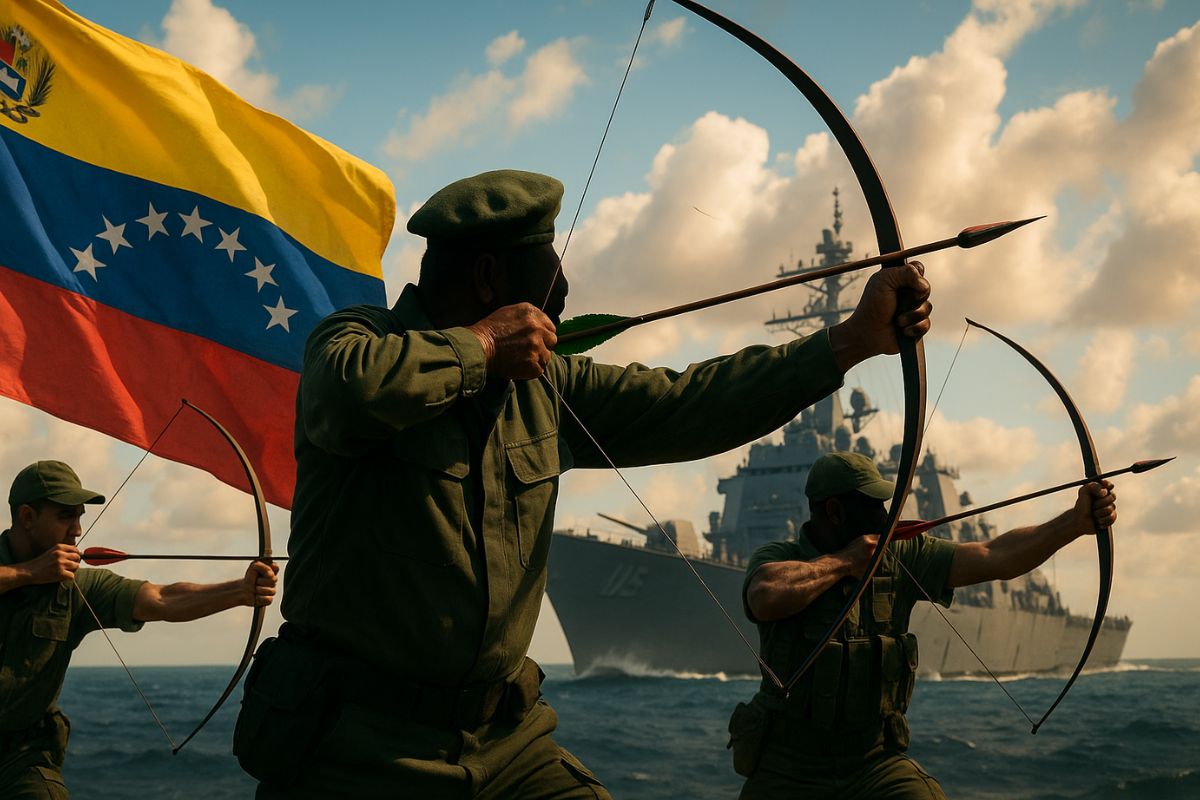
With Brigades of 4.5 Million Activists and Training with Poison Arrows Given by Indigenous People, the Regime of Nicolás Maduro Bets on an Image of Extreme Popular Resistance in Venezuela, Using the Threat of American Invasion to Mobilize the Chavista Base and Test the Limits of Military Rhetoric.
The Chavista leadership has placed poison arrows at the center of a new narrative of radical resistance in Venezuela. Amidst declarations of “extreme” threats from the United States, Nicolás Maduro’s regime announced the mobilization of millions of pro-government militants and training offered by indigenous groups for the use of silent weapons, in a staging that mixes ancestral symbolism, political propaganda, and preparation for a conflict scenario that, in practice, is unlikely.
Under the command of Diosdado Cabello, the number two of Chavismo, the official message tries to present the country as a besieged fortress, but organized into popular brigades ready to react. The discourse combines patriotic appeals, the mobilization of 4.5 million activists, and the public display of poison arrows in Maduro’s hands as proof that the government is willing to go to great lengths in the event of a military aggression.
Chavista Brigades and the Construction of the External Threat
In his weekly program, Diosdado Cabello outlined the main lines of the regime’s response to the supposed “extreme external threat” coming from the US.
-
China has deployed more than 1,400 fishing boats in formation, creating a barrier of 320 kilometers at sea, and the whole world wants to know if this is fishing, a military exercise, or a message of war.
-
Spain surprises the world by erecting 62 artificial dunes, mixing sand with natural remains of posidonia, and causing the structure to lose only 1.4% of its volume in 1 year.

-
With 16 Bulava missiles, improvements in acoustic stealth, and a design focused on silent patrols, Russia’s nuclear submarine was born to ensure Moscow’s invisible retaliation and has become one of the pillars of its maritime strength.

-
‘Populous’ city in Rio among the worst in Brazil in national ranking and exposes silent development crisis.

He called for “steady feet, nerves of steel, maximum mobilization, calm, and composure” from the militants, reinforcing that the order is for active resistance.
Cabello highlighted the mobilization of 4,523,822 activists over the age of 15, organized into Integral Bolivarian Committees.
The precise count and the high number serve a clear role in propaganda: to show that behind the poison arrows, there is an organized mass ready to act in defense of Chavismo.
In the discourse, the external enemy is activated as an emotional and political trigger. Even without directly mentioning Donald Trump, the regime relies on the American military presence in the Caribbean, including the USS Gerald Ford aircraft carrier, to justify a permanent vigilance and actions of “popular defense.”
Indigenous People Train Militants in the Use of Poison Arrows
Among the most controversial measures announced is the training of Chavista militants by indigenous brigades in the use of poison arrows. Cabello revived an ancestral custom of Amazonian peoples and stated that the militants will learn to use silent weapons in the event of conflict.
According to reports, the arrows are fitted with curare, a paralyzing poison derived from plant extracts, historically associated with indigenous hunting and warfare.
The idea of placing poison arrows in the hands of urban and rural militants is not limited to the tactical dimension, but functions as a symbol of “grassroot” resistance, radical, inspired by indigenous traditions to oppose foreign powers.
Cabello even stated that “they will discover what curare is,” in reference to the supposed external aggressors, reinforcing the threat with a warning tone.
Although the scene has a strong choreographic and rhetorical component, it helps fuel the image of a people armed not only with rifles but also with handcrafted weapons loaded with historical significance.
Poison Arrows as a Piece of Propaganda and Staged Resistance
The use of poison arrows is not just an exotic military option but a central element of a political theater of resistance.
In recent demonstrations, Maduro appeared holding arrows in public during events related to Indigenous Resistance Day, projecting an image of a leader connected to the country’s ancestral roots.
The narrative builds the idea that, in the event of an invasion, the Venezuelan people would resort to everything within their reach, including indigenous combat techniques.
In practice, more than a realistic defense plan against modern armed forces, the gesture seeks to reinforce the idea of a popular resistance willing to face any enemy, with any weapon, on any ground.
This symbolic choreography interacts with other elements of Chavista propaganda, such as the character “Super Bigode,” a superhero modeled after Maduro, who reappears in official mobilizations to represent an apparently unbeatable leader against external villains.
Special Powers, Vigils, and Popular Military-Police Fusion
While displaying poison arrows and impassioned speeches, the regime is also laying the institutional groundwork for a broader response. There is talk of the possibility of Maduro assuming “special powers” in the event of an American attack, in line with the history of states of exception and extraordinary measures adopted by governments under internal and external pressure.
The president has called for a permanent vigil of Chavista militants in six regions of the eastern part of the country, describing the initiative as a “perfect popular military-police fusion” to resist threats.
Raising Venezuelan flags, street acts, and speeches in a pacifist tone, in English, with references to “Imagine” by John Lennon, compose a scenario where peace and war are evoked simultaneously. The contrast between singing for peace and wielding poison arrows reinforces the ambiguity of a strategy that relies on both diplomacy and symbolic intimidation.
Hardline in the US and the Political Use of Confrontation by Chavismo
On the other side, the hardline of the American government, allied with Maduro’s opponents, fuels scenarios of attacks on Venezuelan targets and even regime change.
The alternative of a ground invasion is seen as unlikely and politically explosive, but the mere existence of this scenario serves Chavismo as a tool for internal cohesion.
The Venezuelan leadership works this risk into the imagination of its militants to keep the base mobilized. The rhetoric of defense, the figure of “Super Bigode,” the vigils, and the poison arrows trained by indigenous people are part of the same set of signals, designed to tell the world and the internal public that the regime would not back down in the face of aggression.
Ultimately, this combination of ancestral weapons, televised discourse, and street acts helps sustain the narrative that Chavismo continues to be a project under siege, surrounded by external enemies and legitimized by a supposed radical popular resistance.
Do you think that the use of poison arrows and indigenous symbols in this strategy is more a real sign of preparation for conflict or mainly serves as propaganda to keep the Chavista base mobilized in Venezuela?






-

-

5 pessoas reagiram a isso.