





 Portuguese
  English
  Spanish
  7 min of reading
  46 comments


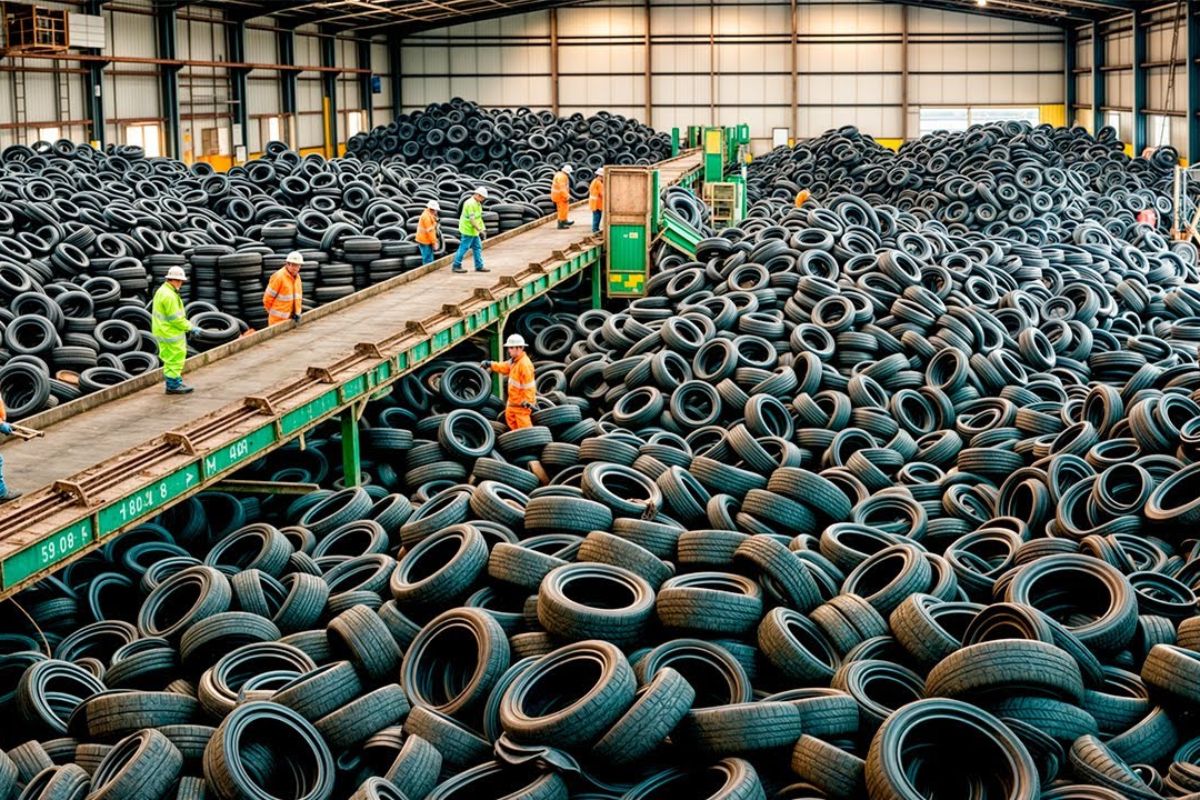


With Giant Machines And A Brutal Shredding Process, Nigeria’s Largest Recycling Operation Transforms Hundreds Of Thousands Of Tires Daily Into Rubber Flooring For Playgrounds And Sidewalks, Showing How The Country’s Largest Recycling Operation Can Tackle Urban Waste And Environmental Risk At The Same Time.
In Lagos, Nigeria’s largest metropolis, mountains of old tires stop crowding landfills and roadside workshops to feed the production line of Free Recycle, the company that now runs the country’s largest tire recycling operation. Each day, up to 500,000 tires can be directed to an industrial process that removes steel wires, grinds the rubber into precise granules, and returns the material to the city in the form of durable and stable flooring.
At the same time, this industrial machine operates in a context of global environmental pressure: nearly 1 billion tires are discarded each year worldwide, and the technical difficulty of recycling a material designed to be extremely durable means many end up burned, piled in landfills, or abandoned in open areas. In this scenario, a structure capable of functioning as Nigeria’s largest recycling operation gains strategic weight in discussions about waste, public health, and urban infrastructure.
From Tire Waste To Nigeria’s Largest Recycling Operation

Free Recycle was founded in 2018 with a vision deemed risky: to transform abandoned tires into a value-added product in a country ranked among the bottom 10% globally in sustainability and recycling.
-
Drought may be creating stronger superbugs in the soil and helping antibiotic resistance reach hospitals, warns a study highlighting a problem that could grow alongside extreme weather.

-
The biggest scam in history: Napoleon’s France deceived the United States by selling them a territory that was Spanish.

-
Why is the Danakil Desert so dangerous? It has unstable terrain and how extreme temperatures and toxic gases turn the region into one of the most hostile environments on Earth.

-
With a height of 221 meters and a capacity for trillions of liters, Hoover Dam still holds a trick that makes water defy logic.

When Ifedolapo Runsewe began to assemble the company, the idea of using piles of tires as the basis for an industrial business seemed like madness to many.
Today, the plant employs over 100 people and operates on a 2.5-acre lot, concentrating Nigeria’s largest tire recycling operation at a single address.
In the factory yard, more than 1 million tires remain stacked, waiting their turn on the production line.
Still, this stock represents only a fraction of a much broader problem: in developing countries like Nigeria, the flow of discarded tires is constantly increasing, fueled by fleet expansion and a historic lack of recycling infrastructure.
It is this mismatch between waste volume and treatment capacity that the country’s largest recycling operation seeks to reduce, tire by tire.
Collection, Payment, And Logistics Of 500,000 Tires Per Day

The supply chain starts far from the factory, in roadside workshops like Samuel’s, which serves drivers in Lagos and the surrounding area.
Tires that can no longer be repaired, instead of going straight to irregular disposal, become currency.
For every tire Samuel delivers to the company, he receives about 30 cents, a figure that is repeated for other shop owners and small collectors spread throughout the city.
This payment model creates an economic incentive for waste to reach Nigeria’s largest recycling operation instead of accumulating on vacant lots, rivers, or highway margins.
By concentrating sorting and processing at a single industrial hub, Free Recycle can coordinate the daily flow of trucks, organize storage, and scale how many loads enter the shredding line each day.
Every tire that enters the factory represents one less potential source of waste, toxic smoke, or standing water in the city.
How The Tire Becomes A Brick: A Brutal And Precise Process

Inside the plant, the country’s largest recycling operation translates into a sequence of heavy machines and continuous steps.
The first mission is to remove the steel wires embedded in the rubber. For this, the company invested in a piece of equipment internally known as The Bedder, capable of removing the beads in about 20 seconds per tire.
Only after this stage does the material proceed to the main shredder.
In the shredder, tires are torn into large pieces, divided into four or five parts to facilitate handling.
Under normal conditions, about 150 car tires are processed per hour in certain sections of the line, revealing the effort necessary to sustain the largest local recycling operation.
The pieces then go to drums where they are ground again until they become rubber fragments no larger than 5 millimeters.
Workers sweep the remnants onto vibrating screens that separate the granules by size, while large vacuums remove rubber dust from the air.
Remaining metal fragments are captured by magnets, and reinforcing fibers made of nylon, plastic, or other synthetic materials are also extracted.
At the end of this sequence, only clean rubber remains, ready to take on the role of raw material in a coating industry.
From Colored Granules To Flooring For Playgrounds And Sidewalks
In the next stage, the focus of Nigeria’s largest recycling operation shifts from separation to transformation.
The granules between 3 and 5 millimeters, suitable for paving, are directed to large heated mixers.
There, a polyurethane binder is added to unite the rubber particles and give structure to the future bricks.
The adjustment of the ratio between rubber, binder, and pigments required extensive experimentation.
The tropical savanna climate of Nigeria does not allow for simply copying ready-made formulas from other countries, as temperature and humidity affect the curing of the material and the final performance of the flooring.
The solution found combines heated mixing, specific dosing of dyes, and a two-layer molding process: a top colored film, followed by a body of uncolored rubber, which reduces costs without compromising strength.
After being manually pressed and placed in trays, the bricks go to an oven, where they remain for about 8 hours.
The result is rubber pavers in the shape of dog bones.
From each tire, approximately 25 bricks are produced, and in a single day, production nearly reaches the volume needed to cover an entire tennis court.
Energy, Unstable Infrastructure, And Cost Per Recycled Tire
Operating Nigeria’s largest tire recycling operation in an unstable infrastructure environment requires redundancy.
The electricity supply in the country is irregular, leading the company to produce about 80% of the electricity it consumes with diesel generators.
This necessity raises operational costs but ensures that the shredding line and curing of the bricks do not stop.
Even with this barrier, the company receives only about 16 cents per recycled tire, an amount that needs to cover investments in machines, fuel, labor, and maintenance.
The combination of narrow revenue with high costs reinforces the challenging nature of keeping the largest recycling operation continuously running, especially in a market where tires are still often viewed merely as waste rather than as input.
From Malaria To Playgrounds: Direct Urban Impact In Lagos
Before reaching the largest recycling operation, many tires were scattered in makeshift landfills or abandoned lots.
In a humid climate, these piles function as reservoirs of standing water, creating ideal environments for the reproduction of malaria-transmitting mosquitoes.
An abandoned tire is not just visual waste; it is also a health risk.
By converting tires into flooring for playgrounds, sports courts, and residential areas, Free Recycle not only reduces waste volume but also returns the material to the city in the form of infrastructure.
In Lagos, international schools are already using the company’s rubber pavers in recreation areas.
The thick, elastic surface absorbs impacts, facilitates repairs, and allows for targeted replacements when new structures are installed.
In practice, the same rubber matrix that previously collected water and attracted mosquitoes now cushions falls and organizes urban spaces, reinforcing the role of Nigeria’s largest recycling operation as a tool for public health and improvement of the school environment.
A Billion-Dollar Global Market And Nigeria’s Role
Globally, tire recycling drives an estimated $12 billion market.
A significant portion of these tires is burned for energy generation in paper mills and cement kilns, especially in Europe, Japan, and the Americas, where about one-third of discarded tires are used as fuel.
Another third is recycled into rubber coatings, artificial grass, and other products, while a smaller fraction ends up in landfills.
At the end of the 20th century, over 1 billion old tires were accumulating in the United States alone, a number that only began to drop after the implementation of specific recycling incentive legislation, reducing the stored stock to about 50 million by 2021.
This history shows that transforming tires into products requires regulation, investment, and industrial capacity, exactly the points where initiatives like Nigeria’s largest recycling operation are trying to advance.
In a country that still ranks low in recycling listings, Free Recycle’s declared ambition is to close all tire landfills in Nigeria.
In practice, the flow of waste continues to grow faster than installed capacity, but each new line, each new batch of pavers, and each workshop that begins selling old tires to the company expands the reach of this transformation.
By observing the journey of tires, from informal workshops and makeshift landfills to colorful playground flooring, it becomes clear the potential to scale such models in other urban centers.
And you, if you could choose, would you place this type of flooring made from the largest recycling operation in schools, parks, and sidewalks in your city?









Matéria importantíssima nos tempos atuais,em que se discute a polêmica situação do clima no mundo! Parabéns aos empresários c/está iniciativa,saindo da teoria e desenvolvendo a prática!!
Parabéns IRMÃOS NIGERIANOS, Para mim aqui no Brasil 🇧🇷, É uma novidade muito importante 👏🏼👏🏼👏🏼 !
Quando vai ter no Brasil
Quando algum empresário visionário ver que pode fazer com lixo..