





 Portuguese
  English
  Spanish
  6 min of reading
  0 comments


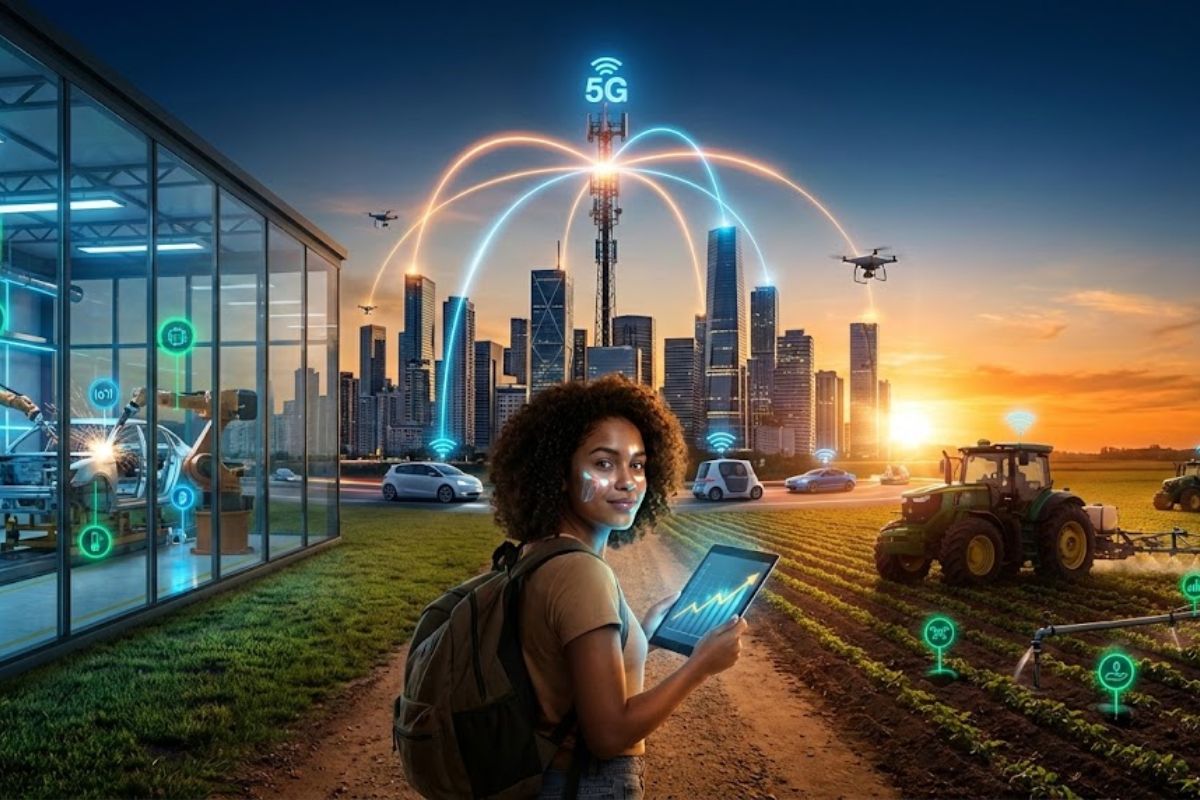
With advanced 5G and companies competing for few specialists, the career in IoT integrates hardware, software, and cloud, connects factories, cities, and farms, and already pays high salaries, with projections of earnings above the technology average for professionals with multidisciplinary education and mastery of digital security by 2030 in Brazil.
If you are thinking of changing your life and filling your resume with technology, the career in IoT is already one of the most sought after in the market. While many people are still stuck in basic IT, engineers and specialists in the Internet of Things are starting to receive salaries between R$ 12,000 and R$ 18,000, with projections that could exceed R$ 35,000 by 2030, as responsibility and seniority increase.
In a scenario dominated by 5G, this career in IoT is responsible for connecting refrigerators, tractors, traffic lights, industrial machines, and sensors in the field in the same smart network. Behind the idea of “connected things” is a rare professional who understands hardware, software, cloud, and security at the same time. It is precisely this mix of skills that explains the talent shortage and the skyrocketing salaries for those who master the field.
Why The Career In IoT Became The Darling Of 5G
The revolution of connected things is no longer fiction. With advanced 5G, everything can be online at the same time, from a pacemaker to a giant harvester in the middle of the farm.
-
Brazilian city bets on the business environment to generate jobs and attract investments in the energy sector — secretary reveals strategy at Macaé Energy 2026.

-
50 viaducts, 4 tunnels, 28 bridges, and 40 kilometers of bike paths: BR-262 in Espírito Santo will receive 8.6 billion reais for the largest engineering project in the state’s history, inspired by the Immigrant Highway in São Paulo.

-
Brazil produces too much clean energy and doesn’t know what to do with it: over 20% of solar and wind capacity was wasted in 2025 while investors flee and 509 renewable generation projects were abandoned in the last year.

-
Piauí will produce a new fuel that replaces diesel without needing to change anything in the truck’s engine and reduces pollutant gas emissions by half: truck drivers from all over the Northeast are already celebrating the news that will arrive later this decade.


The career in IoT was born precisely to design, build, and maintain this invisible infrastructure that constantly exchanges data between machines and cloud systems.
The IoT Engineer is the hybrid professional who builds the bridge between the physical and digital worlds. He designs systems where sensors spread across machines, vehicles, or appliances collect data, send it to the cloud, and receive commands back.
In a modern factory, for example, this career in IoT programs robots and industrial equipment to warn before breaking down, preventing unexpected shutdowns and million-dollar losses.
Meanwhile, companies of all sizes have realized that they can no longer compete without automation and real-time data.
The result is simple: the demand for professionals in the IoT career is growing much faster than the formation of specialists, leaving the market with excess job openings and a lack of qualified people.
How Much Does Someone Who Bets On The IoT Career Earn Today
The numbers show why so many people have placed this career on their radar. In senior positions, the IoT career already pays between R$ 12,000 and R$ 18,000 for IoT Engineers, depending on the size of the company and the complexity of the projects.
But projections indicate that this remuneration should double by 2030, reaching an estimated range of R$ 24,000 to R$ 35,000 for those at the top.
Other positions related to the IoT career also follow this curve. The Connected Solutions Architect currently appears with average salaries between R$ 15,000 and R$ 22,000, with projections between R$ 30,000 and R$ 45,000 by 2030.
The IoT Security Specialist currently falls in the range of R$ 14,000 to R$ 20,000, with projections that can reach R$ 28,000 to R$ 40,000 in the same period.
At the same time, traditional industrial companies have started to compete for these talents with big techs and software companies, which only increases the pressure for more aggressive salaries. The IoT career has an important detail: it is not enough to know programming.
You need to understand electronics, connectivity, and security, which further reduces the number of candidates ready to take on critical projects.
Mandatory Skills To Grow In The IoT Career
Entering this area is not just about taking a quick course and putting “IoT” on LinkedIn. The IoT career requires a curious, technical, and multidisciplinary profile, moving away from the idea of a professional who only masters one specific box.
In practice, those who want to pursue this IoT career need to:
- Program in low-level languages, such as C++ or Python, to get the most performance out of small devices with limited resources.
- Understand wireless network protocols to ensure that sensors can communicate with the cloud without disconnecting frequently.
- Have solid knowledge of electronics, boards, and sensors, since the entire lifespan of the solution depends on how the hardware is assembled.
- Master information security applied to physical devices, because hacking a computer is serious, but hacking an autonomous car or an insulin pump can be fatal.
This sum of skills makes the career in IoT one of the most sensitive in the market. The responsibility for the physical integrity of people helps to justify high salaries and greater selectivity in hiring, as small flaws can have real consequences in the physical world.
Where The Jobs Are: Factories, Cities, And Connected Farms
If you imagine that the career in IoT only exists in offices in major capitals, it’s time to update that vision.
One of the biggest drivers of this field today is the Brazilian agribusiness, known as Agrotech, which uses sensors in the soil, machines, and drones to monitor crops, water, and fertilizers. Those who accept to take the IoT career to the field find a true ocean of opportunities.
At the same time, Smart Cities are beginning to take shape. City halls and utility companies need specialists to manage connected traffic lights, autonomous public lighting, and real-time urban monitoring.
All of this involves the IoT career, which designs how data will be collected, sent, and transformed into action.
In the industry, the so-called Industry 4.0 connects entire production lines, robots, conveyor belts, and vibration or temperature sensors.
Traditional companies in the electrical, automotive, and consumer goods sectors are already competing for IoT career professionals to keep machines operating with fewer failures, less waste, and more predictability. The competition is fierce, and the number of ready professionals is still small.
How To Prepare For 2030 And Not Miss The Wave Of The IoT Career
The classical basis of this journey typically involves degrees in Electrical Engineering, Mechatronics, or Computer Science, which provide the necessary technical foundation.
However, the IoT career does not stop at the diploma. Those who want to stay in the game until 2030 need to continue studying in areas such as embedded systems and real-time data analysis, keeping up with the evolution of chips and communication networks.
Day-to-day, an important differentiator is mastering cloud platforms geared towards IoT, such as Azure IoT or AWS IoT, moving beyond theoretical discourse and showing that you can make devices, data, and dashboards work for real.
The market wants those who solve connectivity problems now, not just those who understand the concept in the classroom.
Connecting the physical world to the digital world tends to be one of the most lucrative missions of the next decade for those who truly invest in this IoT career.
With salaries reaching R$ 18,000, projections that exceed R$ 35,000 and job openings emerging in factories, cities, and farms, the IoT career is open for those who are willing to study hard and join the team of a few specialists.
Looking at your current moment, do you see yourself prepared to enter this career in IoT or do you still need to take the first serious step toward this connected future?









-

Uma pessoa reagiu a isso.