





 Portuguese
  English
  Spanish
  5 min of reading
  1 comment


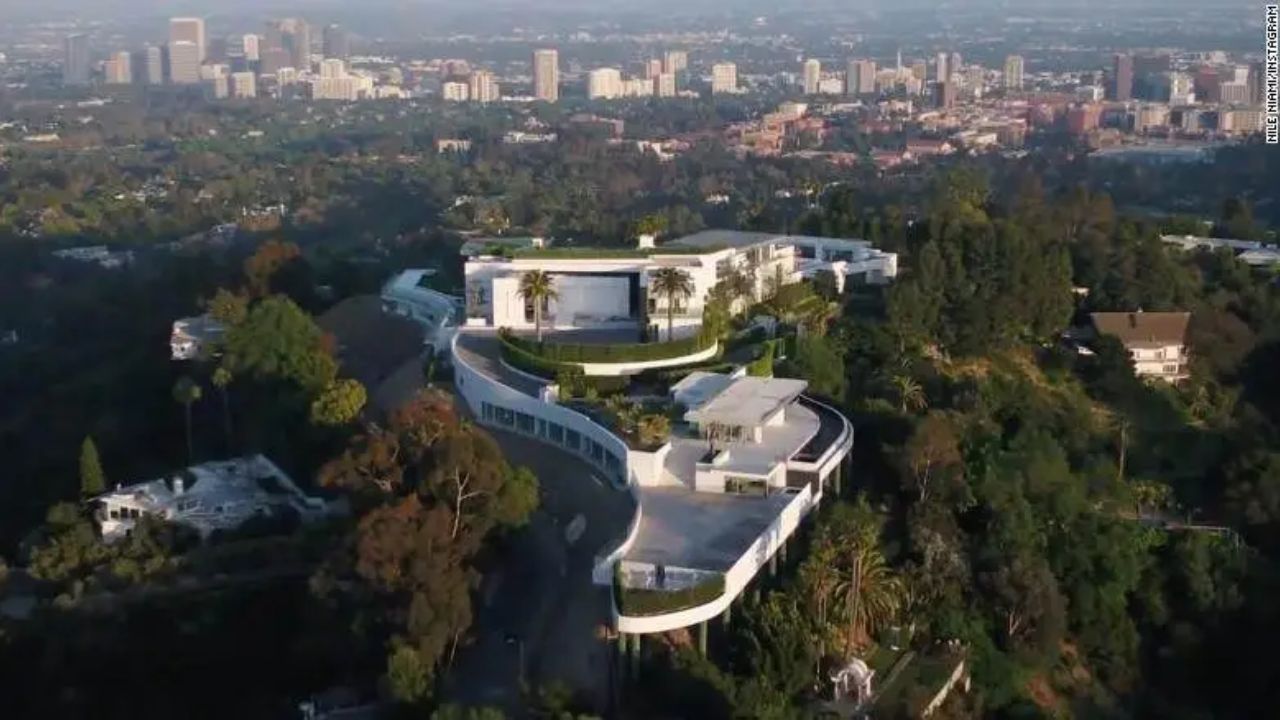


Valued At Half A Billion Dollars, The Sumptuous 9,700 M2 Property Was Auctioned For A Fraction Of The Value After A Waterfall Of Debts, Legal Issues, And An Unfinished State.
The Bel Air megamansion known as “The One”, a colossal 9,700 m2 property (almost double that of the White House), was designed to redefine ultra-luxury with a speculative price tag of US$ 500 million, as reported by Forbes.com.br. The ambitious project, which according to Wikipedia was developed by Nile Niami and designed by architect Paul McClean, included 21 rooms, five swimming pools, a private nightclub, and a garage for 30 cars.
However, what was meant to be the pinnacle of the Los Angeles real estate market turned into a financial nightmare. Plagued by debts exceeding US$ 100 million, including a crucial US$ 82.5 million loan from Hankey Capital that went into default, the mansion was forced into judicial liquidation, as detailed by CNNbrasil.com.br. The saga culminated in an auction that exposed the harsh reality of the market, far removed from the original vision.
Nile Niami’s Vision Of Excess
The driving force behind “The One” was Nile Niami, a real estate promoter whose career evolved from producing low-budget films to developing speculative ultra-high-end homes. Wikipedia documents that Niami’s aim was not just to build a house, but to create a “showcase” of wealth, a media narrative that would set a new standard of luxury and justify its astronomical price.
-
The Argentine government celebrates the lowest poverty rate in 7 years, but experts warn that the methodology has changed, real wages have fallen, unemployment has risen, and the number of people on the streets of Buenos Aires has increased by 57% since Milei took office.

-
7.8 magnitude earthquake in Indonesia frightens the population, triggers tsunami alert, and hits an island with over 200,000 inhabitants this Thursday.

-
Google will finally let you change that embarrassing Gmail address you created in your teenage years without losing any accounts, logins, or old emails: the feature is already available in the United States.

-
Heading to Brazil in a Bonanza F33 single-engine aircraft: a couple departs from Florida on a visual flight, makes technical stops in the Caribbean to refuel and organize paperwork, and begins the staged crossing until they reach the country.


To materialize this vision, Niami hired renowned architect Paul McClean. The design focused on a “minimalist grandeur”, utilizing extensive glass walls and neutral color palettes to provide panoramic 360-degree views of Los Angeles, the Pacific Ocean, and the mountains. The construction, which spanned from 2014 to 2021, involved over 600 workers, a monumental logistical effort to erect the structure on top of the hill, according to Wikipedia.
The amenities challenged the concept of residence, positioning the property as a private resort. The list included a master suite of 510 m2 (larger than many whole houses), a four-lane bowling alley, a cinema with over 40 seats, a wine cellar for 10,000 bottles, and even a “philanthropy wing” dedicated to charity galas. It was this fusion of residential use with commercial-grade facilities that, ironically, planted the seeds of many of the future legal and licensing issues.
The Financial House Of Cards Collapses


The prolonged and logistically complex construction was financed by extreme financial leverage. A critical point, documented by CNNbrasil.com.br, was the US$ 82.5 million loan obtained in 2018 from Hankey Capital. As construction delays piled up and costs skyrocketed, the debt situation became unsustainable.
In March 2021, Niami’s company, Crestlloyd LLC, defaulted on a total debt that already exceeded US$ 165 million, including the Hankey loan (which with interest and fees surpassed US$ 110 million). CNNbrasil.com.br reports that, with the 90-day payment deadline expired, the property was placed into receivership in July 2021, a drastic measure to manage the asset and attempt to recover the amounts due to creditors.
The situation found by the court-appointed administrator was chaotic. The mansion lacked a valid insurance policy, exposing it to significant risks, and suffered from construction defects, including water damage and structural cracks. The project was chronically unfinished, becoming a toxic and difficult-to-sell asset.
The Auction: Reality Sets In
After the bankruptcy declaration of Crestlloyd LLC in October 2021, “The One” was listed for auction by Concierge Auctions early in 2022. Despite the initial appraisal of US$ 500 million and a reduced listing price of US$ 295 million, the outcome was a shock for the market. Forbes.com.br reported that the winning bid was only US$ 126 million. With the addition of the 12% auction commission, the total acquisition price rose to US$ 141 million.
The buyer was identified by Forbes.com.br as Richard Saghian, the billionaire founder and CEO of fast-fashion giant Fashion Nova. Saghian, already an avid collector of luxury properties in Los Angeles, described the purchase as a “rare opportunity” to own a unique property that would become part of the city’s history. For him, the mansion is viewed not only as a residence but as a potential and powerful marketing asset for his brand.
But why such a massive discount? The main obstacle, repeatedly pointed out by Forbes.com.br, was the absence of a certificate of occupancy. “The One” was not sold as a move-in-ready home; it was, legally, a complex construction project. Wikipedia corroborates that the property was sold in an unfinished state, requiring an estimated additional investment of at least US$ 20 million just to be completed, legalized, and made habitable.
The Legacy Of “The One”: An Unrepeatable Landmark
The saga of “The One” serves as a stern cautionary tale about the dangers of extreme speculation, excessive leverage, and allowing the marketing narrative to disconnect from the logistical and financial realities in the ultra-luxury market. Niami’s dream has transformed into a classic example of how unchecked ambition can lead to catastrophic financial failure.
Ironically, the mansion’s greatest legacy may be its uniqueness. During its troubled decade of construction, the city of Los Angeles, partly motivated by controversies surrounding giant projects like this, approved new and restrictive “anti-mansion laws”. These regulations now prevent the construction of a single-family residence of this scale, especially on hillside lots.
This means that “The One” is, in fact, the first and last of its kind. The same excess that caused its financial downfall now gives it a regulatory monopoly. The 9,700 m2 property has become an architectural asset that can never be replicated in Los Angeles, solidifying its legendary status, although for reasons very different from those its creator envisioned.
The story of “The One” is a mix of unchecked ambition and a harsh reality check. Do you believe that the mansion, for its architecture and location, was worth the initial US$ 500 million, or was the market fair to pay US$ 141 million for an unfinished project? And the new owner, by potentially using it for marketing, made a good deal? Leave your opinion in the comments.








Se for ver bem, mesmo, os dois são uns tontos. O primeiro um tonto desmedido e o segundo ainda pior porque assume U$20 milha que terá de gastar apenas para finalizar a obra e torná-la legalmente operacional. Tudo isso para depois ser dono de um “elefante branco”.