





 Português
  Inglês
  Espanhol
  7 min de leitura
  26 comentários




In Ethiopia, Rural Communities Use Natural Engineering to Dig Hills, Hold Water and See Rivers Resurrecting, Converting Dead Land Into Productive Forests, Restoring Aquifers, Agricultural Income and Hope in the Midst of the Climate Crisis That Is Already Pressing the Entire African Continent and Proves That Simple Solutions Can Restore Entire Ecosystems Quickly
In Ethiopia, what the world classified as dead land has become an open-air laboratory for a silent revolution. Without tractors, large budgets, and almost no seedlings, farmers have reorganized the landscape, witnessed rivers resurrecting, and saw forests reclaiming slopes that had known only dust and hunger for decades.
The secret was neither a miracle nor futuristic technology, but a combination of natural engineering, careful observation of rain, and radical respect for water. In five years, more than 90 million tons of soil were moved by hand, 43 thousand hectares were regenerated, and 13 aquifers that had been dry ran year-round, placing Ethiopia at the center of the global map for ecosystem restoration.
How Ethiopia Came Out of Environmental Collapse to Become a Reference

Before the collapse, Ethiopia was known as the Garden of Africa.
-
Measuring about 44 meters in length, with a nuclear reactor and retractable wheels in its hull, the NR-1 was the only atomic research submersible in the world capable of moving along the ocean floor and remaining submerged for weeks.

-
Millions of people eat oats without knowing that this simple cereal contains a fiber called beta-glucan, which studies have linked to lower bad cholesterol and smaller spikes in blood sugar.

-
Nestlé said it always encourages people to take a break with KitKat, but the thieves took the message too far by stealing 12 tons of chocolate from a truck that disappeared between Italy and Poland.

-
Neither in the refrigerator nor in a plastic bag: this is the correct way to store garlic.


More than 60% of the territory was covered by forests, with abundant rivers and fertile soils sustaining millions of people. In just a few decades, everything fell apart.
Deforestation for firewood, agricultural expansion, wars, and population explosion reduced forest cover to about 3% around 1982.
Without trees, the soil lost its ability to retain water.
The rain flowed away like a flood, rivers dried up, the wind took the fertile layer and vast areas became dead land.
The result was tragic: between 1983 and 1985, the great famine in Ethiopia killed more than 1 million people, with 70% of the population malnourished.
Images of skeletal children circulated the globe, but in the countryside, the question was much more practical: how to make the land productive again?
Rumbo and the Water Map: The Beginning of Natural Engineering

In southern Ethiopia, in the Rumbo region, then known as dead land, the residents themselves decided to turn the tide.
Without machines, without money, and without foreign consultants, they gathered beneath the few old trees that remained to think.
They understood one obvious, yet powerful thing: without water, nothing lives again.
They began by observing the rain.
Where it fell, where it flowed, in which part of the hills the soil still retained moisture, where erosion was more aggressive.
From this, they drew a water map, identifying strategic points to hold every drop. It was the first major act of natural engineering in the region: using the topography to the advantage of water, not against it.
This “water map” guided everything that followed.
Instead of trying to dominate nature, the farmers decided to work with it. And thus, the reputation of completely lost lands began to crumble.
FMNR: Planting Forests Without Seedlings in Dead Land

It was in this context that the FMNR (Farmer Managed Natural Regeneration) method came into play, or Farmer Managed Natural Regeneration.
The idea seemed absurd until explained: planting forests without planting trees, using only the roots that were already hidden beneath those dead lands.
In the mid-2000s, in the Humbo and Rumbo regions, farmers discovered that what seemed like just “dry brush” were actually living trees, cut time and again, with roots that could reach up to 30 meters deep.
When they learned to protect the stumps, prune weak shoots, and leave only three or four strong branches, the trees began to sprout vigorously.
In no time, 2,700 hectares of arid land turned green without a single seedling planted.
The Australian agronomist Tony Rinaudo systematized the method, but it was thousands of small farmers who implemented it.
Here, natural engineering is surgical: protecting what already exists, letting the old roots do the heavy lifting, and recovering forests from the soil’s memory.
Instead of spending on nurseries and seedlings that die in the heat, Ethiopians began to wake up every morning on slopes where spontaneous shoots formed the basis of new forests.
90 Million Tons of Soil, Stone Dikes and Resurrecting Rivers
Alongside FMNR, the most impressive collective effort in recent Ethiopia began.
With rusty shovels and calloused hands, the communities dug infiltration trenches, opened wells, built terraces, and constructed dike after dike of stone in the ravines.
The goal was simple and technical: to slow down the water and let it seep into the soil.
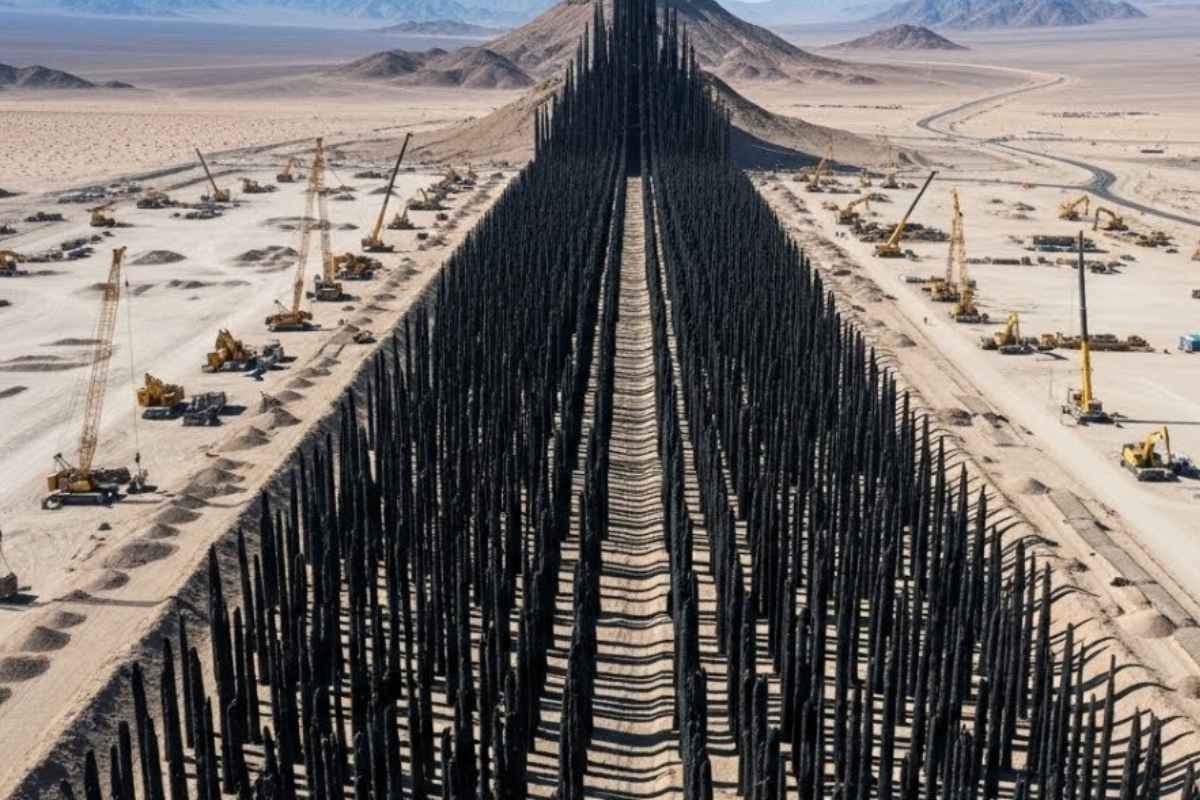
In total, more than 90 million tons of soil were moved manually, a volume comparable to the construction of a pyramid of Giza.
However, instead of honoring pharaohs, this “invisible pyramid” served to return life to the dead lands.
Slopes that were once smooth and sterile became true water staircases, capable of holding every rain torrent.
In previous projects, when only planting was attempted, 90% of the seedlings died within weeks, scorched by heat nearing 40 degrees or devoured by roaming livestock.
This time the logic was reversed: first hold water and soil, then let the natural engineering of the roots do the work.
The result: vegetation increased by up to 200% in just five years, with spontaneous shoots filling the landscape and rivers resurrecting where there had previously been dry cuts in the earth.
With hundreds of dikes spread across eroded valleys, water ceased to run in violent torrents and began to seep slowly.
Silt accumulated, grasses appeared, shrubs grew, and within months, discreet streams began to reappear.
After one or two rainy seasons, many residents saw, for the first time in their lives, rivers resurrecting silently beside their homes.
43 Thousand Hectares Restored, Aquifers Returned and Direct Social Impact
With FMNR and natural engineering applied to water and soil, the scale of the project exploded.
In Ethiopia, more than 43 thousand hectares were restored, starting in Rumbo and expanding to seven entire communities.
Regenerated forests began to protect springs, and 13 natural aquifers that had dried up began to flow all year round, without drilling wells or using pumps.
The economic effects were equally concrete.
Agricultural productivity increased by about 85%, driven by more moist and protected soils, and the average family income increased by around 76%.
Less erosion meant less loss of nutrients, more stability in harvests, and more food security in regions that had previously suffered from extreme famine in the 1980s.
The social impact appears in details that do not make it to reports but change lives.
Women stopped walking for hours a day to fetch water, freeing up time to care for family, study, or work on supplementary activities.
Children returned to school, carrying notebooks instead of water cans on their heads.
Bees returned to the regenerated areas, enabling honey production, while forests also began to generate income through managed firewood, fruits, and even carbon credits recognized by organizations such as the UN, FAO, World Vision, and ICRAF.
When these institutions point to Ethiopia as one of the largest cases of ecosystem recovery in the world, they are not talking about theory.
They are looking at slopes that were dead land and today are green forests with rivers resurrecting, stable agricultural production, and a local economy less vulnerable to climate.
From the Sahel to the World: The Domino Effect of Ethiopia’s Experience
Rumbo did not remain isolated on the map.
The experience of Ethiopia with FMNR and natural engineering became a reference throughout the Sahel belt, from Burkina Faso to Niger and Mali.
Inspired by the Ethiopian case, farmers from other countries began to protect old roots, build dikes, and reorganize grazing.
In just a few decades, more than 5 million hectares were restored in Niger alone, transforming semi-arid areas into mosaics of productive forests and cultivated fields.
In Burkina Faso, cracked hills gave way to slopes covered with trees, ensuring food and income for millions of people.
The lesson is direct: solutions do not need to be complex or expensive; they need to be replicable, community-based, and adapted to the local climate.
Nature does not need to be reinvented; it needs space to remember what it already knew how to do.
The recent history of Ethiopia proves that even dead lands can be rewritten when there is coordination between community, science, and minimally aligned public policies.
In the end, what the world saw was not only rivers resurrecting and forests reappearing after 43 thousand hectares restored, but a country using natural engineering to recover soil, water, and dignity.
What Ethiopia’s Renaissance Says to Countries in Environmental Crisis
The case of Ethiopia dismantles a comfortable myth: that only rich countries, equipped with state-of-the-art machines and large international funds, can carry out ecosystem recovery on a large scale.
Here, it was organized peasants, simple hoes, and a precise reading of the landscape that moved 90 million tons of soil, held water, and made rivers resurrecting change the fate of hundreds of communities.
When dead lands become forests, dry aquifers start flowing again, income rises and hunger recedes, it is not just an environmental victory, but a turning point for an entire country.
The uncomfortable question that the Ethiopian experience leaves for the rest of the world is clear: if Ethiopia managed to rebuild rivers and forests with natural engineering and community work, what exactly is missing for us to do something similar in our own threatened lands?





No Brasil, faltam milhares de pequenos agricultores e terra disponível. Uma vez que a propriedade da terra está cada vez mais concentrada e pequenos agricultores, mesmo amparados por programas e financiamentos governamentais, são os que menos degradam a terra, um movimento de pequenos agricultores como o MST, sempre é perseguido como se criminosos fossem. Ou seja, no Brasil, mais fácil o desmatamento continuar do que reverter.
Uma reportagem verdadeiramente comovente e lúcida, que nos lembra da importância de preservarmos o meio ambiente, e jamais permitir que a exploração dos recursos naturais se torne uma prática doentia e progressiva até à exaustão total de algo tão valioso para a vida de todos nós.
Não foi milagre. É a simples aplicação das regras de manejo e conservação do solo evda água, ensinada nas facukdadescdevagrojomiavde todo o mundo POR MAIS DE UM SÉCULO.
TODOS OS AGRONOMOS E TÉCNICO AGRÍCOLA JA OUVIU FALAR EM EROSÃO HIDRICA E ÉOLICA E AS PRáTICAS conservaciobistas de Manejo Vegetativo (evitar as queimafas e alterar e conservar o padrão da cobertura do solo e das culturas para preservar o solo e a água, evitando a erosão e a enxurrada), práticas agronômicas (alterar a Fertilidade do solo, adubando-o, plantando em nível no terreno, contra a declividade do terreno para evitar a erosão, preparando corretamente o solo, evitando e corrigindo a compactação e manejando o sistema de cultivo, suas rotações e sucessões de cultivo, de modo a manter o solo sempre protegido e produtivo), por fim as práticas mecânicas que evitam o deslocamento do solo para as áreas mais baixas e mantém a Fertilidade, a estrutura e a infiltração do solo em cada nível de declividade do terreno, fazendo trabalhos mecânicos como canais e camalhões, cinturões em contornos, terraço bases larga tipo Mgnum e terraço base curta, alem de bancadas e terraço em costas de montanhas.
A manutenção da vegetação nativa onde a declividade for excessiva, o solo for pedregoso e não houver meios financeiros de fazer terraceamentos e bancadas individuais.
Há muito trabalho técnico disponível. Porém, a galera do meio ambiente tenta desqualificar a ciência agronômica tradicional, mistura secas periódicas normais, guerras e mau uso do solo pelos agricultores, até crescimento populacional, como agentes destruidores do ambiente. A ideia é confundir e mentir para VENDER UMA AGENDA AMBIENTAL CHEIA DE IDEOLOGIA DE ESQUERDA E DESTEUIR TUDO QUE NÃO ATENDE ÀS SUAS NARRATIVAS PRÉ-CONCEBIDAS E FORAA DA REALIDADE LOCAL.