





 Portuguese
  English
  Spanish
  6 min of reading
  1 comment


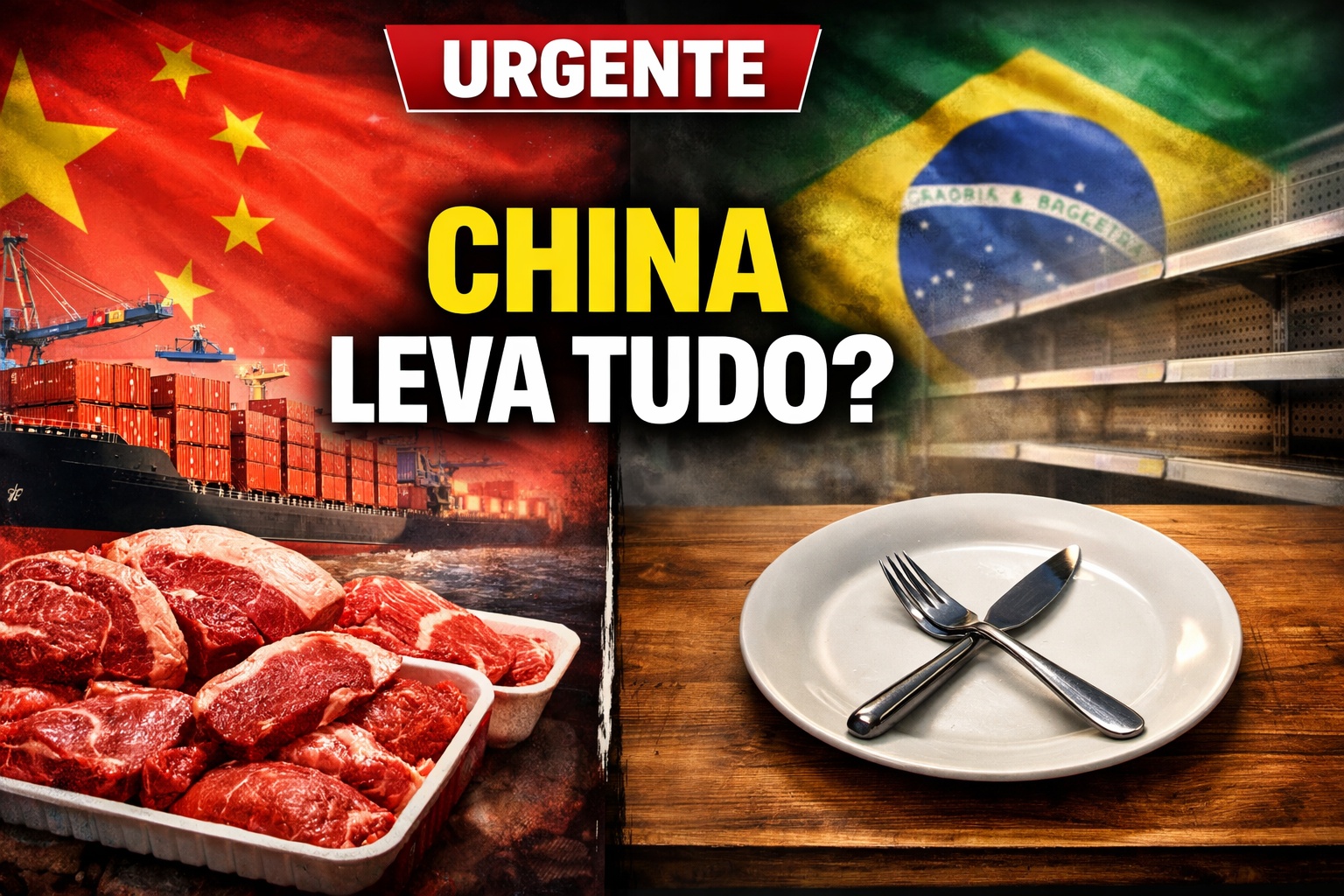


Record Beef Exports to China Lead Government to Consider Quotas to Avoid Shortages and Price Increases in Brazil.
In 2024 and early 2025, the debate over the so-called “meat crisis” gained momentum after the Ministry of Agriculture and Livestock issued a warning about the risk of disruption to trade flows and a possible collapse of domestic beef supply. The warning comes amid a scenario where China accounts for about 40% to 50% of Brazilian beef exports, according to sector data and entities like Abiec. In 2024, Brazil exported approximately 1.34 million tons of beef to the Chinese market, consolidating the Asian country as the main destination for Brazilian protein.
The central problem is not the physical lack of production, but the combination of record exports, a strong dollar, and economic incentives for slaughterhouses to prioritize external sales. In light of this scenario, the government is studying the creation of a quota system that would require exporting companies to guarantee a minimum amount of beef for the domestic market before selling abroad.
Record Exports and Dependence on China in the Beef Market
Brazil is the world’s largest beef exporter. In recent years, Chinese demand has become the main driver of this performance. Following episodes of African swine fever in China and restructurings in the Asian animal protein sector, the country drastically increased its beef imports.
-
The government requests the Federal Revenue Service for a new system to automate the income tax declaration, reducing errors, time, and bureaucracy for millions of Brazilians.

-
Pix in installments, international Pix, and contactless payment without internet: the Central Bank revealed the new features coming to the tool that is already used by almost every adult in Brazil.

-
Mercado Livre has just started selling medications with delivery in up to three hours to your door, and this move could completely change the way Brazilians buy medicines on a daily basis.

-
In Dubai, rising tensions from the war in the Middle East are causing super-rich individuals to leave the Gulf and direct their fortunes to a new financial refuge in Asia.


In 2024, more than 1.3 million tons were shipped from Brazil to the Chinese market, accounting for almost half of the total exported. In financial terms, exports amount to billions of dollars annually, contributing significantly to Brazil’s trade balance surplus.

This dependency, however, creates structural vulnerability. When China imposes new rules, quotas, or additional tariffs, the entire Brazilian trade flow is impacted. In 2025, Beijing announced limits on beef imports, establishing annual quotas and additional tariffs for volumes exceeding a certain cap. This measure aims to protect domestic Chinese production but raises uncertainties for Brazilian exporters.
The strong concentration of sales in a single market increases the risk of volatility. If China reduces purchases or changes sanitary rules, the surplus may pressure domestic prices. On the other hand, when Chinese demand grows, slaughterhouses tend to direct a larger portion of production abroad.
High Dollar and Pressure on Domestic Beef Supply
The appreciation of the dollar against the real acts as an additional incentive for exportation. The higher the exchange rate, the greater the profitability of external sales. For slaughterhouses, selling beef to China can mean higher margins than those obtained in the domestic market.
This mechanism creates a potential imbalance. Although Brazil produces millions of tons of beef annually, a significant portion is directed abroad. If the exported proportion grows excessively, domestic supply may become relatively smaller, pressuring retail prices.
The government’s fear is that the exchange incentive leads slaughterhouses to prioritize international contracts over local butcher shops and supermarket chains. In a country where beef plays a significant role in families’ consumption baskets, any significant price increase impacts inflation and purchasing power.
It is important to note that there is no evidence of an immediate physical lack of meat in the country. The debate revolves around the structural risk of shortages or price hikes if exports continue to grow without coordination.
Export Quota System: How the Proposal Would Work
The proposal under study involves creating a mechanism for the internal management of beef exports to China. In practice, each slaughterhouse would have a maximum volume authorized for export within the Chinese quota without surcharge.
The model could require companies to demonstrate fulfillment of a minimum share for the domestic market before accessing the export quota. The declared objective is to avoid the external flow compromising domestic supply.
This type of policy is not unprecedented in international trade. Several countries adopt supply management mechanisms to balance the domestic market and strategic exports. However, in the Brazilian case, the measure faces strong resistance from the private sector.
Slaughterhouses argue that Brazil operates under a free market regime and that interventions can generate distortions. According to industry representatives, the best solution would be to stimulate production, increase the herd size, and enhance efficiency, rather than limiting sales that generate foreign currency.
There is also concern that creating internal quotas could reduce international competitiveness and harm Brazil’s image as a reliable supplier.
Economic Impact of Limiting Beef Exports
Beef exports account for billions of dollars in annual revenue. A significant part of this value enters the country as foreign currency, strengthening reserves and contributing to the balance of trade.
Industry studies estimate that potential restrictions could result in losses of up to US$ 3 billion in annual revenues if Brazil cannot redirect volumes to other markets. Additionally, slaughterhouses operate with logistical planning and long-term contracts. Abrupt changes can lead to fines, renegotiations, and legal insecurity.
On the other hand, the government is assessing the social cost of potential increases in domestic prices. Beef is a significant component of the inflation index. Significant hikes could pressure macroeconomic indicators and require monetary responses.
The balance between exporting to generate foreign revenue and preserving domestic supply is at the center of the discussion. The creation of quotas would be an attempt to reduce volatility and ensure predictability for the domestic market.
China, Global Quotas, and Reconfiguring International Trade
China announced an annual quota of approximately 2.7 million tons of beef for 2026, with additional tariffs applied to volumes exceeding that limit. This decision affects all major exporters, including Brazil, Australia, and the United States.
The new scenario may create a redistribution of trade flows. If Brazil exceeds the limit and faces surcharges, part of the production may seek other markets in Asia, the Middle East, or Europe.
Excessive dependence on a single trading partner thus becomes a strategic point. Experts argue for diversifying destinations as a way to reduce risk from external shocks.
At the same time, maintaining Brazil’s leadership in the global beef trade depends on competitiveness, sanitary agreements, and regulatory stability.
The Real Risk of Collapse in Domestic Supply
The term “collapse” used in official debates refers to an extreme scenario in which domestic supply becomes insufficient to meet internal demand. So far, there is no confirmation of widespread shortages.
What exists is a preventive alert in light of the combination of high exports, favorable exchange rates, and market concentration in China. The government seeks to prevent international dynamics from affecting the plate of the Brazilian consumer.
Technical analysis indicates that Brazil has a robust productive capacity. The Brazilian cattle herd is among the largest in the world, and the production chain is highly structured. However, abrupt export fluctuations can change regional balance and prices.
The potential adoption of quotas would have a preventive character, not emergency. The debate remains in an evaluation phase, with dialogue between the government and the private sector.
Beef Crisis
The so-called beef crisis in Brazil does not stem from immediate scarcity but from a strategic dilemma: how to reconcile billion-dollar exports to China with price stability and domestic supply. With more than 1.3 million tons sent annually to the Chinese market and the dollar pressuring margins, the incentive to export is evident.
The quota proposal seeks to create a mechanism for balancing the external and domestic markets. The slaughter sector resists, defending a free market and production expansion as a structural solution.
The outcome will depend on the coordination among the government, producers, and exporters. What is at stake is not only international trade but also food security, inflation, and Brazil’s position as the world’s largest exporter of beef.









Exportação..!
Pior que pesa no bolso do consumidor brasileiro..! Alguém tem de pagar a conta..!