





 Portuguese
  English
  Spanish
  7 min of reading
  1 comment


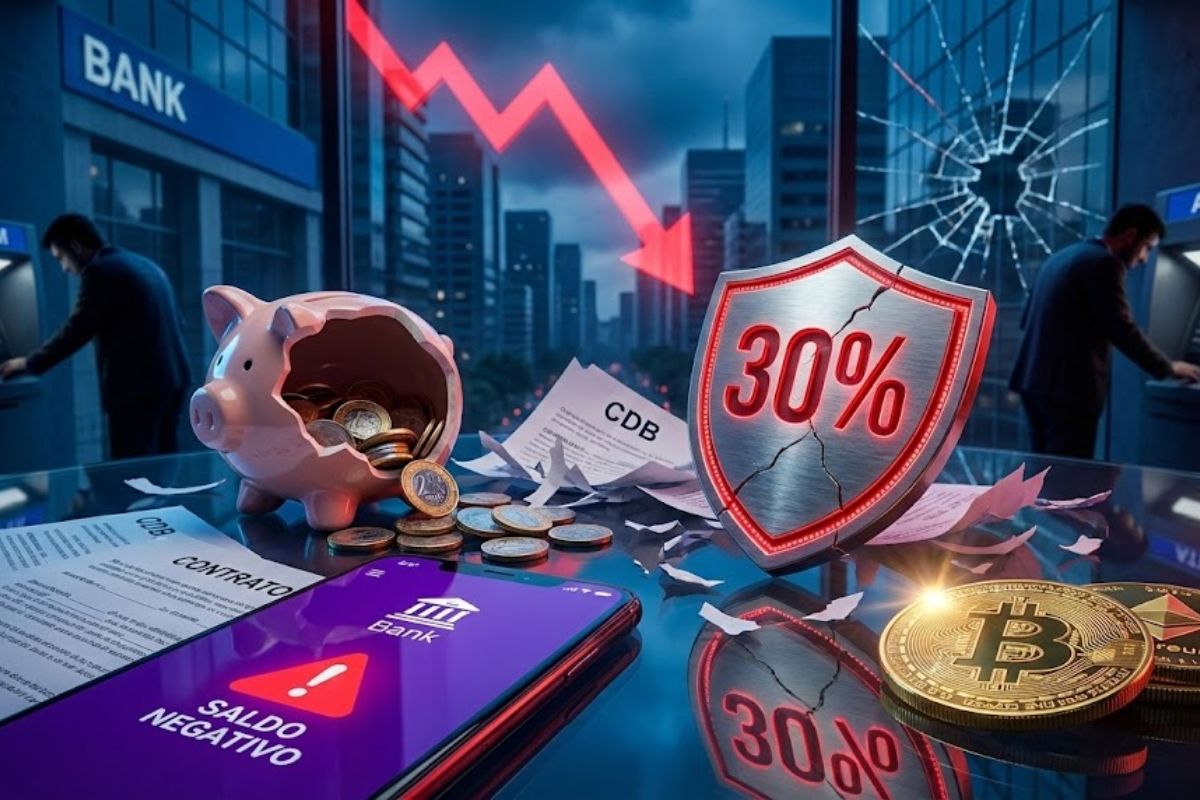

When A Medium Bank Hid A Shortfall Estimated In Billions, Sold Inflated Credit, Promised Turbocharged CDBs And Ended Up Burning 30% Of The FGC’s Cash, Brazilians Saw Up Close The Real Risk Of Banks And Discovered That Trust Alone Is Not Enough To Protect Their Wealth.
In recent weeks, millions of account holders received strange notifications on the purple app talking about the liquidation of Banco Master, activation of the Credit Guarantee Fund, and automatic redemption of CDBs. Many people discovered for the first time that they had exposure to a bank with which they never opened an account while trying to understand what the real risk of banks means in a crisis of this size.
According to Josué Aragão, at the same time, the arrest of banker Daniel Vorcaro, allegations of unsecured credits, inflated balance sheets, and triangulations with pension funds revealed a machinery of financial engineering that would have generated a shortfall estimated at 41 billion reais and required the largest activation in the history of the FGC, with approximately 30% of its cash consumed in a single case. The episode raised a national alert: when a bank falls, the problem is not just its own; it is the entire system that depends on trust to keep functioning.
Notification On The App, Turbocharged CDBs And Customers’ Shock
The starting point of the crisis for the general public was simple: a message on the app explaining that CDBs from Banco Master, sold within the Nubank platform, would be covered by the FGC due to the insolvency of the issuer.
-
Brazilian city bets on the business environment to generate jobs and attract investments in the energy sector — secretary reveals strategy at Macaé Energy 2026.

-
50 viaducts, 4 tunnels, 28 bridges, and 40 kilometers of bike paths: BR-262 in Espírito Santo will receive 8.6 billion reais for the largest engineering project in the state’s history, inspired by the Immigrant Highway in São Paulo.

-
Brazil produces too much clean energy and doesn’t know what to do with it: over 20% of solar and wind capacity was wasted in 2025 while investors flee and 509 renewable generation projects were abandoned in the last year.

-
Piauí will produce a new fuel that replaces diesel without needing to change anything in the truck’s engine and reduces pollutant gas emissions by half: truck drivers from all over the Northeast are already celebrating the news that will arrive later this decade.


Many discovered that behind the purple visual and app seal, their money was invested in securities from a completely different bank.
These Master CDBs were precisely the products featuring returns well above the average, often paying 140%, 150% or more of the CDI over short terms.
The magic was always the same: high interest, the symbol of the digital bank, short terms, highlighted FGC protection, and, in smaller letters, the name of the actual issuer.
In practice, the average investor saw the rate and the app logo but rarely checked who issued the security or what the structural risk behind that out-of-line remuneration was.
When Banco Master went bankrupt, the question exploded in WhatsApp groups: if the issuer of the CDBs vanished from the map, does that mean Nubank is also at risk?
The doubt, even if poorly formulated, revealed the central point of this crisis: Brazilians began to see the real risk of banks not as a theoretical concept, but as a direct impact on retail products that promised security and liquidity.
How The Banco Master Fraud Got Out Of Control
According to the investigations cited in the original content, Banco Master did not collapse due to a series of bad credit decisions, but rather due to a structured financial manipulation scheme.
The accusations include selling unsecured credit, using fictitious assets to inflate balance sheets, simulated operations to hide defaults, and internal debt rearrangements to create the appearance of solvency where there was already a growing hole.
At the center of this network, the figure of Daniel Vorcaro was pointed out as the mastermind of the operation, connecting the bank to influential law firms and top names in national politics.
Messages and phone calls mentioning ministers and authorities were used as supposed political capital to open doors, calm regulators, and justify moves that, under normal circumstances, would sound absurd.
The result of this combination of fictitious assets, inflated portfolios, and triangulations was a shortfall estimated at 41 billion reais.
When the Central Bank looked at the real balance sheet, the conclusion was straightforward: there was no way to keep the bank alive without generating a domino effect risk on the system.
Judicial liquidation was decreed to interrupt the process before trust deteriorated in a chain reaction.
The Largest Activation Of The FGC And The Message Behind The 30%

The Credit Guarantee Fund exists precisely to cushion shocks like this. However, this time, the scale was unprecedented.
About 1.6 million creditors became entitled to coverage, and the FGC had to mobilize approximately 30% of its entire cash in a single event.
The message behind this number is clear: the FGC is not an infinite pool of money. It is a robust but limited mechanism.
If a single case consumes almost one-third of the fund, it is evident that the guarantee is powerful for specific crises, but it is not designed for a series of systemic breakdowns.
For the small investor, the rule resurfaces strongly: the individual coverage ceiling is 250,000 reais per CPF per institution.
If someone had, for example, 400,000 reais invested in CDBs from Banco Master, only 250,000 would be covered by the FGC.
The remainder would join the line of creditors in the liquidation, with no guarantee of full recovery.
It is precisely at this point that the real risk of banks ceases to be an abstract concept and becomes a clear line of demarcation on the statement.
Nubank, Psychological Panic And The Risk Of Bank Run
In the specific case of Nubank, the exposure occurred through the distribution of CDBs from Master to its customer base.
The digital bank did not share structure, did not divide credit portfolio, and was not a partner of the issuer.
The direct risk was with Master, not Nubank. Nevertheless, the fear of psychological contagion was immediate.
Today, Nubank is the largest digital bank in the world by number of customers, with over 120 million users across Brazil, Mexico, and Colombia, with billion-dollar profits in dollars and a market value greater than that of traditional giants like Santander, Banco do Brasil, and BTG Pactual combined.
From a balance sheet perspective, there is no indication of a shortfall similar to that of Master.
The real danger in this scenario lies elsewhere: the bank run.
If a relevant mass of customers decides to withdraw money simultaneously, no bank is prepared to honor 100% of demand deposits, as the money is lent, invested, and circulated.
It is at this point that the real risk of banks intertwines with mass psychology: it is not enough to be healthy; maintaining public trust is necessary for the system to stay upright.
Limit Of 250,000, CDB Issuer And The Illusion Of Miracle Rates
The first practical lesson from this crisis is almost didactic: do not concentrate more than 250,000 reais per institution covered by the FGC.
Anyone exceeding this limit needs to disperse among different banks if they wish to maintain full protection.
The second lesson is to understand that in fixed income, the issuer guarantees the CDB, not the platform that sells it.
If the CDB is from Banco Master, the risk is with Banco Master even if the investor purchased it through the Nubank app, Itaú, or any other institution.
The app icon does not replace the name of the issuer on the contract.
The third lesson targets buyers of magical rates: interest rates well above the average are always a warning of high risk.
A CDB paying 150% or 160% of the CDI over a short term is not a gift; it is a price.
The investor is being compensated for taking on a higher risk, even if often unaware.
Ignoring this was part of the path that led thousands of people to discover, in practice, the real risks of banks in seemingly innocuous products.
Cryptocurrencies, Self-Custody And Partial Shielding Outside The Banking System
In light of a case where a single bank consumes 30% of the FGC and reveals political, accounting, and regulatory vulnerabilities, a fourth layer of protection emerges: having part of one’s wealth outside the traditional banking system.
This includes assets like cryptocurrencies in self-custody, which do not rely on banks, brokerages, or the FGC to exist.
The reasoning is simple.
Money deposited in a bank is, legally, the bank’s, with the account holder as a creditor.
On the other hand, crypto stored in one’s own wallet, with a private key controlled by the investor, is an asset that cannot be locked by a specific institution.
The risk changes nature: it moves from banking risk to technological, market, and digital security risk.
Financial shielding strategies with cryptocurrencies, as described in self-custody-focused protocols, do not eliminate risk but reduce dependence on a single system.
Part of the money remains in banks to pay bills, receive salaries, and operate daily, while another part is converted into digital assets under direct control of the investor.
In a banking crisis scenario, those with this parallel reserve gain time and options.
Still, it is crucial to emphasize: there is no magical solution without study and responsibility.
Cryptocurrencies require a minimum technical knowledge, an understanding of volatility, and discipline in key storage.
Shielding one’s assets means combining the best of both worlds: discipline in distributing among traditional institutions, respecting the FGC limits, and a well-structured block of assets outside the direct reach of banking failures.
Beyond Master: What This Crisis Teaches About The Real Risk Of Banks
The collapse of Banco Master and the record rescue of the FGC left an uncomfortable yet necessary message.
The financial system works well until the day someone makes a gigantic mistake, mixing politics, accounting engineering, and a hunger for excessively high yields.
When that happens, the damage overflows the bank’s balance and impacts investors, pension funds, digital platforms, and trust in the currency itself.
In the end, the episode forces Brazilians to reconsider their habits.
It is not enough to choose the “trendy bank” or the CDB with the highest rate.
It is necessary to understand who issues the security, respect the FGC limit, diversify among institutions and asset classes, and increasingly study ways to keep part of their wealth outside the traditional banking circuit, with autonomy and responsibility.
After everything that happened with Banco Master, the FGC, and turbocharged CDBs, what was the main change you decided to make in your investment strategy to protect yourself from the real risks of banks?








¨O sistema financeiro funciona bem até o dia em que alguém erra em escala gigantesca¨
O rico erra, não ****, é isso que entendi ?