





 Portuguese
  English
  Spanish
  4 min of reading
  6 comments


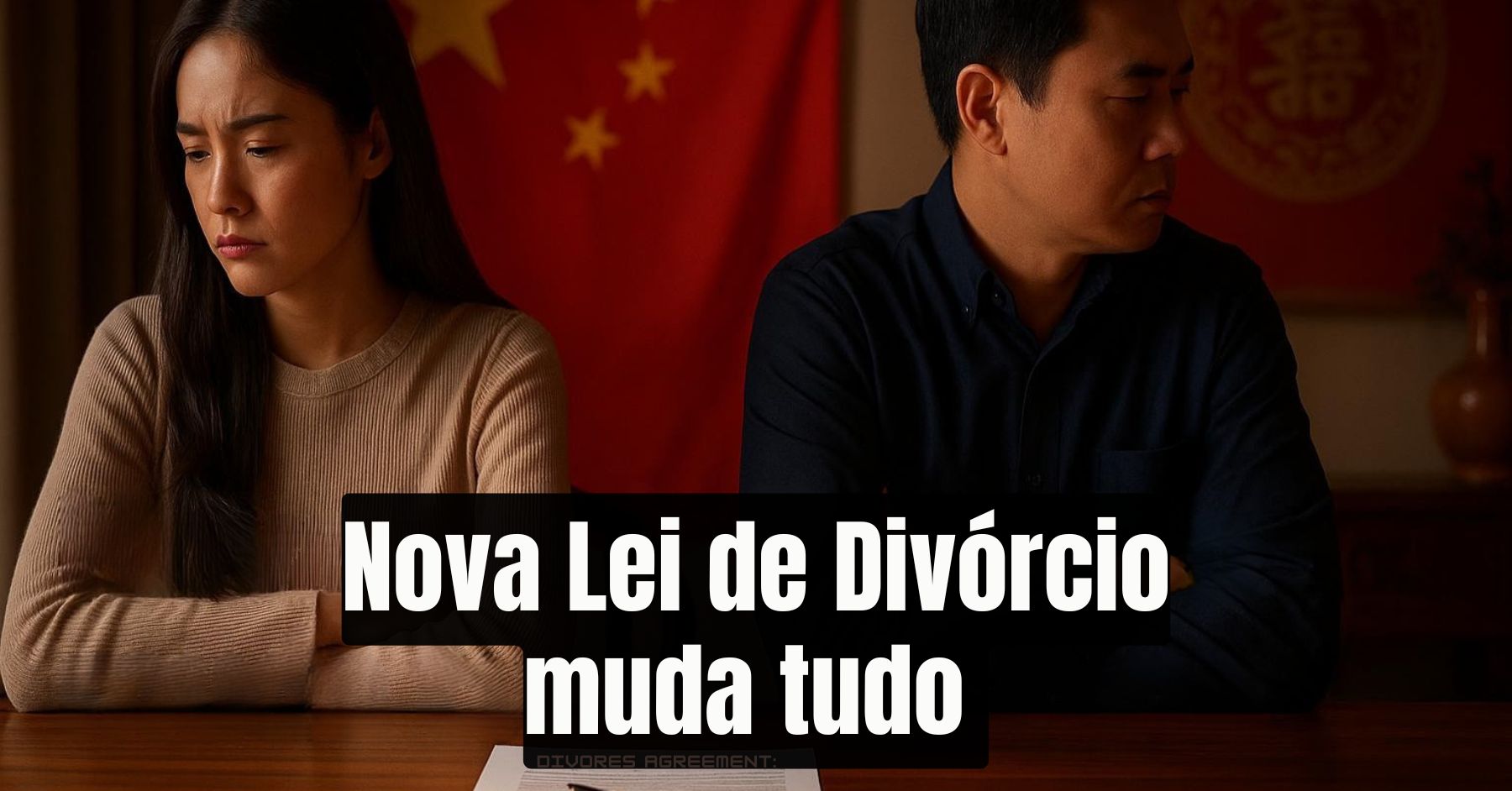


New Divorce Law in China Changes Everything: Wives Can Only Keep What They Can Prove They Bought or Paid for, Eliminating Automatic Property Division.
China has taken another step towards one of the most controversial family reforms of the last decade. The new Divorce and Property Division Law, introduced in 2025, redefines the rules of asset division between couples, eliminating the principle of automatic division and establishing that each spouse will only have rights to what they can prove they have bought, paid for, or participated directly in its construction.
The measure was initially reported by law firms specializing in international law, such as MacLean Family Law, which deals with cases involving divorces between Chinese citizens and foreigners. According to the survey, the Chinese government has adopted a division model based on proven financial contribution, breaking with the tradition of equally dividing assets acquired during the marriage.
New Law Completely Changes the Logic of Property Division in China
Until recently, the Chinese property regime considered assets acquired during marriage as jointly owned by the couple, regardless of whose name was on the property.
-
The noise law will no longer be in effect at 10 PM starting in June with a new rule valid during the 2026 World Cup.

-
The Chamber opens a debate on driver’s licenses at 16 years old as part of a reform that includes around 270 proposals to change the Brazilian Traffic Code and may redesign rules for licensing, enforcement, and circulation in the country.

-
The new Civil Code could revolutionize marriages in Brazil with “express divorce” and changes that could exclude spouses from inheritance.
-
Banco do Brasil sues famous influencer for million-dollar debt and intensifies debate on delinquency, risks of seizure, and direct impact on Gkay’s credibility.


This rule ensured that, in the event of a divorce, the division would be proportional, taking into account not only the money invested but also domestic contributions and childcare.
With the new legislation, the scenario changes radically. Now, only the spouse who can prove direct financial participation, whether through bank transfers, contract signatures, or payment receipts, will be able to claim the asset.
In practice, this means that women who left the workforce to dedicate themselves to home and family may exit the marriage without any rights to real estate, vehicles, or investments that are exclusively in the husband’s name.
Domestic Contributions and Family Care Lose Legal Weight
According to MacLean Family Law, Chinese courts have been receiving an increasing volume of cases in which wives contest judicial decisions for losing the right to housing after divorce.
The new legislation formalizes a trend already observed in recent years: judges have begun to require objective proof of financial contribution, which, in practice, excludes many wives who dedicated themselves exclusively to the home.
The Chinese government justifies the change by stating that it aims to “reduce property disputes and matrimonial fraud”, especially in cities with high real estate speculation, such as Beijing, Shanghai, and Shenzhen, where properties acquired by one spouse have quadrupled in value over the last 10 years.
But family law experts warn that the new rule increases the vulnerability of women in unequal unions, as many do not have formal documentation proving their contributions.
Understand What Changes with the New Rule
Prior to the reform, Article 17 of the old Marriage Law of the People’s Republic of China stipulated that “assets acquired during marriage belong jointly to the couple.”
Now, the new wording requires documentary evidence of ownership or direct participation, which eliminates the automatic right to half of the assets.
The rule applies to real estate, vehicles, financial investments, and even businesses registered solely in the name of one of the spouses. In cases of inheritance or family donations, the asset is considered exclusive property of the recipient, with no possibility of division.
In other words: those who do not have their names on the deed, contract, or bank register will find it difficult to claim the asset after divorce.
International Debate and Controversy
The measure has generated intense debate both within and outside of China. While part of society defends the new legislation as a means to “protect individual assets and reduce marriage for profit,” other groups argue that the text ignores the value of domestic work and the role of women in family stability.
Civil rights organizations and Chinese jurists are already calling on the government to establish compensation mechanisms for those who dedicated years to caring for the home and children without independent income.
They warn that the measure could widen inequalities and leave millions of women without financial protection after divorce.
According to local media, courts in Shanghai and Beijing have already applied the new rule in recent rulings, and the first cases resulted in decisions largely favorable to husbands, consolidating the new legal understanding.
Global Reflection and New Trends
The Chinese reform reflects a trend of tightening family laws in various Asian countries, which seek to deter marriages motivated by economic gain.
However, international experts observe that the social impact could be profound: in a country where over 70% of urban properties are registered solely in men’s names, millions of women could be left without housing rights in the event of separation.
The subject is expected to remain under discussion in the coming months, especially with the possible publication of complementary guidelines by the Ministry of Justice of China and the Supreme People’s Court, which will define the practical application of the law in future cases.










Isso ai não vai adiantar NADA para aumentar a natalidade, e os homens que não se iludam, agora que as chinesas não vão querer se casar. Seja como for, um país com um governo que bota política de filho único, que ferrou com seus cidadãos e TODO o planeta, merece sessa baixa natalidade
ainda esta melhor que a lei Putin na Rússia criada em 2017. o homem pode bater na mulher a vontade desde que não apareça sangue. (no Google procure Lei Putin mulheres agredidas)
Boa sorte pra tr0x@ que vai ter toda a dor de cabeça comprovando o que contribuiu com o que não contribuiu e PROVAR tudo isso sem restar nenhuma duvida.
Prefiro a solterice, viajar e jogar meus jogos da Steam. 0 dor de cabeça.