





 Portuguese
  English
  Spanish
  4 min of reading
  0 comments


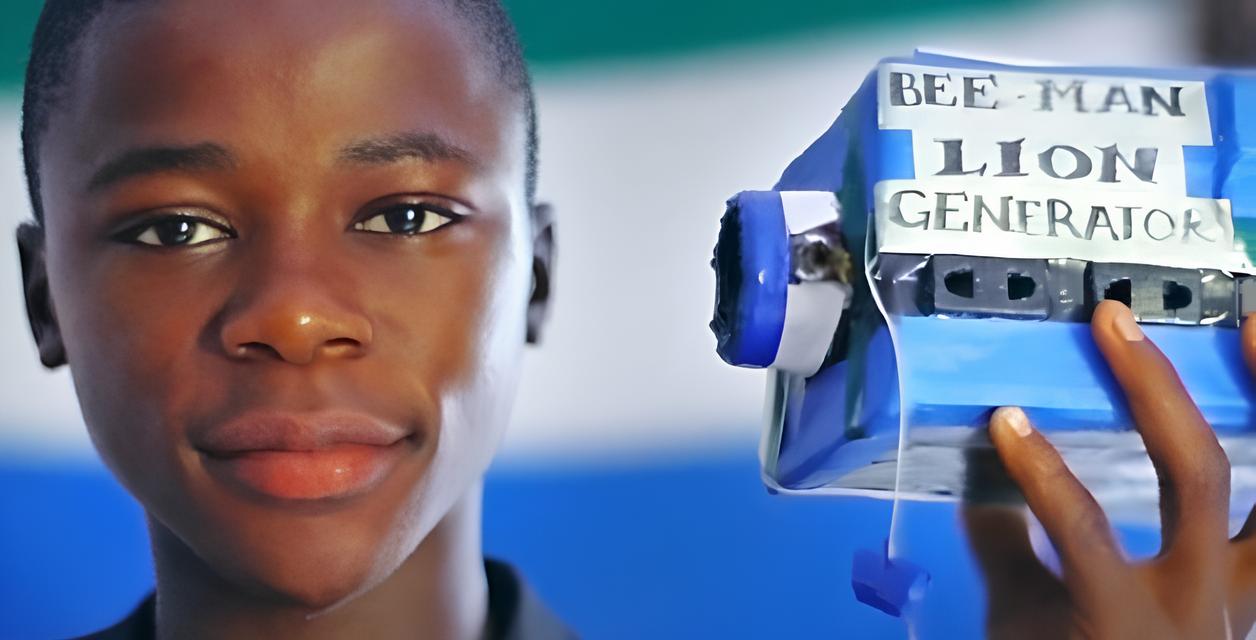
At Just 13 Years Old, Kelvin Doe Built Generators and a Radio Station with Scrap in Sierra Leone. Discovered by MIT, He Became a Global Symbol of Innovation and Hope.
In a country ravaged by poverty and lack of infrastructure, a 13-year-old teenager proved that genius does not depend on resources, but on creativity and purpose. Kelvin Doe, born in Freetown, the capital of Sierra Leone, became known worldwide for building electric generators, batteries, and even a community radio station using only scrap collected from the streets. His talent and determination made him a global symbol of innovation amidst scarcity.
Kelvin’s story gained international attention in 2012, when he was discovered by researchers from the Massachusetts Institute of Technology (MIT) in the United States. At that time, the young man was already known in his community as “DJ Focus”, a nickname he received for his ability to solve technical problems and his passion for electronics. Using cans, burnt wires, pieces of plastic, and old fan motors, he managed to build an energy system that lit up homes and powered radios in a neighborhood without access to the electrical grid.
An Inventor Born of Improvisation
Sierra Leone is one of the poorest countries in the world, and in many neighborhoods of Freetown, electricity is a luxury. Tired of seeing his family living in the dark, Kelvin decided to study how broken radios and abandoned generators worked.
-
China has created a mass-produced hypersonic missile that costs the same as a Tesla, and this is changing everything in modern warfare because the United States cannot defend itself without spending millions.

-
100% Brazilian technology transforms agricultural waste into a meat-scented ingredient using fungi from the Amazon rainforest. The process does not use excessive water or chemicals, and it also increases the nutritional value of the final product.

-
Psychology reveals that adults who avoid conflicts at all costs are not balanced individuals, but rather children who learned in the worst way that expressing emotions brought punishment and now live paralyzed by the fear of expressing themselves.

-
Goodbye pet hair on clothes: a washer with an internal filter promises to remove up to 5 times more hair than regular machines and uses an XL trap dryer system to capture what remains.


Little by little, he learned to disassemble and reassemble circuits until he understood the basics of current and voltage — all without ever attending a technical school.
Using recycled batteries, burnt bulbs, and discarded motors, he managed to create handmade rechargeable batteries capable of keeping a light bulb lit for several hours. He then built a portable generator powered by scrap and an AM radio transmitter.
Thus, “Radio Focus” was born, a community station that covered an area of about 3 km and transmitted local news, awareness messages, and music that he programmed himself.


With his voice on the air, Kelvin spoke about hygiene, education, and citizenship, inspiring hundreds of people in the neighborhood to believe in the power of innovation.
International Recognition
The boy’s talent caught the attention of engineer David Sengeh, also from Sierra Leone and a researcher at the MIT Media Lab, who invited him to participate in the “Visiting Practitioner” program in Boston. In 2012, Kelvin became the youngest participant in MIT’s history.
During his stay in the United States, he presented his projects at universities, gave interviews to CNN and BBC, and was welcomed as a symbol of African creativity. “Kelvin is living proof that talent is universal, but opportunities are not,” Sengeh stated at a conference at MIT.
The case gained worldwide proportions. Harvard University, Intel, and the United Nations Development Programme (UNDP) recognized him as an example of social innovation and sustainability. Kelvin participated in TEDx events and school lectures, showing how technology can change realities even in the most precarious conditions.
From Self-Taught to Social Entrepreneur
Today, as an adult, Kelvin continues his journey as an inventor and entrepreneur. He founded the K-Doe Innovation Lab, a nonprofit organization that offers technology and electronics workshops for youth in Sierra Leone.
The lab teaches concepts of clean energy, robotics, and entrepreneurship to hundreds of students, encouraging the use of recyclable materials to solve local problems.
His goal is clear: to train a new generation of African innovators. In recent interviews, he emphasized the importance of “creating sustainable solutions made by people who understand the challenges of their own country.”
A Global Symbol of Hope
Kelvin Doe’s story continues to be told in schools and documentaries such as “The Young Makers”, produced by CNN, and is studied as an example of creative education in UNESCO programs.
Even without formal education, the boy who once built a generator from scrap managed to illuminate a symbolic path for millions of youth.
Experts in education and social innovation view his case as a milestone. Economist Paul Collier from the University of Oxford stated, “Kelvin represents what is most powerful on the African continent: the ability to create out of nothing.”
At just 13 years old, he showed that knowledge is not tied to diplomas but to the desire to transform the reality around. Today, his name is remembered alongside other great self-taught inventors in history, and his message continues to resonate: “Genius is born where there is need and courage to create.”








-

Uma pessoa reagiu a isso.