





 Português
  Inglês
  Espanhol
  5 min de leitura
  0 comentários


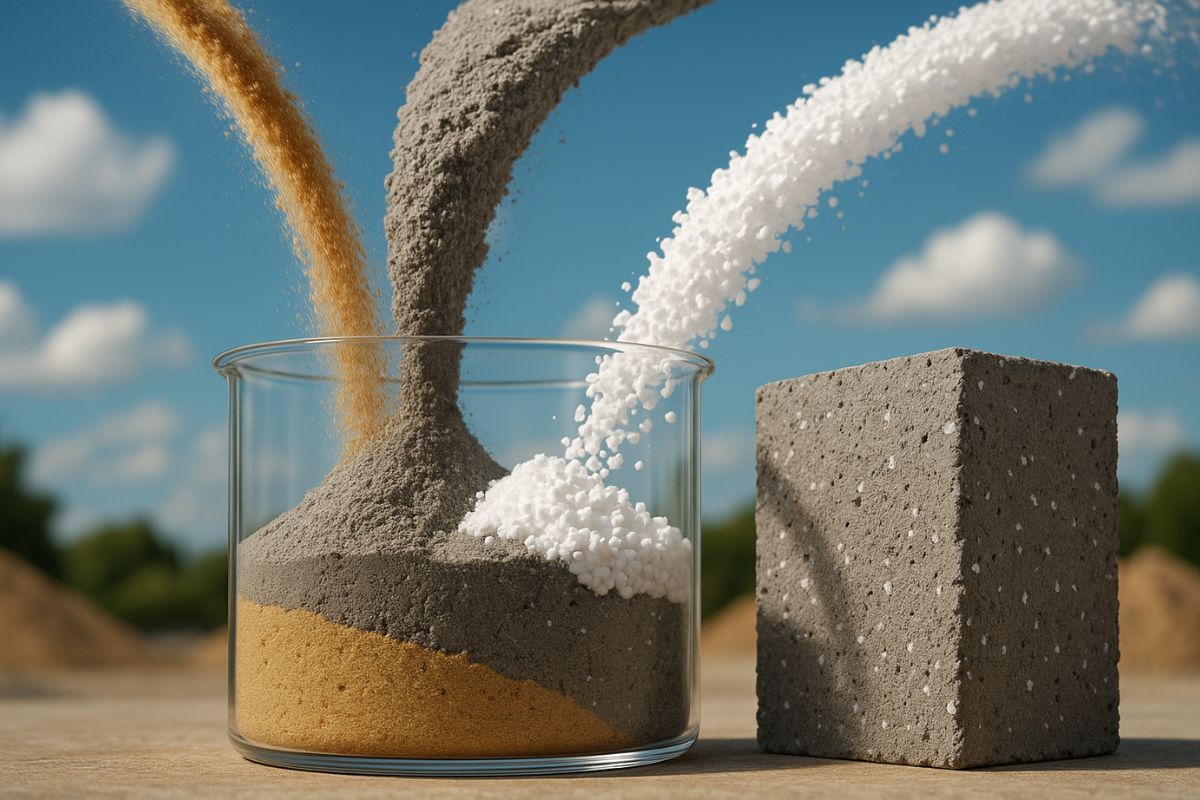
With Sand, Cement, and Crushed Styrofoam, a Simple Technique Creates an Eco-Friendly Concrete Block Weighing Much Less Than Conventional Ones, Reusing Waste and Easing Work in Small and Medium Construction Projects
The traditional concrete block is heavy, consumes a large volume of raw materials, and is usually seen just as another input in civil construction. However, experience with cement, sand, and crushed styrofoam shows that it is possible to transform a little-used waste product into a lightweight and functional aggregate, reducing the weight of the block by up to 60 to 70 percent without compromising adequate resistance for walls and fences.
Rather than discarding styrofoam packaging, the process crushes the material, mixes it with the cement and sand, and incorporates a simple additive made from PVA glue diluted in water. The result is a concrete block that is lighter, easy to mold, with good internal cohesion and performance compatible with non-critical applications, configuring a type of eco-friendly concrete that turns waste into a constructive resource with added value.
From Waste to Eco-Friendly Concrete
The basis of the method is the reuse of styrofoam, a material widely used in the packaging of appliances and electronics.
-
Drought may be creating stronger superbugs in the soil and helping antibiotic resistance reach hospitals, warns a study highlighting a problem that could grow alongside extreme weather.

-
The biggest scam in history: Napoleon’s France deceived the United States by selling them a territory that was Spanish.

-
Why is the Danakil Desert so dangerous? It has unstable terrain and how extreme temperatures and toxic gases turn the region into one of the most hostile environments on Earth.

-
With a height of 221 meters and a capacity for trillions of liters, Hoover Dam still holds a trick that makes water defy logic.


Instead of going to waste, these blocks are broken into smaller pieces and placed in a regular blender until they turn into a kind of “snow” of crushed styrofoam, loose and extremely light.
The gain in volume is significant.
The amount of styrofoam that could fit whole in the blender cup now occupies up to 2 liters after the process, thanks to the structure of expanded polystyrene, which is nothing more than air encapsulated in a plastic matrix.
This crushed styrofoam then functions as a lightweight aggregate within the concrete block, reducing the overall weight and changing the texture of the mixture.
From this point, the technique approaches a formulation of eco-friendly concrete: instead of discarding the material, it is incorporated into the cement and sand, decreasing the consumption of natural aggregates and giving new function to a waste product with difficult environmental disposal.
Mix Proportions and Function of Each Component
The formulation used in the experience follows a volume proportion: three parts sand, one part cement, and four parts crushed styrofoam, all measured in liters.
The washed medium grain sand provides the granular base that ensures stability for the concrete block, while the cement acts as the binder between the particles and provides final strength after curing.
Before adding the crushed styrofoam, the dry mixture of cement and sand is prepared carefully until it is as homogeneous as possible.
Then comes an important enhancement: a solution of water with white PVA glue, essentially a homemade additive that improves adhesion between cement paste, sand, and styrofoam flakes.
This solution is incorporated into the mixture until the “crumbly mass” point is reached – moist enough to remain cohesive when compressed in hand but not with excess water.
Only then is the crushed styrofoam slowly distributed throughout the mass.
The mixing stage requires patience, ensuring that this lightweight aggregate is evenly spread within the future concrete block, a crucial condition for the eco-friendly concrete to behave predictably during curing and use.
How the Concrete Block Is Molded in Practice
With the mass ready, the molding stage comes next.
The example shown uses a two-hole mold, similar to those used in the production of concrete blocks for walls and partitions.
Before filling, the internal surface of the mold receives a thin layer of used motor oil, acting as an improvised release agent and preventing the material from sticking to the walls.
The mixture of cement, sand, and crushed styrofoam is placed in the mold in successive layers.
With each layer, manual compaction is performed, eliminating air pockets and ensuring that the concrete block remains dense and uniform, even though it is a lighter eco-friendly concrete.
When the mold is completely filled, the assembly is carefully demolded, and the freshly molded block is placed on a flat and level surface.
Curing is crucial.
The block remains in a ventilated environment, protected from rain, for up to seven days, being moistened daily with a gentle water spray.
This handling reduces the risk of cracks, improves cement hydration, and contributes to final strength.
Practically speaking, the solution produces a concrete block that, according to the test itself, can weigh about 3 kg less than a conventional block, maintaining sufficient stability for applications such as walls, fences, and lightweight partitions.
Advantages, Precautions, and Limitations of the Lighter Block
Immediate gains include lighter weight, ease of transport, and reduced physical effort on site.
A lighter concrete block speeds up execution, facilitates handling at heights, and tends to tire the worker less.
At the same time, using crushed styrofoam helps reduce the volume of waste sent to landfills, reinforcing the eco-friendly concrete character of the solution.
Another benefit is work versatility.
The block can be cut with a saw, drilled with simple tools, and adapted to masonry details with relative ease, as the combination of cement, sand, and lightweight aggregate results in material less dense than traditional concrete.
On the other hand, it is important to remember that this is an experimental technique that starts from a handcrafted process.
Any relevant structural use must be sized by a qualified professional, who can evaluate strength, type of load, and application context.
Technically speaking, the proposal is suitable for walls, fences, closures, and situations where the gain in lightness and waste reuse outweigh the pursuit of high mechanical resistances.
By transforming what would be waste into input, the method points to accessible innovation pathways in materials, reinforcing the idea that eco-friendly concrete does not only depend on large industries, but also on better understanding the behavior of cement, sand, and alternative aggregates in the day-to-day construction.
Would you dare to test a concrete block made with crushed styrofoam in some renovation or small project at your home?









-

-

-

-

-

-

43 pessoas reagiram a isso.