





 Portuguese
  English
  Spanish
  4 min of reading
  0 comments


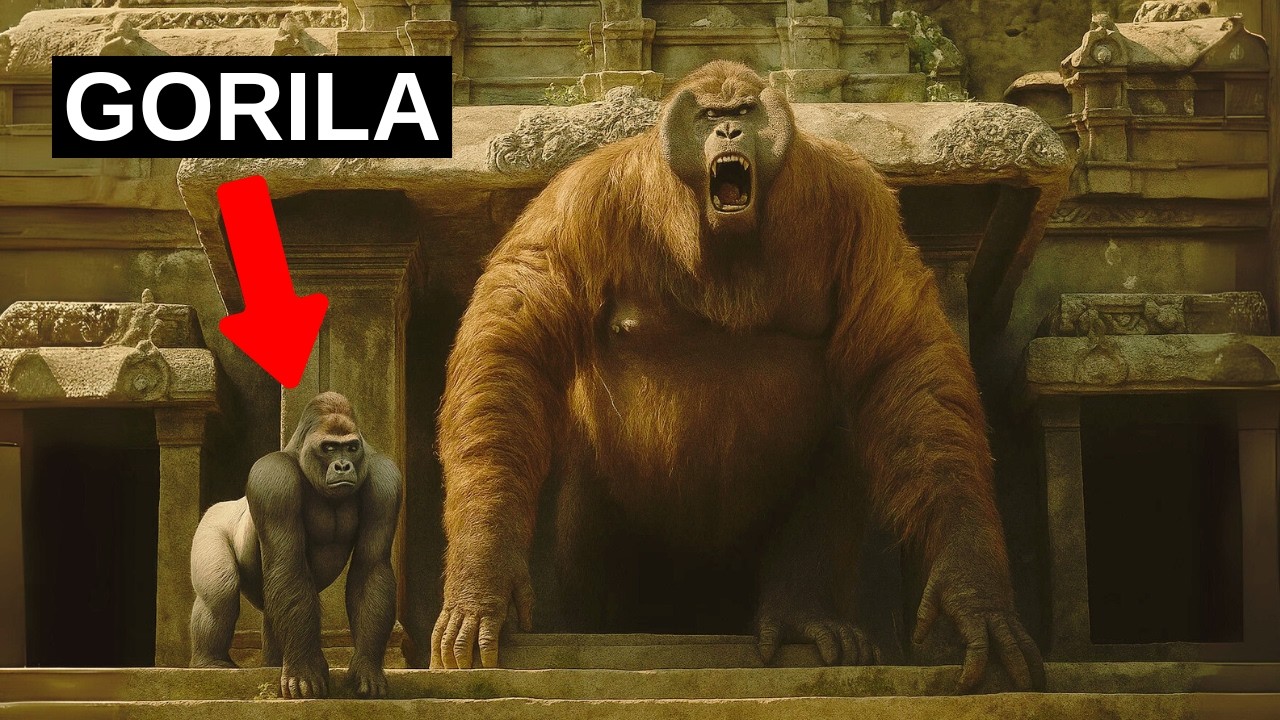
Weighing Over 100 Kg and Greater in Size than Modern Gorillas, Gigantopithecus blacki Was the Largest Primate in History and Reveals How Climate Change Led to the Extinction of Giants.
For much of the 20th century, the idea of a primate much larger than any living gorilla seemed exaggerated or mythical. Today, thanks to real fossils found in Asia, science knows that the largest primate to ever walk the Earth really existed. Its name was Gigantopithecus blacki — a colossus that lived in the dense forests of Southeast Asia and surpassed all modern great apes in size and mass.
Even without complete skeletons, the available evidence allows for the reconstruction of an animal that defies the biological limits of the primate group.
The Discovery of an Unlikely Giant: Gigantopithecus blacki
The first traces of Gigantopithecus did not come from planned excavations but from an unexpected place: traditional Chinese pharmacies, where fossilized teeth were sold as “dragon bones.” When analyzing these gigantic teeth, paleontologists realized they were something completely outside the known standard.
-
With a cost per shot close to zero, the DragonFire laser could change naval warfare in 2027 and provide British ships with nearly unlimited defense against drones.

-
A British startup creates tires that generate electricity in electric vehicles when passing over potholes, speed bumps, and cracks.

-
Scientists have created robots made with living cells that have their own nervous system, swim on their own, explore the environment, and self-organize without any genetic engineering, and now they want to do the same with human cells.

-
Students create a solar-powered ambulance that operates without a plug, without fuel, and still keeps medical equipment running in remote areas.


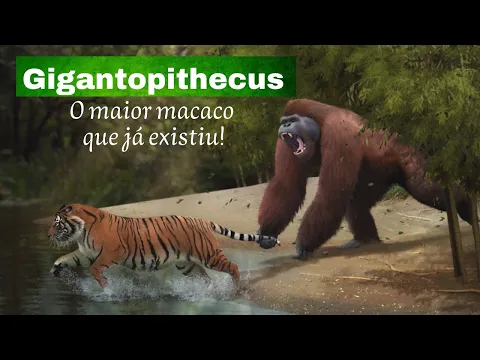

Since then, hundreds of teeth and jaw fragments have been identified in southern China, Vietnam, and nearby regions. While it may seem few, these fossils are enough to confidently state that the animal was enormous.
Dimensions That Exceed Any Modern Primate
Based on the size of the teeth and the robustness of the jaws, scientists estimate that Gigantopithecus blacki could reach over 3 meters tall when upright and weigh well over 100 kg, with some estimates suggesting even greater figures.
By comparison, an adult mountain gorilla rarely exceeds 180 kg, even though it is extremely muscular. The Gigantopithecus, aside from being large, had a body structure adapted for strength and endurance, not agility.
Its long arms suggest a locomotion somewhat similar to that of great apes, but on a completely different scale.
A Giant Herbivore in Closed Forests – Gigantopithecus blacki
Contrary to what its size might suggest, the Gigantopithecus was not a predator. The wear on its teeth and isotopic analyses indicate a predominantly herbivorous diet, based on:
- hard fruits
- shoots
- seeds
- resistant plant fibers
For a long time, it was believed to feed almost exclusively on bamboo, much like the panda. Today, this hypothesis is considered simplistic. The most likely scenario is that the animal had a varied diet, but highly dependent on dense, moist forests.
This detail is crucial to understand both its success and its extinction.
Extreme Strength, but Little Ecological Flexibility
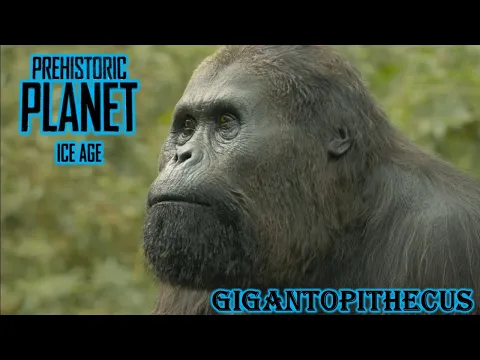
The colossal size of the Gigantopithecus brought clear advantages. Few predators could threaten it, and its physical strength was probably far superior to that of any current primate. However, this same characteristic also imposed limits.
Very large animals:
- require enormous amounts of food
- adapt more slowly to environmental changes
- suffer more when habitats fragment
And that is exactly what happened.
Climate Change and the Beginning of the End
Gigantopithecus blacki lived between approximately 2 million and 300 thousand years ago, a period marked by intense climate changes in Asia. Tropical forests began to recede, giving way to more open and seasonal environments.
While other smaller primates managed to:
- diversify their diet
- move through open areas
- explore new niches
the Gigantopithecus remained trapped in the closed forest environment. Its specialization, which was once an advantage, became an evolutionary trap.
Coexisted with Human Ancestors
One of the most intriguing aspects of Gigantopithecus is that it coexisted in time with primitive hominins, such as Homo erectus, in Asia. While there is no direct evidence of interaction, mere coexistence fuels fascination around the animal.
It is important to clarify: there is no evidence that Gigantopithecus walked upright like humans or that it inspired specific legends. Still, the presence of a primate of this size in Asian forests helps explain why stories about “giant men” emerged in various cultures.
Why Haven’t We Found Complete Skeletons of Gigantopithecus blacki
A common question is: if it was so large, why don’t we have an entire skeleton? The answer lies in the environment in which it lived. Humid tropical forests:
- accelerate decomposition
- dissolve bones easily
- make fossilization difficult
Moreover, large carnivores and natural processes quickly fragment carcasses. Thus, teeth — the most resistant material of the body — ended up being the most preserved fossils.
The Largest Primate Was Not the Most Successful
The story of Gigantopithecus blacki is a powerful reminder that size does not guarantee evolutionary survival. While it disappeared, smaller primates — including our own ancestors — thrived thanks to behavioral and ecological flexibility.
The giant of the Asian forests did not lose due to weakness but due to rigidity in a transforming world.
Even though extinct, Gigantopithecus remains relevant. It shows how far evolution can take a primate when there is abundant food and few immediate limits. It also helps science understand the physical limits of the primate group and why these limits are rarely exceeded.
More than a paleontological curiosity, it is a lesson about adaptation, climate change, and the risks of relying too heavily on a single type of environment.
The largest primate in history was not defeated by a direct enemy but by the very planet in transformation.







-

-

-

-

5 pessoas reagiram a isso.