





 Portuguese
  English
  Spanish
  5 min of reading
  0 comments


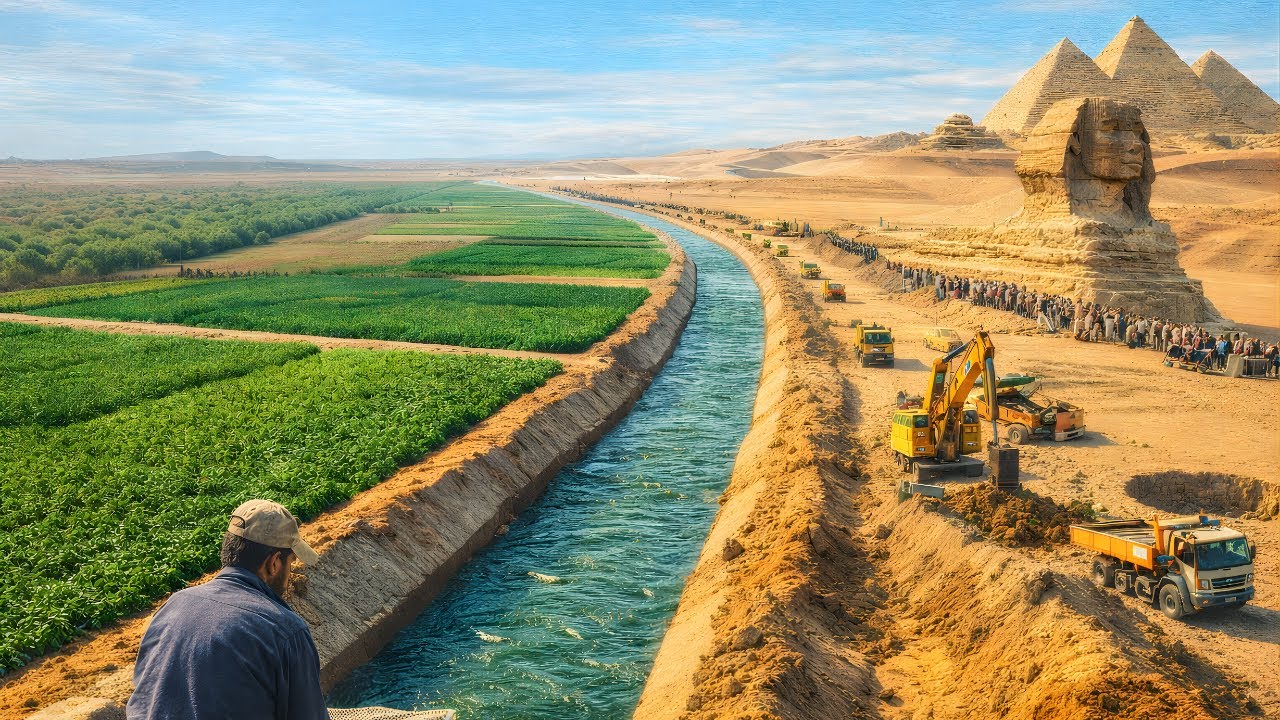
Toshka Project Took Water From Lake Nasser to the Egyptian Desert With Mega Pumps and Giant Canals, Aiming to Expand Agriculture and Occupy the New Valley.
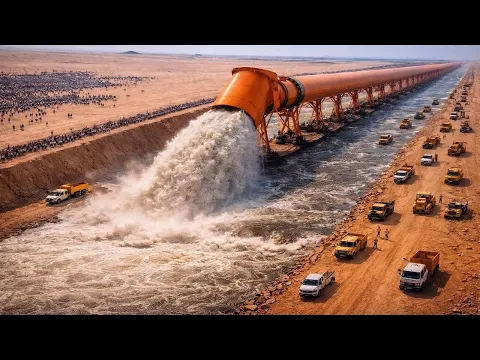
In southern Egypt, near Lake Nasser, between the governorates of Aswan and the New Valley, the Egyptian government launched in 1997 a megaproject of hydraulic engineering known as the Toshka Project, also associated with the territorial expansion plan called the New Valley Project. The initiative was conceived and executed under the responsibility of the Ministry of Water Resources and Irrigation of Egypt, then headed by Minister Mahmood Abu Zeid, with the goal of transferring water from Lake Nasser to desert areas in the southwest of the country through a large pumping station and a canal system known as the Sheikh Zayed Canal.
The project has been extensively documented by Egyptian government agencies, by technical engineering reports published since 2004, and by international coverage in the early 2000s, detailing costs, hydraulic capacity, and agricultural goals.
The Structural Context That Led to the Creation of the Toshka Project
The central motivation of the Toshka Project lies in Egypt’s extreme geography. More than 95% of the population and agricultural activity in the country are concentrated in a narrow strip along the Nile River, while the rest of the territory is dominated by arid deserts.
-
With a DNA shape, this bridge in Singapore draws attention in modern architecture and surprises tourists by transforming a simple crossing into an unforgettable visual experience in the urban heart.

-
Giant underwater pipeline begins to take shape with a R$ 134.7 million project at the Port of Santos: the 1.7 km structure uses 12-meter and 700 mm pipes to supply water to 450,000 people in Guarujá.
-
A mason reveals a professional plastering technique that uses aligned guides and a 3-meter ruler to plaster an entire wall in up to 3 hours, without visible seams, with uniform thickness, perfect plumb, and a finish ready for painting without rework.

-
The project that was supposed to be ready for the 2014 World Cup in Brazil debuted with a 12-year delay and nearly R$ 6 billion invested: the Line 17-Gold of the São Paulo monorail opened with reduced hours and is only expected to operate fully in October.


Since the second half of the 20th century, successive Egyptian governments have discussed ways to “decongest” the Nile Valley and expand human and productive occupation to the western desert.
The Toshka emerges, in this context, as an attempt to use the vast volume of water stored in Lake Nasser, created by the Aswan Dam, to enable irrigated agriculture in previously unproductive regions.
The Pumping Station of Lake Nasser and Its Energy Scale
The technical heart of the Toshka Project is the pumping station installed on the banks of Lake Nasser, often referred to in technical documents as the Mubarak Pumping Station.
According to a technical dossier published in 2004 by the specialized magazine Gulf Construction, the station was designed with 24 large pumps, totaling an installed capacity of approximately 375 megawatts.
This power is necessary to lift the water from the reservoir and push it against a hydraulic gradient estimated at about 50 meters.
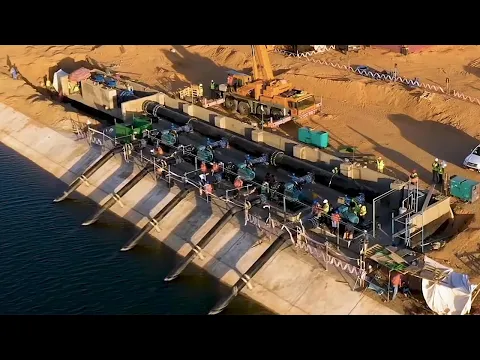

The projected maximum annual capacity of the pumping system is about 5.4 billion cubic meters of water per year, a number that in itself reflects the ambition and the energy weight of the undertaking.
The Sheikh Zayed Canal and the Engineering of Water Conveyance in the Desert
After being lifted by the pumping station, the water is conveyed through a canal system known as the Sheikh Zayed Canal. Reports published in 2001 by the AFP agency, reproduced by regional outlets, quote statements from Minister Mahmood Abu Zeid stating that the canal would have a total length of about 310 kilometers, with approximately 30 meters in width at the bottom, reaching almost 60 meters at the surface, and an average depth of 6 meters.
However, more detailed technical descriptions published by engineering firms involved in the project indicate that the system consists of a main canal of about 50 kilometers from the pumping station, accompanied by four large lateral branches of approximately 22 kilometers each, intended for distributing water to specific agricultural areas.
The difference in numbers reflects different ways of accounting for the complete system, including main sections and planned branches.
Agricultural Goals, Project Phases, and Political Promises
Since its launch, Toshka was presented as a phased project, with progressive goals for agricultural occupation.
In public statements in the early 2000s, the Egyptian government spoke of transforming extensive areas of desert into arable land, utilizing continuous irrigation and crops adapted to the arid climate.
However, many of these goals were expressed in political terms and varied over time, which requires caution in interpreting them as effective results.
Costs, Investments, and What Was Officially Declared
Financially, data published in 2001, attributed to then-Minister Mahmood Abu Zeid in reports by AFP, indicate that the accumulated investment in Toshka had reached about 711 million dollars at that time, with total cost estimates of around 1.2 billion dollars for the initial phases of the project.
These figures refer to the specific period of the statements and do not represent a consolidated final cost but are important for being officially recognized figures by the Egyptian government at the time and widely reported by the international press.
The Weight of Continuous Pumping and the Physical Limits of the Project
One of the main structural challenges of Toshka lies in the fact that the entire operation depends on active and continuous pumping.
Unlike traditional irrigation along the Nile, which benefits from the natural flow of the river, Toshka requires a permanent consumption of electrical energy to maintain the transportation of water.
This creates a delicate equation between operational cost, energy availability, and agricultural return. In addition, open channels in desert regions are subject to losses due to evaporation and infiltration, requiring lining, constant maintenance, and strict leak control to preserve hydraulic efficiency.
Environmental Pressures and Concerns About Water Sustainability
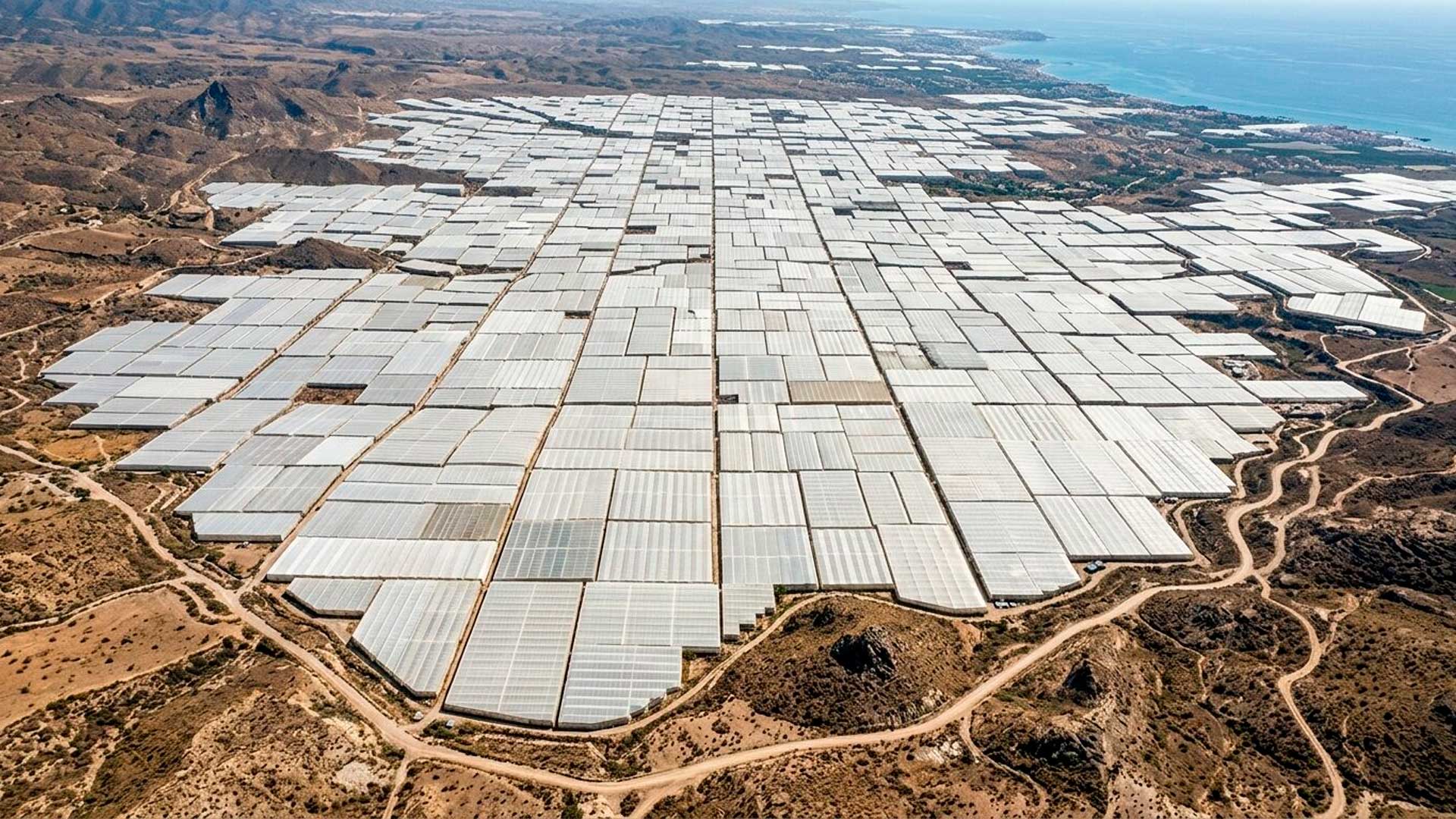
Recent technical studies about the Toshka region and the surroundings of Lake Nasser, published in scientific journals specialized in water resources, analyze the environmental impacts associated with agricultural expansion in the desert.
Research that evaluated data from 2016 and 2022 highlights the need to monitor water quality, soil salinization, and limits of water exploitation in a system that depends on both surface water and, in some areas, groundwater aquifers.
These studies do not classify the project as unfeasible, but they point out that its continuity depends on rigorous water governance and constant adjustments in the scale of water use.
Why the Toshka Project Entered the Review Phase
Over the years, Toshka has come to be seen less as a definitive solution and more as a large-scale engineering experiment subject to revisions.
Population growth, pressures on the Nile, climate change, and energy costs have made it clear that irrigating the desert on a billion-meter-cubic scale is not just a matter of infrastructure, but of national resource balance.
Thus, the project remains active in parts, but with an adjusted pace, more cautious goals, and greater attention to the country’s water limits.
Summary Timeline of the Toshka Project
In 1997, the Egyptian government officially launched the Toshka Project as part of the New Valley plan. In the early 2000s, the Ministry of Water Resources and Irrigation released public data on costs, pumping capacity, and progress of construction.
In 2004, technical reports detailed the installed capacity of the pumping station and the projected annual capacity of the system.
Starting in the 2010s, scientific studies began to assess environmental impacts and sustainability limits of agricultural expansion in the Toshka region, leading to a gradual reassessment of the project’s role within Egypt’s water strategy.








-

2 pessoas reagiram a isso.