





 Portuguese
  English
  Spanish
  5 min of reading
  0 comments


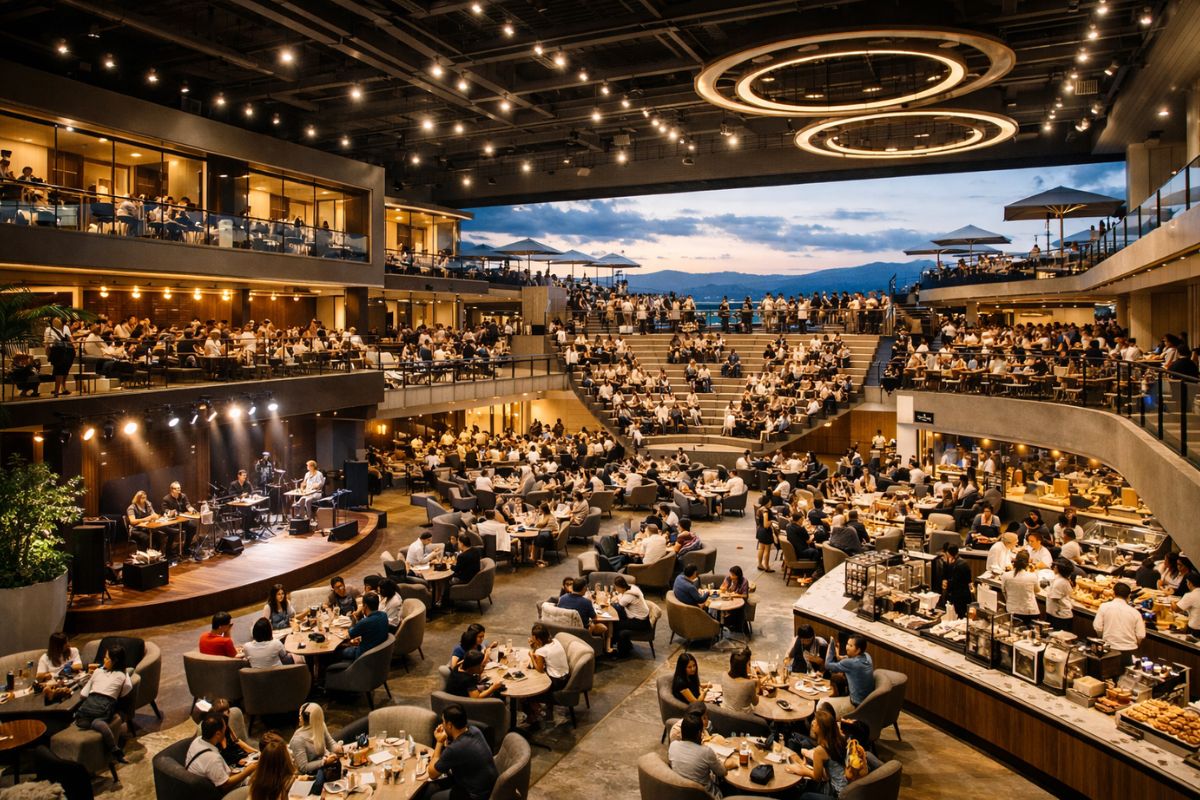
World’s Largest Coffee Shop Becomes A Laboratory of Spaces, With 2,190 Seats and A Guinness Seal, Where The Terrace, Private Rooms, Floor Areas, Children’s Park, and Arena-Style Sections Reorganize The Consumption Experience, Create Internal Routes, and Transform A Simple Visit Into An Event Agenda Year-Round
The world’s largest coffee shop, recognized by Guinness and capable of seating 2,190 people, has become a practical study on how architecture and operation can devour the concept of a “regular coffee shop.” The Positive Space, as it is called, is described as a set of different environments designed to encourage the public to circulate and spend time, not just drink.
In practice, what sustains its fame is not just the volume, but the variety of uses: terrace, private rooms, open area, area to sit on the floor, an arena-shaped sector for K-Pop videos, and reservable spaces for larger gatherings. The coffee shop operates as a cultural equipment, with a logic of flow and occupancy.
A Record That Becomes A Large-Scale Operation

Guinness recognizes the world’s largest coffee shop for its capacity of 2,190 seats, but this number only makes sense when it becomes routine.
-
Friends have been building a small “town” for 30 years to grow old together, with compact houses, a common area, nature surrounding it, and a collective life project designed for friendship, coexistence, and simplicity.

-
This small town in Germany created its own currency 24 years ago, today it circulates millions per year, is accepted in over 300 stores, and the German government allowed all of this to happen under one condition.

-
Curitiba is shrinking and is expected to lose 97,000 residents by 2050, while inland cities in Paraná such as Sarandi, Araucária, and Toledo are experiencing accelerated growth that is changing the entire state’s map.

-
Tourists were poisoned on Everest in a million-dollar fraud scheme involving helicopters that diverted over $19 million and shocked international authorities.


Seating 2,190 people implies managing circulation, cleaning, noise, and queues, in addition to a design that prevents the public from seeing just a repeated hall.
Fragmentation into environments is the operational answer. Instead of a single corridor with tables, the space divides into zones with their own identities that redistribute occupancy throughout the day.
This reduces the feeling of “mass” and creates internal micro-destinations that compete for attention, photos, and time spent.
Multiple Spaces Instead of A Single Hall

The account describes “a little bit of everything for everyone” as the central concept.
There are private rooms for smaller groups, open areas for those who just want to sit, and a section where people sit on the floor, changing ergonomics and time spent.
The world’s largest coffee shop behaves like a building with simultaneous programming, not just counters and tables.
The terrace appears as a strategic piece of this diversity.
It creates an external layer with a view and a feeling of “escape” from the inner core, in addition to operating as an occupancy valve in hotter times.
By the end of February, when it’s cold, the terrace would be empty, but it is expected to see more use as we transition to April, May, June, and July.
Cultural Arena, K-Pop, and Coffee as A Setting
One of the spaces is described as a “terrace where you could sit like in a stadium to watch K-Pop,” and this changes the consumption function.
Coffee stops being the center and becomes an excuse for the experience, like in cultural arenas where the audience pays to occupy the space.
This design also helps explain why the world’s largest coffee shop becomes a point of internal tourism.
The visitor is not just after an espresso, but a circuit: walking, choosing an environment, taking pictures, changing areas, and repeating.
Guinness becomes a seal of entry, but the arena ensures retention.
Events, Reservations, and The Logic of Planned Occupancy

In addition to spontaneous flow, the venue is described as capable of hosting events, including gatherings of 100 or 200 people in a large reservable hall.
This layer of scheduling transforms the space into a revenue-generating platform through rentals, reducing reliance on counter peaks.
Coffee becomes a component within an events structure.
The account also mentions a shopping event and the existence of a “speakeasy” area, suggesting thematic zones that function as internal surprises.
This strategy is typical of entertainment environments: offering discovery, maintaining circulation, and encouraging return visits.
In less than a year of operation, with the opening noted in April 2023, the perception is of an increasing audience over time.
Price and Quality: When The Atmosphere Matters More Than The Drink
The account makes a straightforward observation: coffees cost US$ 8 or US$ 9, with the reading that you pay for the atmosphere more than the quality of the drinks.
The evaluation of food appears as a credibility test because a huge place can become a “white elephant” if the basics fail.
In spaces of this size, the public’s standard rises precisely because the record creates expectation.
The mentioned pizza costs US$ 20 and positively surprises in size and cost-effectiveness based on perceived standards. At the same time, there is criticism of the crust and texture, considered “doughy” and not crispy, with the sauce described as acceptable within local standards.
The world’s largest coffee shop, therefore, does not escape comparison: the record attracts, but the quality on the plate and in the cup decides if returns happen.
Why Scale Changes The Idea of A “Regular Coffee Shop”
When a place can accommodate 2,190 people and still offers a terrace, private rooms, and an arena-style section, it stops competing only with coffee shops.
It starts to compete with leisure spaces, community centers, and even event areas.
The Guinness record becomes an argument, but the architecture becomes the product.
This logic also explains why the debate is not just tourist-based.
The model is replicable as an idea: multiply environments, create an “internal route,” and sell time spent.
The world’s largest coffee shop stands as a synthesis of a larger phenomenon, where consumption and setting blur, and what was a quick pause becomes a complete program.
The world’s largest coffee shop, with its Guinness record and 2,190 seats, challenges the notion of coffee as routine because it operates as a set of environments, from the terrace to the private rooms, passing through a cultural arena and an event agenda.
The record is the hook, but the engineering of the space is what retains the public.
If you had a place like this in your city, which environment would make you stay longer, the terrace, private rooms, or the arena-style area? And, being honest, would you pay US$ 8 or US$ 9 for a coffee just for the experience?










-

-

2 pessoas reagiram a isso.