





 Portuguese
  English
  Spanish
  6 min of reading
  3 comments


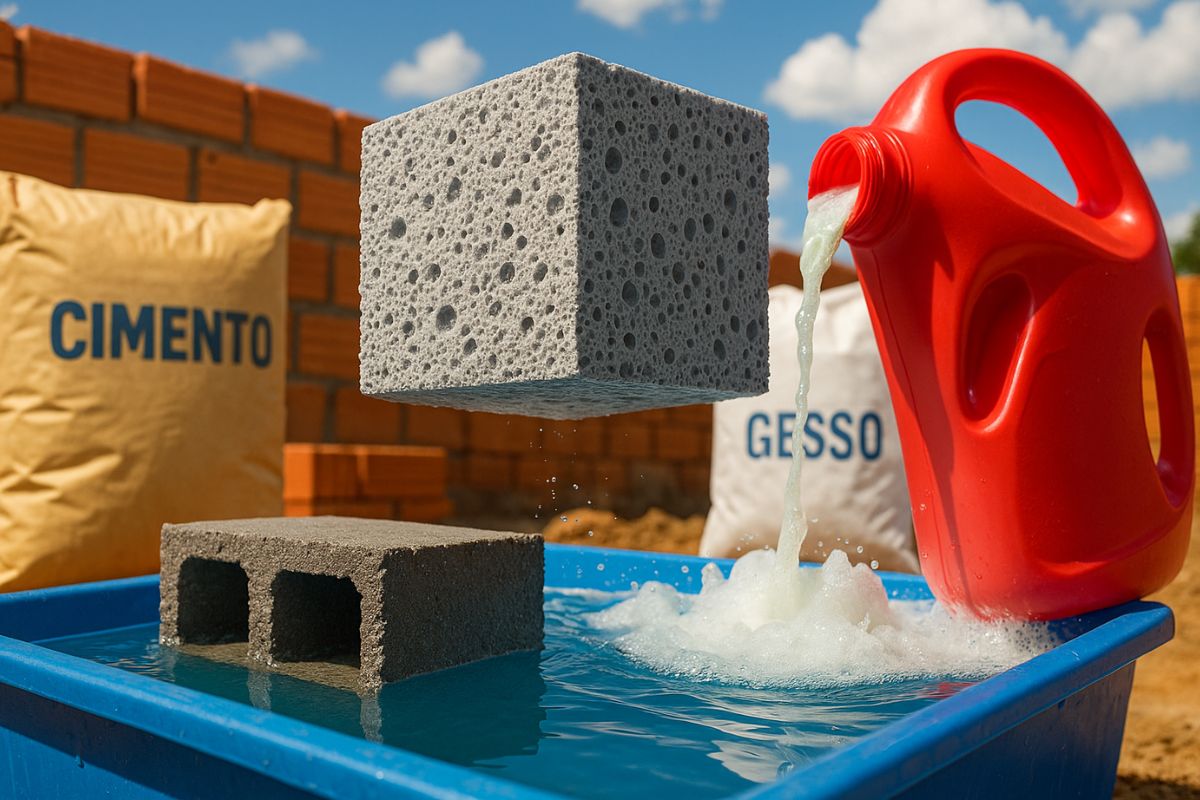


Experimental Mixture With Cement, Gypsum, Detergent, And Microbubbles Of Air Creates A Block 70% Lighter Than Traditional Concrete, Capable Of Floating In Water Without Losing Apparent Structural Rigidity
In a detailed bench experiment, a content creator in civil construction demonstrated how the combination of cement, gypsum, detergent, and water can result in a block 70% lighter than concrete, with such a reduced density that the piece is able to float in a basin filled with water. The proposal is not to immediately replace conventional concrete in critical structures, but to reveal the potential of alternative mixtures based on trapped air and stable microbubbles.
The formula is made from common materials, easily found at any construction site, but applied in a laboratory logic: measured water, precise dosage of additives, control of proportions, and use of fiberglass for reinforcement. The result is a block 70% lighter than concrete, with a creamy texture in the fresh phase, high final volume, and an unusual behavior after curing, combining low apparent mass and sufficient strength for handling, cutting, and drilling without immediate fractures.
How The Block 70% Lighter Than Concrete Comes To Be
The starting point of the experiment is assembling a carefully measured mix.
-
With more than 635,000 doctors, Brazil sees competition increasing in large cities, and recent graduates are competing for shifts at an accelerated pace while the countryside still faces shortages.

-
The world’s first octopus farm wants to open in the Canary Islands and is already provoking an international reaction: the plan aims to produce 3,000 tons per year.

-
Drought may be creating stronger superbugs in the soil and helping antibiotic resistance reach hospitals, warns a study highlighting a problem that could grow alongside extreme weather.

-
The biggest scam in history: Napoleon’s France deceived the United States by selling them a territory that was Spanish.


Into the mix go 5 liters of clean water, 7 kg of cement, 1 kg of gypsum, 35 g of chopped fiberglass, and 50 ml of plasticizing additive, all combined in a specific sequence.
The test mold is a wooden box measuring 50 cm long, 20 cm wide, and 10 cm high, prepared with used motor oil to prevent sticking during demolding.
This liquid base, still resembling a traditional cement mix, only transforms into a block 70% lighter than concrete when it receives the component that changes everything: a foam rich in microbubbles of air generated from household detergent.
The volume gain is visible and immediate, altering the density, fluidity, and appearance of the mixture.
The Role Of Detergent And The Formation Of Microbubbles
The detergent is not added directly to the cement. Instead, it is transformed into stable foam in a 30-liter drum.
With 150 ml of dishwashing detergent and 1 liter of water, an improvised concrete mixer attached to a drill, adapted with steel wool and plastic clamps, creates a foamy mass that fills the entire volume of the container.
This foam is the heart of the block 70% lighter than concrete.
The microbubbles of air generated by the detergent act as a lightness aggregator.
When incorporated into the cementitious mass, they drastically reduce the specific weight without disintegrating the structure.
Instead of dense concrete, what is obtained is a controlled porous composite, in which air becomes part of the internal “skeleton” of the material.
Mixture, Plasticization, And Reinforcement With Fiberglass
While the foam is prepared, the cement base is assembled in another container.
First, water and plasticizing additive are combined to facilitate workability.
Then, the 7 kg of cement is incorporated in stages, with the aid of a drill with a mixing paddle, until the paste becomes homogeneous, free of lumps, and with no powder accumulated at the bottom.
The addition of 35 g of chopped fiberglass has a clear technical function: to create a network of micro-reinforcements, reducing cracks and increasing internal cohesion.
This step is crucial so that the block 70% lighter than concrete does not become too brittle.
The mass gains body but still maintains sufficient fluidity to receive the detergent foam later without losing uniformity.
When The Foam Comes In And The Volume Soars
With the base already plasticized and reinforced, the decisive step begins.
The foam created with detergent is gradually added to the cement container under continuous stirring.
Visually, the effect is immediate: the level of the mixture rises, the apparent weight decreases, and the texture changes to something described as creamier, lighter, and more aerated.
It is at this moment that the block 70% lighter than concrete truly begins to take shape.
The sound of the drill decreases because the mass offers less resistance.
The color softens, and the mixture begins to behave like a homemade cellular concrete, where air is distributed in millions of microcavities.
Still, the cement paste and fiberglass ensure integrity and cohesion.
Gypsum As Accelerator And Critical Time Step
The final stage of the mixture involves the introduction of 1 kg of gypsum, which acts as an accelerator and agent for initial rigidity.
The reaction is quick, necessitating the completion of the mixture and pouring within a few minutes.
After the complete incorporation of the gypsum, the material reaches the ideal point for molding.
It is at this state that the foamed mass, the base of the block 70% lighter than concrete, is poured into previously greased molds, without the need for vibration.
The fluidity is sufficient to fill corners and edges, and the low density prevents segregation.
The curing environment must be ventilated, dry, and protected from rain, a fundamental condition for cement, gypsum, and foam to consolidate into a uniform and stable matrix.
Curing, Demolding, And Weight Difference Compared To Regular Concrete
After about 36 hours of curing, the demolding phase begins.
The gradual removal of the sides of the molds reveals a block with a smooth surface, well-defined corners, and a surprisingly homogeneous texture.
To the touch, the material does not behave like heavy concrete.
According to the experiment, a block of equivalent dimensions would weigh, in traditional concrete, something close to 24 kg, while the piece produced by the foamed mixture reaches around 7 kg, consolidating the idea of a block 70% lighter than concrete.
Despite the significant weight difference, the product maintains sufficient resistance to be handled, transported, cut with a saw, and drilled without collapsing immediately.
The Test That Caught Attention: The Block That Floats In Water
The most didactic moment of the experiment is the flotation test.
In a large basin of water, the already cured block is carefully placed on the surface.
Instead of sinking, as would be expected for a dense cement element, the block 70% lighter than concrete remains floating, completely supported by the water.
The explanation lies in the network of microbubbles of air trapped internally.
By reducing the overall density of the material to values lower than the density of water, the buoyancy becomes sufficient to keep it on the surface.
The visual test reinforces the idea that this homemade technology approaches, in concept, cellular concrete and lightweight materials used industrially, even if on an experimental scale.
Potential Uses And Limits Of Such A Light Material
From a technical standpoint, a block 70% lighter than concrete opens up important discussions for applications where weight is a critical factor, such as light fillings, non-structural elements, decorative panels, thermal or acoustic insulation.
The ease of cutting and drilling demonstrated in the experiment also favors modular and customized solutions.
However, caution is needed. The experiment does not include formal tests for compressive strength, durability, fire resistance, or adhesion with other materials.
Therefore, any structural use would be inappropriate without standardized tests.
The value of the test lies, above all, in demonstrating the potential of the technique to inspire studies, prototypes, and more in-depth research into lightweight materials based on microbubbles of air.
What The Experiment Teaches About Innovation In Construction
More than a ready-made recipe, the experiment of the block 70% lighter than concrete shows how understanding the chemical and physical behavior of common materials can generate unexpected solutions.
Cement, gypsum, detergent, and fiberglass, used daily in different contexts, gain a new role when combined with method, measurement, and process control.
The creation of a composite that floats, reduces weight by over 70%, and still maintains resistance for handling exposes the space that exists between “do-it-yourself” and formal engineering, especially when the practice is conducted with care, visual documentation, and well-defined steps.
For you, who follow trends in construction and materials, would a block 70% lighter than concrete be something you would consider using in renovations or decorative projects, if there were technical reports proving safety and durability?








Eu trabalho com cubas de concreto artesanal alto padrão e placas de gesso 3d bem como placas cimenticia vou fazer uma experiência com essa técnica pra ver se aprova
36 horas para desenformar??? Pra que gesso então se com cimento puro desenformar em 24 horas?
Engenharia química responde: o tempo de cura para a maior resistência depende da composição dos materiais e não de um material da composição.
O tempo de cura maior, deve ser para atingir o nível de resistência desejado.
Considerando o aumento de volume, e redução de peso, o tempo maior na produção não inviabiliza o processo.