





 Portuguese
  English
  Spanish
  6 min of reading
  1 comment


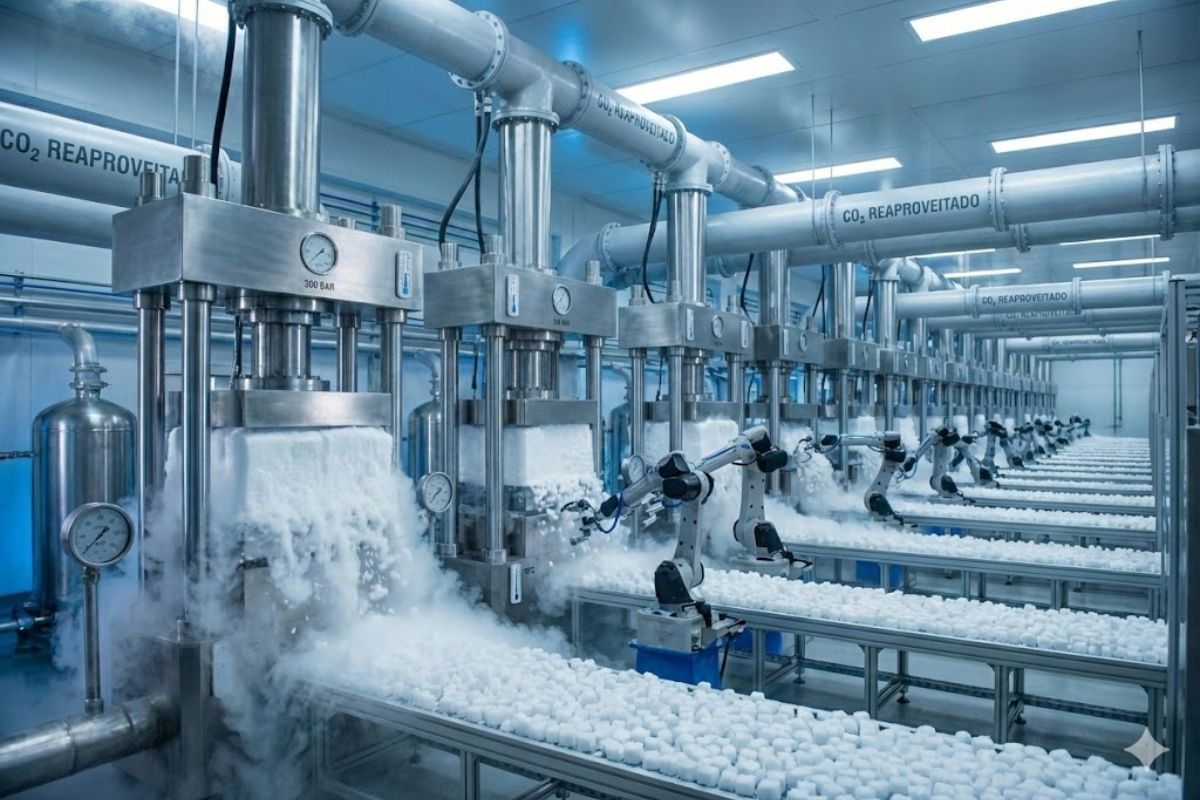


With Recycled Industrial CO2, Dry Ice Factories Compress Carbon Dioxide, Generate Carbon Snow, Mold Blocks and Pellets of Dry Ice Under Up to 300 Bar, and Use This Extreme Refrigeration in the Transport of Vaccines, Organs, Frozen Foods, and in Creating Special Effects at Scale Around the World
In 1835, when French chemist Adrian Jean-Pierre Thilorier observed that liquid carbon dioxide, when released from a high-pressure container, left behind a white, solid mass, he could not have imagined that this material would be known as dry ice and become a central piece of the global refrigeration chain. Decades later, starting in the 1920s and especially during World War II in the 1940s, dry ice began to be used to preserve food, vaccines, and medications, establishing itself as one of the most strategic inputs in cold logistics.
Today, factories in different countries recycle industrial CO2, operate at pressures of about 300 bar, produce carbon snow at around 78 degrees below zero, and convert this polluting gas into blocks and pellets of dry ice. This ensures extremely low temperatures for transporting vaccines, transplant organs, frozen foods, and even creating special effects in cinemas, shows, and events around the world.
What Is Dry Ice and Why Does It Behave Differently
Dry ice is simply carbon dioxide in a solid state. Unlike water ice, which melts and turns into liquid, dry ice sublimates directly from solid to gas, in a process called sublimation.
-
Remains with battle wounds of over 100 soldiers from the Roman Empire are found beneath a football field in Vienna, leaving everyone surprised.

-
Elon Musk notes Brazil and lowers the price of his internet, Starlink, promising to connect all corners of the country with affordable plans, 10,000 satellites, and 1 million active users in the national territory!

-
Man creates an infinite source of FREE electricity at home with a PVC wind turbine using a repurposed motor.

-
An aquatic seed consumed for centuries in Asia is going viral in the West after studies highlighted its antioxidant compounds and potential anti-inflammatory properties. It pops like popcorn, has low fat content, and is already being called the new functional snack.


This means that dry ice does not leave puddles of water when it “melts”, which is a huge advantage in applications requiring intense cold without moisture.
In practice, when exposed to room temperature, dry ice gradually evaporates, releasing CO2 without generating liquid waste.
At around minus 78.5 degrees Celsius, it can freeze a strawberry in seconds, preserve sensitive materials for long periods, and generate a dense fog when placed in hot water, which is widely used in special effects.
This combination of extreme temperature and lack of moisture is what makes dry ice so valuable for modern industry.
From the Discovery of 1835 to Expansion in the Global Industry

Although it was identified in 1835, the practical use of dry ice only gained scale nearly a century later.
In the 1920s, chemical companies began to produce dry ice commercially, mainly for the transport of meats and dairy products, as the material kept products frozen without melting into water like conventional ice.
During World War II, the use of dry ice expanded even further.
It became essential for preserving vaccines, medications, and food intended for troops, ensuring that sensitive loads could survive long journeys without access to electrical refrigeration systems.
From then on, dry ice ceased to be merely a laboratory curiosity and quietly integrated into the logistical and healthcare infrastructure of various countries.
How Industrial CO2 Becomes Raw Material for Dry Ice
The industrial chain of dry ice begins before the factory, in the carbon dioxide emissions from various productive processes.
Instead of releasing the gas directly into the atmosphere, companies capture and purify it, creating a valuable raw material for refrigeration.
Among the main sources of CO2 are:
- Sugar fermentation in breweries and distilleries
- Production of ammonia for fertilizers
- Refinery processes and chemical industries
- Combustion in thermal power plants, as long as the gas goes through purification
This carbon dioxide is filtered to remove solid particles and impurities, passed through gas scrubbers, and directed to a compression system.
By concentrating CO2 that would be emitted, dry ice factories turn a polluting gas into a high-value input, even though the use does not eliminate the final emission but delays and controls the moment the gas returns to the atmosphere.
From Liquid CO2 to Carbon Snow in Seconds

Once purified, CO2 is compressed to about 15 bar of pressure and cooled to approximately minus 20 to minus 30 degrees Celsius, transitioning to the liquid state inside stainless steel cryogenic tanks, designed to withstand high pressures and low temperatures.
These tanks can store thousands of tons of liquid carbon dioxide, keeping the gas ready for the production of dry ice.
When the liquid CO2 is sent to manufacturing machines, the pressure is reduced to something around 5 bar, in a rapid expansion process.
This sudden drop in pressure causes instant cooling, causing some of the carbon dioxide to transform into small solid particles, a type of extremely cold carbon snow.
Another portion of the CO2 returns to the gas state and is recovered in ventilation and recycling systems, reducing waste.
The carbon dioxide snow accumulates inside the machine, forming a fine and loose powder that resembles real snow, but is at about 78 degrees below zero, ready for the next step: compacting into blocks or pellets of dry ice.
300 Bar Presses that Mold Blocks and Pellets of Dry Ice
To transform the carbon snow into solid dry ice, factories use hydraulic presses that apply pressures of up to 300 bar on specific molds.
Large amounts of CO2 snow are deposited into rectangular molds, and a hydraulic piston compresses the material until the particles clump together into a compact block of dry ice, still at approximately minus 78.5 degrees Celsius.
These blocks of dry ice are then ejected from the mold and cut into different sizes, according to customer needs.
Meanwhile, part of the production goes to extruders, where the carbon snow is forcefully pushed through calibrated openings, forming solid cylinders known as dry ice pellets.
Larger pellets, around 16 millimeters, are used for refrigeration and transport, while smaller pellets, about 3 millimeters, are common in dry ice blasting for cryogenic cleaning of industrial surfaces.
This versatility allows for adapting dry ice to different applications: larger blocks for long trips, medium pellets for coolers, and fine pellets for cleaning and specific industrial processes.
Storage, Transport, and Daily Sublimation of Dry Ice
After being compacted, dry ice continues to gradually sublimate, even in good storage conditions.
Generally, mass loss ranges between 5 and 10 percent per day, varying according to the type of packaging and ambient temperature.
Therefore, logistics is planned so that the product leaves the factory very close to the moment it will be used.
To transport blocks and pellets of dry ice, large thermal boxes made of polystyrene and other insulating materials are used, which function as passive coolers.
The idea is to keep dry ice as insulated as possible from external heat, prolonging its shelf life until the point of consumption.
As dry ice itself is around minus 78 degrees Celsius, it is not necessary to keep the boxes in electric cold chambers, as long as the insulation is well designed.
Before shipping, samples undergo tests for weight, dimensions, density, compaction, and purity, ensuring that the customer receives stable dry ice that meets safety standards for indirect contact with food, medications, and biological materials.
Where Dry Ice Is Indispensable: Health, Food, and Entertainment
Dry ice has become virtually invisible to the public, but it is critical at various points in the production chain.
In the food industry, it is used to ensure that frozen products arrive at their destination within the correct temperature range, especially on routes where no electrical power is available.
In healthcare, dry ice is essential for transporting vaccines, biological samples, and transplant organs, maintaining very low temperatures for hours or days, depending on the amount used and the quality of thermal insulation.
In laboratories, it helps preserve sensitive reagents and create controlled environments for experiments.
In the industrial sector, dry ice pellets are used in deep cleanings, in a process known as dry ice blasting.
In this technique, the pellets are shot at high speed onto surfaces, removing dirt, grease, and residue without leaving liquid or chemical remnants, as the material sublimates after impact.
In entertainment, dry ice brings to life that dense and low fog that appears on stages, theaters, and film productions, created when the material is placed in hot water, rapidly releasing CO2 in the form of a cold cloud. The same visual characteristic is also explored at parties, shows, and corporate events, enhancing the scenic appeal.
Given all this, knowing that dry ice comes from recycled industrial CO2 and is both a refrigeration solution and a source of controlled emissions, do you think the increasing use of dry ice helps make logistics chains more sustainable or just reorganizes the environmental impact of this gas in the atmosphere?





O co2 tbm é aquela sensação refrescante que sentimos ao beber refrigerante , cerveja , água com gás…..