





 Portuguese
  English
  Spanish
  7 min of reading
  10 comments


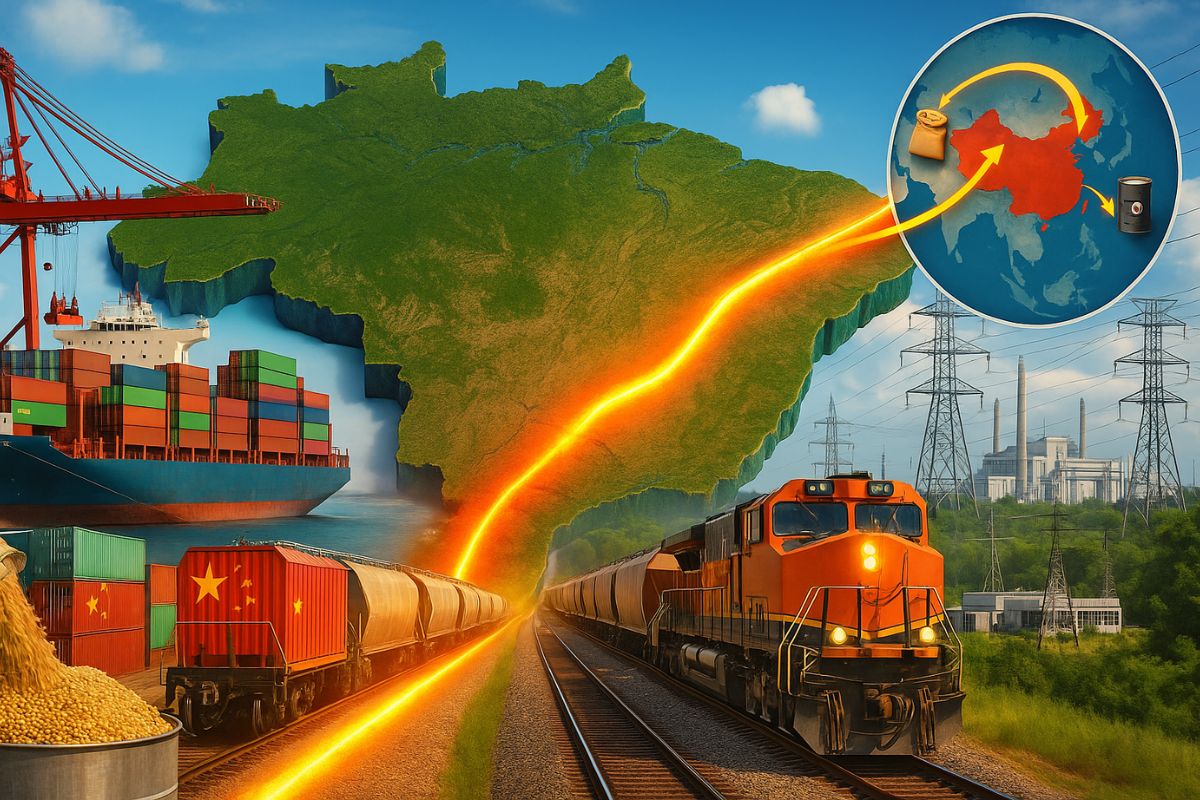


The Advancement of Chinese State-Owned Enterprises in Brazil Is No Longer Just a Matter of Grain Trade or Cargo Purchase in Ports. Gradually, They Are Weaving a Super Logistics Corridor Within the Country, Connecting Soybeans, Corn, Sugar, Oil, Electricity, Railways, Subways, and Intercity Trains in a Same Web of Interests, Capital, and Infrastructure.
The presence of Chinese state-owned enterprises begins in the Brazilian fields and ends at the power supply or fuel pump. In soybeans, for example, Brazil exports around 80% of production to China and, today, nine out of every 100 sacks of grain are shipped under the COFCO brand, a giant state-owned enterprise from that country. The Brazilian operation of the company is already the largest agricultural exporter in Brazil, with about 17 million tons per year in soybeans, corn, and sugar for various destinations.
At the same time, other Chinese state-owned enterprises are taking on significant roles in strategic ports such as Santos, Paranaguá, and Porto do Açu, entering into railway and passenger train projects between São Paulo and Campinas, and gaining space in energy distributors and hydroelectric plants. The result is a system where one Chinese company feeds another, reducing their logistical costs for soybeans and our oil, while Brazil cedes sensitive parts of the infrastructure that drives the economy itself.
From Soybeans to Sugar: Chinese State-Owned Enterprises at the Heart of Agribusiness
It all starts with the grain. For decades, the international trade of soybeans and corn was dominated by Western private trading companies such as Cargill, Bunge, and Louis Dreyfus. They purchase from farms, organize logistics via trucks, trains, and ships, and deliver to clients abroad.
-
A new Brazilian shopping center worth R$ 400 million will be built in an area equivalent to more than 4 football fields, featuring 90 stores, 5 cinemas, a supermarket, a college, and parking for 1,700 cars, potentially generating 3,000 jobs.

-
Larger than entire cities in Brazil: BYD is building a 4.6 km² complex in Bahia with a capacity for 600,000 vehicles per year, but the discovery of 163 workers in conditions analogous to slavery has shaken the entire project.

-
With an investment of R$ 612 million, a capacity to process 1.2 million liters of milk per day, Piracanjuba inaugurates a mega cheese factory that increases national production, reduces dependence on imports, and repositions Brazil on the global dairy map.
-
Brazilian city gains industrial hub for 85 companies that is equivalent to 55 football fields.


Now, the second largest grain trader in the world is COFCO, a Chinese state-owned enterprise operating exactly in that same space. The difference is that, in addition to purchasing Brazilian soybeans, it has also started investing in the infrastructure that moves that soy.
At the Port of Santos, COFCO was already operating two terminals and leasing third-party structures. In 2024, it partially opened its third terminal, known as TEC or STS11.
When it becomes fully operational, the company’s capacity in Santos will soar from about 4 million to approximately 14 million tons per year, making STS11 the largest COFCO terminal outside of China.
In practice, this means that the company begins to rely less on competitors’ infrastructure, consolidates its own cargo within a complex under its control, and drives down the export cost for Chinese clients, including the Chinese government itself, which owns the company. For Brazil, the grain continues to flow out, but now it passes through a funnel increasingly tied to Chinese state-owned enterprises.
Strategic Ports: Santos, Paranaguá, and the Oil of Porto do Açu
In the ports, the offensive of Chinese state-owned enterprises is not limited to agricultural bulk. It is making strong advances in containers and, more recently, in oil.
About 14 million containers circulate every year through Brazilian ports. Of these, 11% pass through TCP, the Container Terminal of Paranaguá, in Paraná.
Since 2018, TCP’s control has been part of the portfolio of CM Ports, a Chinese state-owned enterprise that is the largest container operator in that Asian country and currently ranks third in Brazil.
CM Ports signed an agreement with the Brazilian government to invest approximately 1.5 billion reais in the expansion of the terminal.
The goal is to increase cargo handling capacity and deepen Chinese presence in one of Brazil’s main container hubs, through which iPhones, auto parts, pharmaceuticals, clothing, and industrial equipment that fuel the daily economy pass.
In oil, the movement is even more sensitive. Porto do Açu, in the north of Rio de Janeiro, originated from Eike Batista’s old project and is now operated by Prumo Logística.
The complex has 11 terminals, and its oil arm accounts for about 30% of Brazilian exports of the product, receiving oil from offshore platforms and transferring it to large tankers that set sail.
In February 2025, CM Ports signed an agreement to purchase 70% of the oil terminal at Açu, retaining the remaining 30% with Prumo.
The deal still depends on the approval of regulatory bodies, but if completed, the Chinese state-owned enterprise will handle roughly 21% of Brazil’s oil exports, in a strategic asset for Brazilian energy and foreign policy.
Thus, the map begins to become clear. Chinese state-owned enterprises are growing in soy in Santos, in containers in Paranaguá, and in oil at Porto do Açu, forming a logistical arc that integrates food, energy, and international trade under Beijing’s command.
Trains and Subways: The Arm of Chinese State-Owned Enterprises on Brazilian Rails

The corridor of Chinese state-owned enterprises is not limited to the seaside. It also rises along the tracks and enters metropolitan areas.
One of the most symbolic projects is the Intercity Train that will connect São Paulo to Campinas.
The idea of connecting the two cities by rail has existed since the 19th century, but the service dwindled until it was deactivated in 1999. In 2024, the São Paulo government auctioned a new concession, in a project that anticipates around 14 billion reais in investments.
The structure of the winning consortium reveals another piece of the puzzle. Sixty percent of the project was retained by the Constantino family, through the Comporte Group.
The other 40% went to CRRC, a Chinese state-owned enterprise that is the largest train manufacturer in the world, responsible for about 90% of the market in China.
Of the total investments in the Intercity Train, approximately 8.98 billion reais will come from the São Paulo government. The remainder will be private, with CRRC’s share amounting to around 2 billion reais.
The inauguration is scheduled for 2031, and by then, the trains that will run on the line will be designed and assembled by CRRC itself.
The company’s presence does not end there. In 2025, CRRC won a bidding process to manufacture 44 new trains for the São Paulo subway, surpassing the traditional French supplier Alstom. The contract is worth 3.1 billion reais, and the trains will be assembled in Araraquara, in the interior of São Paulo.
With this, Chinese state-owned enterprises are providing not only the capital but also the equipment that runs on Brazilian tracks, connecting people, metropolitan regions, and economic hubs along this super logistics corridor.
Energy and Oil: When Infrastructure Also Speaks Mandarin
Ports and trains consume energy. And in Brazil, an increasing share of that energy is also in the hands of Chinese state-owned enterprises.
State Grid, the state-owned enterprise operating China’s electrical system, took control of CPFL, one of the largest distributors in the country. CPFL accounts for approximately 15% of electricity distribution in Brazil, serving millions of residential, industrial, and commercial consumers.
In generation, the advancing player is China Three Gorges, known as CTG. It accounts for about 3.5% of Brazil’s generating capacity, operating hydroelectric plants and other strategic assets.
Both State Grid and CTG are captive clients of the Chinese solar industry, purchasing panels from a country that produces about 80% of the world’s supply of this equipment.
In oil, the cycle closes. Part of the oil that arrives at Porto do Açu, targeted by CM Ports, comes from operations by Chinese oil companies like Sinoc, CNPC, and Sinopec, which operate in Brazilian waters.
Thus, the same state that controls energy distributors and solar panel producers also appears in oil fields and at terminals that export that production.
The design resembles Eike Batista’s old dream of a group of giant companies feeding off each other in mining, oil, energy generation, and logistics.
The difference is that now the controlling entity behind the chain is not an individual entrepreneur, it is the Chinese state itself, operating through various Chinese state-owned enterprises.
An Invisible Super Corridor and the Debate Brazil Has Yet to Have
When examined case by case, it seems just a succession of deals: a terminal in Santos, a terminal in Paranaguá, a stake in Porto do Açu, railway concessions, train supply, energy distributors, hydroelectric plants, offshore oil companies.
But, when viewed together, these investments by Chinese state-owned enterprises add up to a super logistics corridor that cuts across Brazil from end to end, linking soybean farms, transmission lines, industrial zones, export ports, container routes, and oil hubs into a single system financed and coordinated by a single foreign state.
For China, the benefits are clear. It reduces the cost of the soybeans it buys, gains efficiency in exporting the oil it helps extract, and strengthens domestic companies in trains, solar panels, and energy, keeping its factories busy and its industrial ecosystem active.
For Brazil, the balance is more complex. The investments bring capital, jobs, and modernization of assets that the country often cannot finance on its own.
At the same time, the concentration of strategic infrastructure in the hands of Chinese state-owned enterprises raises questions about sovereignty, bargaining power, and future dependency in critical sectors for economic growth.
In the end, what is at stake is not just who operates a terminal or signs a train contract, but who controls the flows of goods, energy, and people that structure the Brazilian economy. It is a discussion that touches on energy security, industrial policy, logistical integration, and Brazil’s own role in the global arena.
And you, do you think that this silent advance of Chinese state-owned enterprises over ports, trains, energy, and oil is a necessary opportunity for Brazil or too great a risk for our economic sovereignty?







APOIO! Já que os políticos corruptos só usurpam a nação que os chineses tomem posse de vez…
Precisamos de leis firmes para manter os investimentos interno, onde a nossa evolução técnica possa superar mão de obra vindo de fora e aprofundar nossa cultura de trabalho junto com o sentimento nacionalista, para um dia ser mós um país igual a China ou a Europa. Temos grande potencial para tanto.
É muito positivo, para o Brasil ter a China como parceira,e ampliar ainda mais seus negócios aqui no, Brasil.
Deixando de lado os Estudos Unidos e outros países, que ampliaram o Neocolonialismo e não deixam o País crescer.