





 English
  Francês
  Alemão
  Italiano
  Japonês
  Norueguês
  Portuguese
  Spanish
  4 min of reading
  1 comment


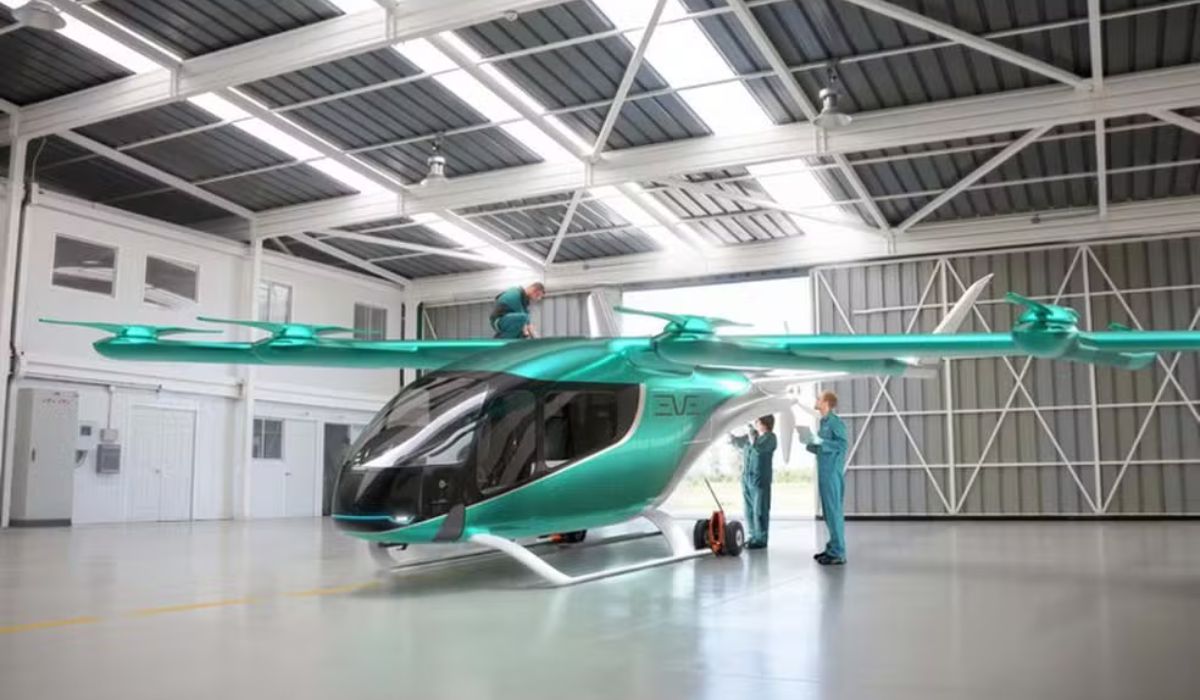


Billion-Dollar Funding Reinforces Brazilian Urban Air Mobility Project and Expands Global Competition for Electric Aircraft, While Company Advances in Testing, Certification, and Coordination with Regulators to Enable Commercial Operation of eVTOL in Large Cities.
Eve Air Mobility, a subsidiary of Embraer dedicated to urban air mobility, announced the hiring of a US$ 150 million funding with a term of five years to continue the development of its electric vertical takeoff and landing vehicle, the eVTOL, often referred to as a “flying car”.
With the new operation, the company reported that the total amount of funds raised amounts to US$ 1.2 billion.
Converted to reais by the average exchange rate of the commercial dollar at the announcement period, the amount is approximately R$ 6.5 billion.
-
Chaos On Airplane Could Be Expensive: Proposal Aims To Prevent Disruptive Passengers From Flying For Up To 1 Year In Brazil And Face Fines Of Up To R$17,500

-
Man Arrested After Halting Takeoff of Fire Department Helicopter During Child Rescue in Guaratuba

-
With 37 Tons of Cargo, Over 8,000 km Range, and Ability to Land on Unpaved Runways, the Airbus A400M Demonstrates How Europe Created a Military Giant That Transports Armored Vehicles, Aerially Refuels Fighters, and Operates in Conflict Zones and Humanitarian Missions Worldwide
-
Emergency Landing in Campos Amarais After Bird Strike on Small Plane

However, the company did not specify whether it uses a specific exchange rate for its internal projections or for the presentation of financial results.
Involved Banks and Loan Structure
The funding was structured as debt and involved the participation of Itaú, Banco do Brasil, Citibank, and Mitsubishi UFJ Financial Group.
According to Eve, the agreement is part of the financial strategy to support the upcoming phases of the eVTOL development program.
Despite the announcement of the total amount and loan term, publicly disclosed information such as interest rates, guarantees involved, or the schedule for releasing funds was not provided.
These details typically remain confidential in operations of this type, according to common practices in the financial market.
Destination of Funds and Focus on Research and Development
The company reported that the funds will primarily be directed toward research and development.
This includes not only the advancement of the aircraft itself but also the integration of the eVTOL into a broader urban air mobility ecosystem, which involves ground infrastructure, air traffic management systems, operational models, and certification processes.
According to Eve itself, this set of elements is considered essential to enable future commercial operations.
Unlike traditional aviation, the eVTOL proposal foresees flights in dense urban areas, with takeoffs and landings at smaller structures, which requires regulatory adaptation and coordination with local authorities.
In this context, topics such as the implementation of vertiports, compatibility with existing air traffic control systems, and the definition of specific routes and altitudes for this type of aircraft come into discussion.
These points are still in development in different countries and cities.
Testing of eVTOL and Progress of Full-Scale Prototype

In technical terms, Eve reported that it conducted the first flight of the full-scale engineering prototype of its eVTOL at the end of 2025.
The test marked the beginning of a more advanced stage of the program, aimed at validating systems, controls, and the aircraft architecture under real operating conditions.
The company stated that the testing campaign is expected to be expanded throughout 2026, with new flights and technical evaluations.
The goal, according to previously disclosed information, is to gather data that supports the certification process with aviation authorities.
International press reports noted that the inaugural flight occurred at Embraer’s facilities in the interior of São Paulo.
These same publications indicate that the company is working with the prospect of certification and the start of commercial operations from 2027, after adjustments to the initially disclosed schedule.
Aviation Certification and Regulatory Requirements
Certification is pointed out by industry experts as one of the most sensitive stages for eVTOL projects.
The process involves proving safety, performance, and reliability requirements, as well as establishing specific standards for a type of aircraft that does not yet operate on a large scale in urban transport.
In Brazil, initiatives related to electric aviation and technological innovation have received support from public funding instruments.
In previous statements, representatives of institutions such as Finep emphasized that projects of this type are aligned with strategies for technological development and the transition to more sustainable forms of aviation.
Potential Markets and Challenges for Urban Operations
Regarding the market, Eve and other companies in the sector often point to large urban centers as potential areas for initial operations.
Cities such as São Paulo, New York, Paris, and Dubai frequently appear in studies and public presentations as locations with potential demand for urban air mobility services.

Still, analyses published by international outlets emphasize that commercial viability will depend on factors such as local regulation, public acceptance, availability of adequate infrastructure, and technological limitations, especially related to battery range.
With the new funding, Eve reported that it seeks to maintain the pace of development and advance discussions with regulators, industry partners, and operators.
The effective schedule for starting operations, however, remains contingent on meeting the technical and regulatory steps outlined for the aviation sector.
As companies accumulate resources and advance their testing, the question remains as to when regulatory milestones and urban infrastructure will be prepared to incorporate this new type of air transportation into the daily lives of large cities.











Esse assunto de ” carro voador” já tá cansando! Nao tem nada de extraordinário nisso ai. O helicóptero ja fez 50 anos e os drones ja voam a mais de 10.! Acho que isso ja tá é atrasado tem muito financiamento envolvido. Nisso e ” tempo de desenvolvimento ” muito extenso é gasto. E Quando finalmente chegar no mercado corre o risco pode ter outros 150 fabricantes com seus modelos prontos quem sabe melhores ou até mais baratos. Isso aí não é nada mais que um drone em escala. Já deveria estar pronto. Mete marcha nisso instala um paraquedas de emergência. Testa Aprova e lança logo. Caso contrário corre o risco de ser mais uma empresa ” voo de galinha “!