





 Portuguese
  English
  Spanish
  6 min of reading
  0 comments


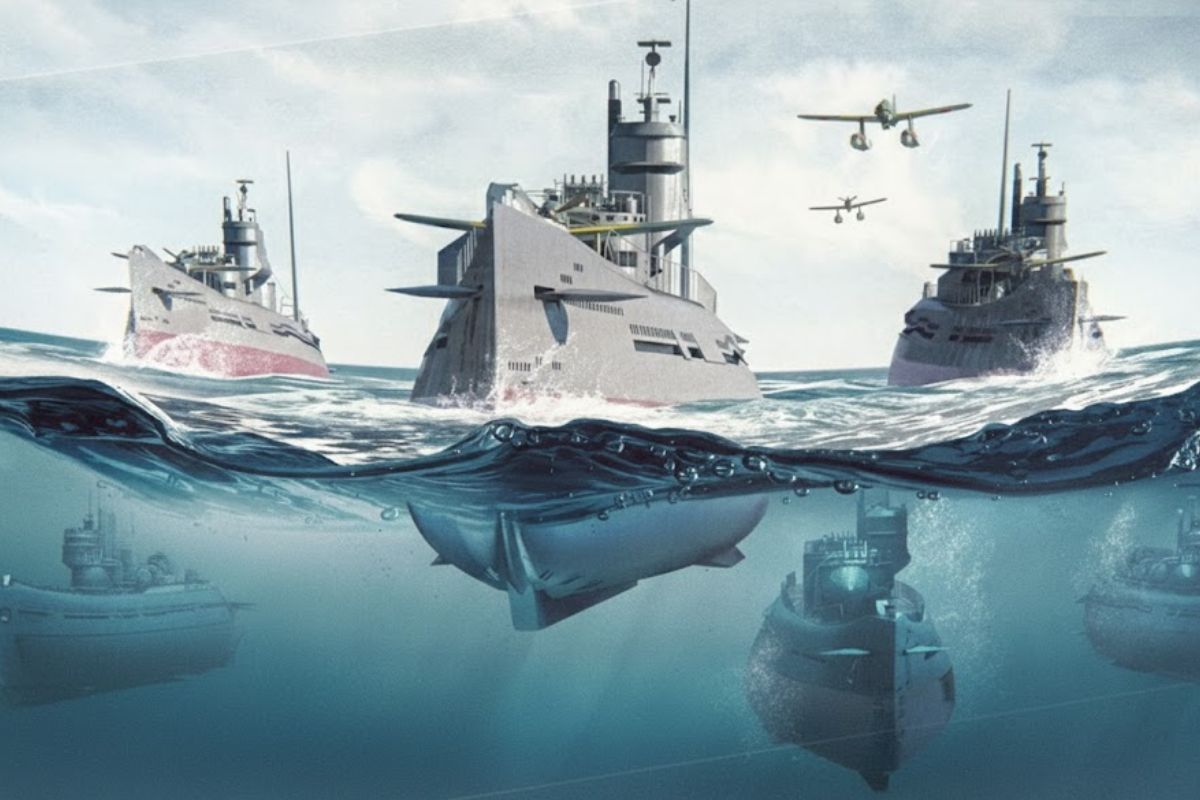
The Japanese Submarine I-400 Carried Folding Bombers In An Internal Hangar, Launched By Catapult And Retrieved By Crane, With Fuel To Cross The Pacific Ocean Without Refueling At Sea. Designed For Surprise Attacks On US Cities, Became A Symbol Of Extreme Engineering And A Plan Terminated In 1946 By America.
The Japanese submarine I-400 came onto the American radar in August 1945, in the Pacific, when the US Navy intercepted a Japanese vessel that looked nothing like anything seen in the war. The size was disconcerting, but the real shock came from what was inside: a closed hangar with attack planes ready to launch from the deck and disappear beneath the waves.
The logic of the Japanese submarine I-400 was simple and brutal: get close without being noticed, surface only for the necessary time, launch bombers, and return to silence. It wasn’t just a big submarine, it was a weapon concept. And, even without fulfilling its planned mission, it exposed a sensitive point of the Pacific War: the fear of an attack that could come from any direction.
A Colossus That Appeared Too Late In The Pacific

On paper, the Japanese submarine I-400 was conceived in the early days of the Pacific War as a response to a strategic question: how to bring the war to American mainland territory without relying on forward bases.
-
Motorola launched the Signature with a gold seal from DxOMark, tying with the iPhone 17 Pro in camera performance, Snapdragon 8 Gen 5 that surpassed 3 million in benchmarks, and a zoom that impresses even at night.

-
Satellites reveal beneath the Sahara a giant river buried for thousands of kilometers: study shows that the largest hot desert on the planet was once traversed by a river system comparable to the largest on Earth.

-
Scientists have captured something never seen in space: newly born stars are creating gigantic rings of light a thousand times larger than the distance between the Earth and the Sun, and this changes everything we knew about stellar birth.

-
Geologists find traces of a continent that disappeared 155 million years ago after separating from Australia and reveal that it did not sink, but broke into fragments scattered across Southeast Asia.

The solution was an unusually sized submarine, designed to operate for months, with provisions and fuel for a long crossing and return without refueling.
When the Americans encountered the Japanese submarine I-400 in August 1945, the war was already coming to an end.
Still, the capture revealed a design meant to produce surprise: the internal hangar did not house a light reconnaissance plane, but attack bombers with folding wings and tails, designed to fit in a closed compartment and withstand sea spray, humidity, and long storage periods.
Hangar, Catapult And Bombers: The Logistics Of An Underwater Aircraft Carrier

The central element of the Japanese submarine I-400 was the internal hangar, capable of accommodating three bombers.
To fit, these bombers needed to be folded and stored precisely, as every centimeter of the deck mattered when the vessel surfaced and became exposed to observation and attack.
The operation required a short and rigorous choreography.
The crew would take the aircraft out of the hangar, bring it to the deck, unfold the wings and stabilizers, attach floats, and load the weapons, before launching each unit by compressed air catapult.
On return, the hydraulic crane would bring the plane back, placing it back in the hangar.
This combination of hangar, catapult, and bombers was what transformed the Japanese submarine I-400 into an underwater aircraft carrier, a hybrid that combined stealth and attack capability with the physical limitations of a submarine hull.
There’s a detail that exposes the cost of this ambition.
To gain range and performance, the bombers could also be launched without floats, which forced pilots to land in the ocean at the end of the mission.
The operational gain came with a risk decision, as recovery, time, and sea always play a role.
The Ambition To Attack American Cities And Psychological Warfare

The mission designed for the Japanese submarine I-400 had a political target, not just a military one.
The intention was to use bombers launched in the Pacific for surprise attacks against cities like New York, Washington, San Francisco, San Diego, and Los Angeles, trying to shake the confidence of the population and press for a change in direction.
Who articulated this vision was Admiral Yamamoto, associated with the strategy of Imperial Japan after the attack on Pearl Harbor in December 1941.
In March 1942, Japanese engineers were tasked with turning this intention into real capability, with hangar, catapult, and bombers integrated into a long-range submarine.
Later, even the hypothesis of bombing the Panama Canal was considered, but it was ultimately abandoned when the conflict was already heading toward Japanese collapse.
Intercontinental Range, Fuel, And Operational Commitments
To cross the Pacific and return without refueling, the design required a huge volume of diesel and logistics for life on board.
The Japanese submarine I-400 was designed to carry nearly two million liters of fuel, in addition to supplies for a crew that could spend months at sea, far from any friendly port.
The same architecture that enabled the hangar imposed commitments.
To support the weight and maintain stability in operations, engineers turned to a double-hull design, essentially two hulls joined together, increasing displacement and complexity.
At the same time, the Japanese submarine I-400 did not relinquish conventional armament: it had torpedo tubes at the bow, a large deck gun, and anti-aircraft guns on the sail.
It was an underwater aircraft carrier that still needed to survive as a submarine, prioritizing diving, silence, and autonomy.
The launching of the bombers should take about 30 minutes, but in practice, many operations took longer, reaching 45 minutes, a dangerous interval for such a large submarine to remain on the surface.
And the diving time of the Japanese submarine I-400 was almost double that of American submarines, reducing the escape margin when patrols approached.
At this point, the hangar and catapult became both an advantage and a vulnerability.
Why Only Three Were Finished And What Limited The Project
The initial plan talked about a fleet of eighteen units, later reduced to five, but the industrial reality and the wear of Imperial Japan changed everything.
Fuel and raw material shortages, plus shifts in priorities, delayed construction and slowed the pace.
In total, only three units of the Japanese submarine I-400 were completed before the surrender on August 15, 1945, when the country was already under siege and bombardment.
Yamamoto himself would not see his idea materialized: in 1943, during an inspection trip in the South Pacific, his plane was shot down.
And, when the first submarines were ready, the strategic window had closed.
Even a final mission aimed at bombing American forces concentrated near a small atoll in the Pacific lost meaning with the surrender.
Even as a concept, the Japanese submarine I-400 carried structural and operational limitations.
The bombers were put into service in a hurry and were considered unreliable, and the riveted hull, instead of welded, was seen as vulnerable upon impact.
The promise of surprise came with a high operational risk, mainly due to the time exposed on the surface to use the hangar and catapult.
Sunk In 1946 And Remembered As War Technology
After the formal end of the conflict, the contest for technology became the next battlefield.
With the Soviet Union demanding access and inspection, the American decision was to eliminate the object of contention: in 1946, the US sank submarines of the class of the Japanese submarine I-400 off the coasts of Hawaii and Japan, keeping the location of the wrecks secret.
The result was a historical paradox.
The Japanese submarine I-400 did not carry out the attack on American cities and did not change the military course of the Pacific War, but it became evidence that engineering and strategy can move at different paces.
The hangar, catapult, and bombers proved that the combination was possible, albeit late, costly, and full of compromises.
What The Japanese Submarine I-400 Still Provokes In The Debate
It is difficult to look at the Japanese submarine I-400 without seeing a permanent tension between innovation and viability.
The project solved, with hangar and catapult, the problem of launching bombers from the sea, but did not solve the dilemma of exposing a submarine for too long, in an environment where every minute on the surface is a signature for the enemy.
Whether this logic still makes sense depends on what one considers a priority: range, surprise, cost, and risk. For those tracking military technology, the Japanese submarine I-400 serves as a reminder that the most important question is not always whether something can be built, but whether the context allows it to be used as planned. If you had to decide, which detail weighs more: range in the Pacific, the hangar with bombers, or the vulnerable time on the surface during the catapult?







-

-

-

-

-

-

37 pessoas reagiram a isso.