





 Portuguese
  English
  Spanish
  3 min of reading
  0 comments


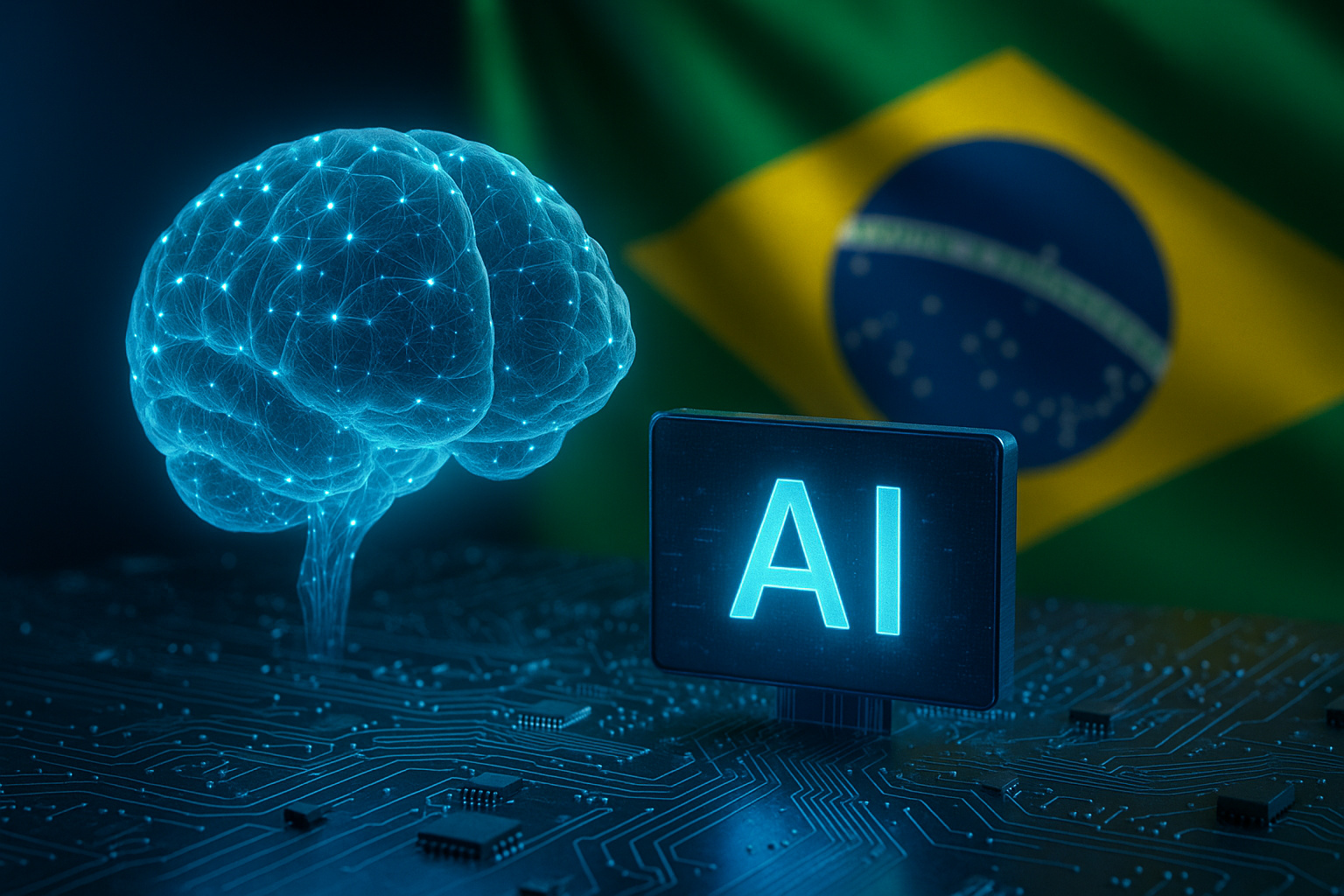
National Model Trained in Brazilian Portuguese Promises to Increase the Accuracy of Responses and Strengthen the Protection of the Country’s Strategic Data.
A significant change occurred in the Brazilian technology sector in November 2025, thus marking the launch of the first artificial intelligence created for digital sovereignty. The initiative arose after the publication of the Brazilian Artificial Intelligence Plan (PBIA), released in July 2024 by the Ministry of Science, Technology and Innovation. Therefore, the launch positioned Brazil more competitively in the global artificial intelligence landscape.
The MK1 platform was fully trained in Brazilian Portuguese and uses 32 billion parameters aligned with the national reality. Thus, the model delivers more precise and contextually appropriate responses for Brazilian culture. As stated by CEO Alessandro Quattrini, “all countries need their own AI to preserve culture and protect sensitive data”. The statement, therefore, reinforces the main motivation behind the project.
Technical Investigation Reveals Strategic National Advancement
The creation of MK1 resulted from a planned technical process executed over several years. MeetKai Brasil, founded in September 2025, structured the model with Brazilian databases analyzed between 2020 and 2024. Additionally, the training included exams from the OAB, editions of the Enem, and records published in the Official Gazette of the Union.
-
Scientists drilled nearly 8,000 meters into the ocean floor above the fault that caused the 2011 tsunami in Japan and discovered that a layer of clay 130 million years old was responsible for making the wave much worse than any model had predicted.

-
Thousands of years after causing the largest eruption of the Holocene, one of the world’s largest supervolcanoes is rebuilding itself beneath the sea south of Japan, receiving new magma and alarming scientists with its transformation.

-
China has activated a magnet 700,000 times more powerful than the Earth’s magnetic field that operates for over 200 consecutive hours while consuming little energy, and now the world wants to know what Beijing plans to do with this technology in 2026.

-
Mercado Livre has started selling medications in Brazil with delivery in up to 3 hours, and the project that launches in São Paulo may expand to the entire country, transforming the way millions of Brazilians buy medicines.


This set ensures that the AI “thinks in Brazilian Portuguese”, avoiding common intermediate translations found in international models. Many multilingual models translate questions into English or Mandarin and, therefore, reduce the final accuracy. This step often generates distortions and harms the clarity of the responses.
MK1 works directly and consults only a database installed on national servers. Therefore, the response returns quickly in the same language. Tests conducted in October 2025 showed accuracy 85% higher compared to foreign platforms. The result thereby reinforces the efficiency of the approach used by the company.
Economic and Competitive Impacts of the New Platform
The advancement of sovereign AI occurs during a period marked by increasing investments in the sector. The PBIA anticipates R$ 23 billion in public resources by 2028, according to the Center for Management and Strategic Studies (CGEE). Furthermore, the Brazilian private sector projects an investment 340% higher, according to a study released in March 2025.
Despite this growth, Brazil still mobilizes fewer resources than major global powers. In 2024, the United States invested US$ 109.1 billion in AI. China, in turn, allocated approximately US$ 9.3 billion in the same year. These figures, therefore, illustrate the gap between Brazil and international leaders.
With access to the Official Gazette of the Union, universities, public agencies, and companies use MK1 for strategic analyses and research. Thus, the platform supports institutional decisions with greater precision and security.
Race for Technological Autonomy Reinforces Security Debate
Despite the association with MeetKai Inc, an American company founded in 2020, the Brazilian operation acts independently. Quattrini states that there is no external interference in national management. Additionally, he emphasizes that the parent company does not maintain contracts with U.S. government agencies. The most well-known international client of the parent company is the Chinese Huawei, which reinforces the variety of global partners.
The Brazilian choice for the existing multilingual base accelerated the project and reduced timelines. Creating an entirely new LLM would require eight to ten years, according to the CEO. The strategy, therefore, allowed Brazil to compete swiftly and preserve data control.
Planning for Widespread and Secure Adoption in the Country
MeetKai Brasil is working to expand its customer base across various sectors. The company targets public agencies, universities, and private companies looking to automate processes and protect sensitive information. Therefore, the goal is to integrate the platform widely and securely.
The arrival of MK1 inaugurates a decisive phase in the pursuit of digital autonomy. Thus, the country increases its capacity to compete with its own technologies and reinforce its sovereignty. In light of this scenario, an essential question arises: Should Brazil Rapidly Adopt Sovereign AI or Proceed with Caution to Protect Its Strategic Data?







-

2 pessoas reagiram a isso.