





 Portuguese
  English
  Spanish
 6 min of reading
  1 comment




Isolated In The Woods In Minas, Man Shares Routine With Monkeys At The Window, Cascavel In The Bathroom, Dogs At Coffee, And Preserved Forest Around A Simple House Every Day
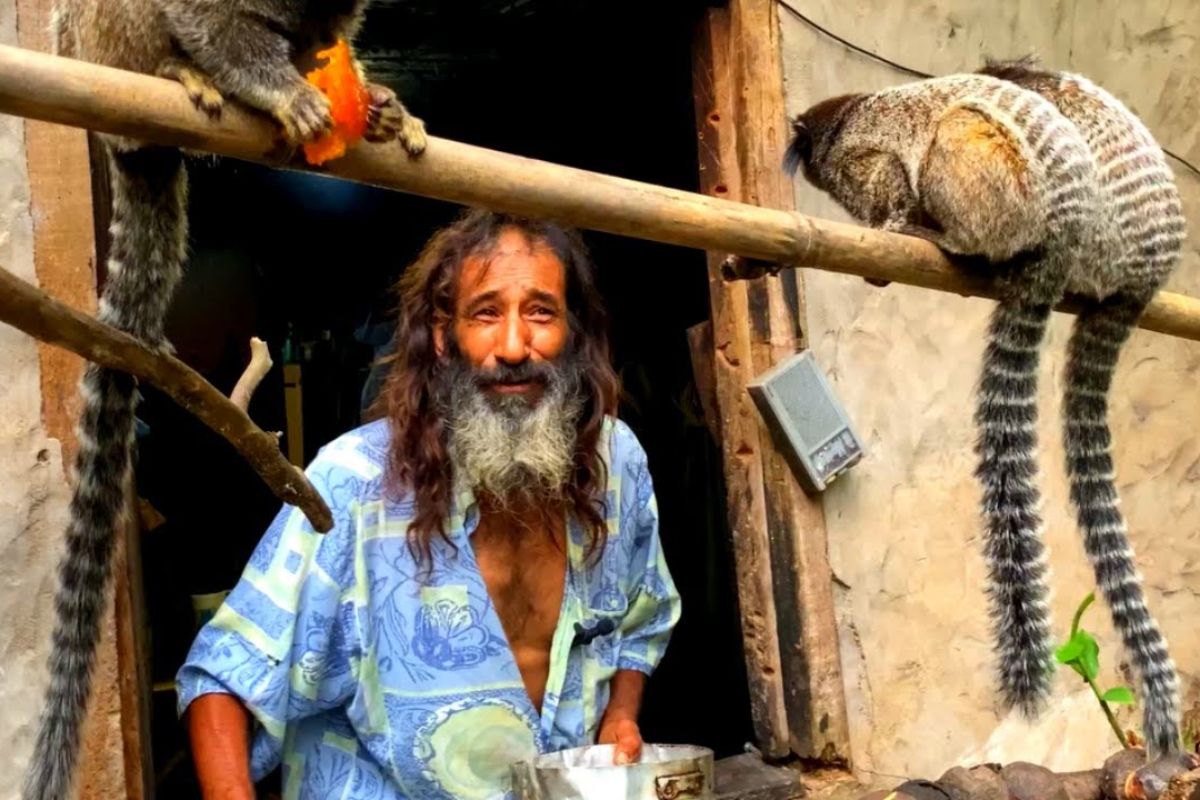
Isolated in the woods, in a remote corner of Minas, he wakes up to monkeys at the window, coexists with an old cascavel in the bathroom, serves coffee to the dogs, and turns daily forest care into a discreet life mission, in a site without luxury, but rich in vegetation, water, birds, and silence.
Living isolated in the woods, for him, is neither escape nor eccentricity. It is a choice built over nearly two decades of living with the land, animals, and native forest, between two simple houses in the rural areas of Fortaleza de Minas and São Sebastião do Paraíso, where every detail of the routine reveals a way of life that is disappearing in the country.
A Routine Set Between Two Houses In The Middle Of The Forest

The man who lives isolated in the woods in Minas divides his day between two references: the lower house where he lives, and the house inherited from his sister, higher up, which he is reorganizing and adjusting, including the electrical system.
-
Italian researchers have detected what appears to be a second Sphinx buried under the sands of Egypt, and satellite scans reveal a gigantic underground megastructure hidden beneath the Giza Plateau for over 3,000 years.

-
There are 4,223 drums and 1,343 metal boxes concreted with 50-centimeter walls that store the radioactive waste from Cesium-137 in the worst radiological accident in Brazil, just 23 kilometers from Goiânia, with environmental monitoring every three months.

-
Giant Roman treasure found at the bottom of Lake Neuchâtel in Switzerland reveals an advanced trade system, circulation of goods, and armed escort in the Roman Empire about two thousand years ago.

-
He buried 1,200 old tires in the walls to build his own self-sufficient house in the mountains with glass bottles, rainwater, and an integrated greenhouse.
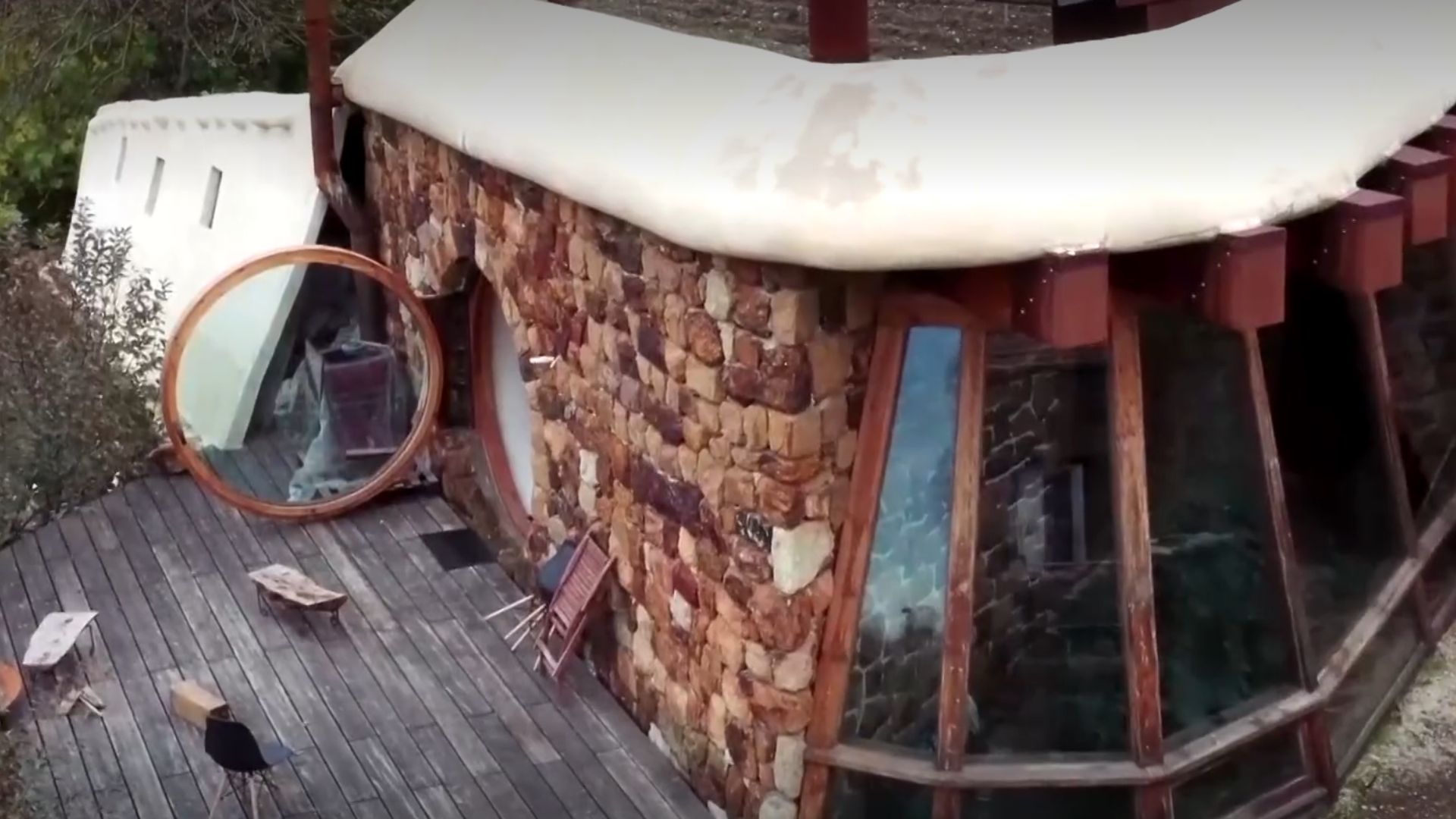

The movement between one point and the other is done on foot, along dirt roads and trails, always surrounded by preserved forest.
He estimates that he has been “truly living” there for about 20 years, in an area on the transition of municipalities, where the landscape alternates between slopes, scrubland, small plots, and forest reserves.
His income is still under construction: the site is “starting from scratch”, which means daily efforts to keep the place standing, planting, fencing, repairing, cleaning, and at the same time, not harming the forest.
The priority is to stabilize, generate some income from the site, and only then think about comfort improvements.
In daily life, there is no washing machine, and there are no tools that reduce physical effort.
Manual labor is the rule: improvised clothesline, hand-washed clothes, wood stove cooking, small fence repairs, wood handling, and planting fruit trees.
Productive life is spread out in small daily steps, rather than large projects at once.
Monkeys At The Window And Dogs Drinking Coffee

When someone arrives at the house where he lives isolated in the woods in Minas, they are first greeted by the dogs, who announce any visit.
They are companions, alerts, and part of the family. So much so that they drink coffee: he prepares a weaker mixture with little sugar, lets it cool, and offers it in small portions, almost like a morning sharing ritual.
The most emblematic visitors, however, are the monkeys.
They appear at the window, in nearby trees, and even on the porch, in a habit that has turned into a routine in the morning and afternoon.
It all started with bananas thrown from time to time, until a whole family of monkeys began to visit the place with visible confidence.
Today, the animals even approach the window, take food, observe the house’s interior, and interact with human presence.
There is no training, only coexistence: he insists that animals should not be mistreated, much less driven away.
For him, anyone living isolated in the woods needs to set aside part of the produce “for the animals,” as if it were a tacit budget of fruits and food reserved for the wildlife around him.
The 18-Year-Old Cascavel That Lives In The Bathroom

If the monkeys at the window would already be a rare portrait of coexistence, the most unusual presence in the house is a cascavel that, according to him, has been around for about 18 to 20 years.
The snake lives in a narrow space near the bathroom, in an area of little use, and has already become part of the resident’s mental map.
The relationship with the animal is one of respect and distance.
There is no hunting, no gratuitous confrontation. He identifies it as an animal that is “on the defense,” and not as an enemy to be eliminated.
The duration of its presence, measured by its shedding, is remembered almost like the animal’s natural resume: each shedding is a risk the cascavel overcomes, a sign of survival.
The curious part is that the resident claims that his biggest concern is not the cascavel, but a large tree close to the house, which may give way if the soil weakens.
The snake, predictable and stationary, is part of the environment; the greater risk, for him, lies in the instability of old trees in sloped areas, which are harder to control than an animal he has known for years.
Isolated In The Woods, But Obsessed With Preserving The Forest
Walking around the property, he makes it clear that living isolated in the woods is not a license to clear everything. Quite the opposite.
He repeats the idea that it is necessary to maintain about 60% of the reserve, that is, to keep most of the area free of deforestation, preserved as native forest.
Instead of opening extensive clearings, he speaks of “localized cleaning”: removing what is really obstructing, without turning the slope into shallow pasture.
The logic is simple: where vegetation is already established, the priority is conservation.
Where space needs to be opened for human use, he prefers to replace spontaneous vegetation with fruit trees, creating a kind of productive edge that serves both people and animals.
Jabuticaba trees, plum trees, and other species take place in transitional areas, serving as a bridge between the dense woods and the domestic farm.
In his view, “if the forest is lacking, life is lacking.” Fauna and flora are mentioned as a set: if the woods end, monkeys, birds, and small mammals disappear.
For those who live isolated in the woods, this is not a theoretical issue; it is something measured by the silence or the noise of the morning.
When the animals appear, the feeling is of balance. When they disappear, it is a sign that something is wrong.
Old Machines, Beans, And The Time Of Things
Upstairs, in the other house he plans to renovate, one of the relics is an old machine for “rolling beans”, a kind of primitive equipment that separates grains from impurities.
The system is simple, made from artisanal rural engineering, designed to work without sophisticated electric energy and endure decades of use.
The beans go up in cans, pass through the structure, and drop screened at another point.
Little comfort, much repetition. The image summarizes the rhythm of someone living isolated in the woods: nothing is fast, nothing is automatic.
Between washing clothes by hand, caring for animals, feeding monkeys, checking on the cascavel, going up to work on fences or wood, the day is filled with small but constant tasks.
He himself recognizes that for someone starting “from scratch”, life on the site generates expenses before generating income.
Fencing requires wire, tools, and maintenance. An old house requires renovations, tiles, wood. At the same time, the gain is another: autonomy, control over one’s own time, direct contact with the woods and wildlife.
A Discreet Life Between Risks And Rewards Of Isolation
Living isolated in the woods does not mean living without human contact.
Neighbors, friends, and visitors come from time to time, talk on the road, help with transportation, film, and record the routine.
There is curiosity, but also respect for someone who chose to stay in the countryside when many have moved away.
The risks are concrete: cascavel in the bathroom, heavy trees over the house, dirt road, distance from urban services.
Still, he insists on adjusting the site, organizing energy, renovating the house above, planting more, preserving the forest, and maintaining space for monkeys, birds, and even the dog that drinks coffee on the porch.
In practice, what is seen is a way of life in extinction, where the idea of progress does not involve more concrete, but more trees, more shade, and more animals circulating around the house.
For him, caring for the forest is not environmental discourse: it is a condition for survival for those who have decided to put down roots there.
In your place, would you be able to live isolated in the woods like this, surrounded by animals and forest, or do you think you wouldn’t give up urban life for anything?










Esse nao foi o texto original que eu li .