





 Portuguese
  English
  Spanish
  5 min of reading
  8 comments


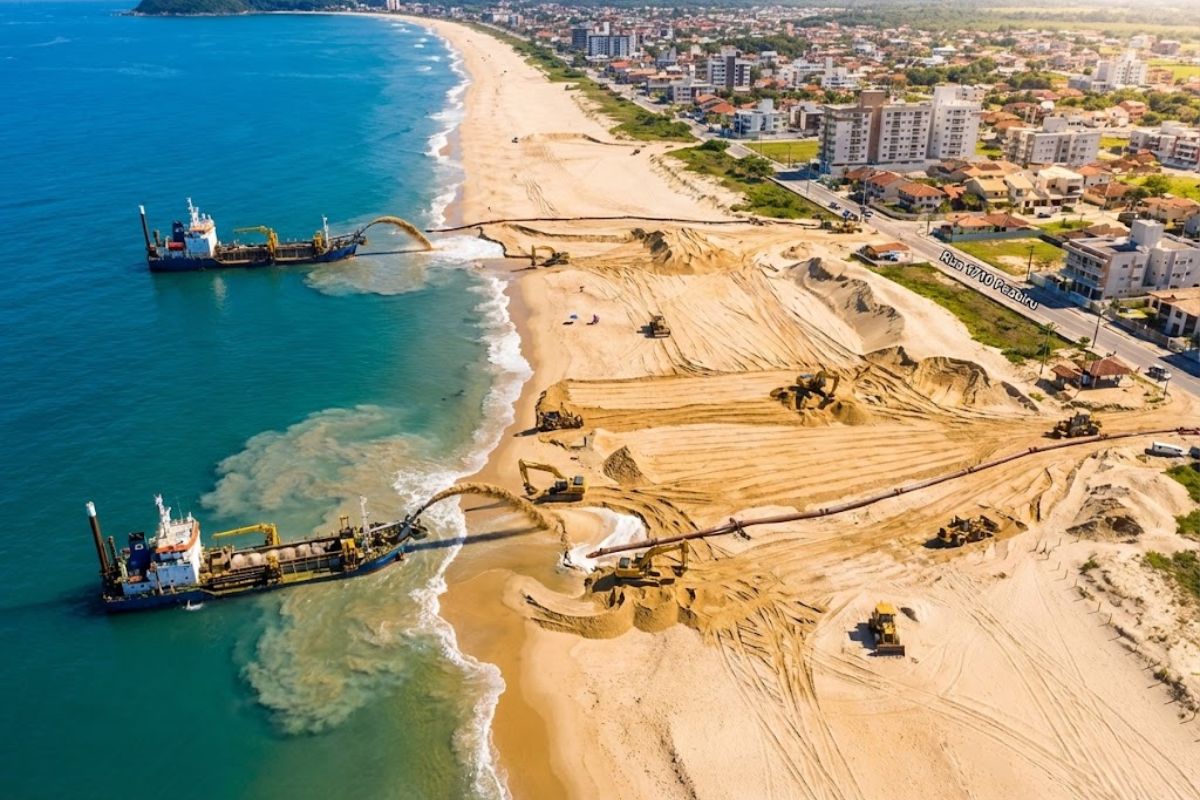


Even with segments already released to bathers, the largest beach widening in Brazil is 57% complete in Itapoá, after depositing 3.9 million m³ of sediments. In parallel, without stopping dredging, the city hall starts licensing environmental studies and projects to expand another 9 km of the coast.
The largest beach widening in Brazil has become both a visible construction and a technical decision: in Itapoá, the stretch of sand is growing in some places, but the intervention still coexists with closed sections and the heavy routine of the dredger depositing sediments on the coast.
While this stage continues to advance, the city hall is already organizing a new bid to hire environmental studies and engineering projects that could expand the sand strip by about 9 kilometers, specifically targeting areas where the sea has been advancing and sand has been disappearing.
The New Planned Section and the Erosion Map in the City

The proposed expansion under study goes from Peabiru Street to Castro Alves Street, passing through stretches of the neighborhoods Itapoá, Itapema do Norte, and Cambijú.
-
The government requests the Federal Revenue Service for a new system to automate the income tax declaration, reducing errors, time, and bureaucracy for millions of Brazilians.

-
Pix in installments, international Pix, and contactless payment without internet: the Central Bank revealed the new features coming to the tool that is already used by almost every adult in Brazil.

-
Mercado Livre has just started selling medications with delivery in up to three hours to your door, and this move could completely change the way Brazilians buy medicines on a daily basis.

-
In Dubai, rising tensions from the war in the Middle East are causing super-rich individuals to leave the Gulf and direct their fortunes to a new financial refuge in Asia.


It is a noteworthy section because it brings together points where the loss of sand is not an aesthetic detail, but a sign of coastal imbalance that affects beach use, urban infrastructure, and the dynamics of tides and swells.

When a city discusses widening the sand strip by kilometers, it needs to answer two questions simultaneously, without oversimplifying: where is the beach “missing” sediment and how to ensure that the material placed remains stable enough to serve its function. Therefore, the design of the section and understanding the local sea behavior are as important as the amount of sand moved.

What the Bid Seeks to Contract and Why Licensing Matters
According to the municipal administration, the Department of Environment is structuring the bidding process to hire the necessary environmental studies and engineering projects.
The technical package includes environmental impact studies aimed at licensing and an assessment of coastal engineering that considers structures such as jetties and headlands for sediment stabilization, in addition to nature-based solutions like dune restoration and planting of coastal vegetation.
In practice, licensing is not a “bureaucratic” step separate from engineering, as it defines conditions, controls, and execution limits. It is in this phase that details on how to reduce environmental risks, manage disruptions along the coastline, and monitor undesirable effects are established, especially when it comes to structures that alter the natural sediment transport along the beach.
The informed expectation is that the documentation will proceed to the pre-bid sector by the end of March, and after hiring, the winning company will have up to 18 months to complete licensing and deliver executive projects. This timeframe indicates that the discussion is not just “putting sand”: it involves designing the solution, justifying it technically, and completing all necessary steps for the intervention to be legally authorized and technically defensible.
How is the Largest Beach Widening in Brazil That is Already in Progress
The new stage is planned while the main intervention is ongoing and is pointed to as the largest beach widening in Brazil. The reported progress is about 57% completion, with approximately 3.9 million m³ of sediments already deposited on the sand strip, a volume that helps to gauge the logistical and operational scale involved.
So far, about 5 kilometers of the 8 planned have been completed, the result of hundreds of operational cycles of the dredger responsible for the work.
Even with sections opened and already frequented by bathers, part of the area remains closed to ensure safety during the works, which highlights a little-perceived aspect: a large coastal construction coexists with the city in real-time, requiring access control, signaling, and risk management while the coast is still undergoing transformation.
For this reason, the debate regarding an additional 9-kilometer expansion carries political and technical weight. When one stage is still in progress, the next needs to be considered based on what has already been observed in practice, both in completed sections and in ongoing works.
Babitonga Bay Enters the Works and Dredging Becomes a Source of Sand
The sand used in the widening comes from dredging the access channel of Babitonga Bay, which is undergoing deepening works.
The total project is over 68% complete and involves an investment of about R$ 333 million, in partnership between the Port of São Francisco do Sul and the municipality, connecting the intervention on the beach with a regional logistics agenda.
Overall, the dredging is expected to remove around 12.5 million m³ of sediments to increase the depth of the channel from 14 to 16 meters, intending to allow larger ships to enter and expand the logistical capacity of the port complex.
Part of this material is directed to the coast of Itapoá, and another portion goes to an offshore disposal area authorized by environmental agencies.
This connection between the port and the beach is often decisive because it transforms an operational waste into construction input but requires criteria.
Directing sediments to the sand strip is not automatic: it is a choice that depends on environmental compatibility and control, as the material must meet the licensing requirements and the objectives of coastal stability.
What Can Determine if the 9 Additional Kilometers Will Truly Advance
The intention to expand the sand strip by an additional 9 kilometers points to a clear objective: respond to the sea advance and sand loss in specific neighborhoods.
However, the final feasibility depends on how the studies will frame risks and solutions, including when mentioning alternatives like jetties and headlands, which can help in sediment stabilization but also require careful evaluation for altering the coastal dynamics.
The nature-based solutions mentioned, such as dune restoration and planting of coastal vegetation, come as part of the response specifically for acting on the “living layer” of the beach, providing protection and helping to stabilize the coastal system.
When coastal engineering and nature are treated as competitors, the beach loses; when combined with criteria, the chances of a more resilient sand strip increase.
In the short term, what puts the project on track is the bidding of studies and the delivery of executive projects, with licensing completed within a horizon of up to 18 months after contracting.
In the medium term, what decides is whether the proposed solution will be able to balance coastal protection, construction safety, public beach use, and the broader regional mechanism involving the dredging of Babitonga Bay.
And for you, what should be the priority in Itapoá now: accelerate the widening of another 9 km to protect the areas with sand loss, or focus on consolidating the largest beach widening in Brazil already in progress before opening a new front?
What do you think weighs more in daily life: coastal safety, tourism, or the connection with the dredging of the canal and the logistics of the port?









A matéria não informa, claramente, a qual Estado e município está se referindo. Por um instante, achei que se tratava da praia de Itapoã, em Salvador/BA, grafada incorretamente… Só depois de pesquisar Baía de Babitonga é que soube qual o local…
Matéria com trechos repetitivos. Ao que percebi não indica em qual estado fica a obra
Baia
Sim está n hora de recuperar a orla principalmente a do cambiju ,o turismo num todo vai crescer muito se esse alargamento for concretizado afinal será o maior do Brasil….