





 Português
  Inglês
  Espanhol
  6 min de leitura
  0 comentários


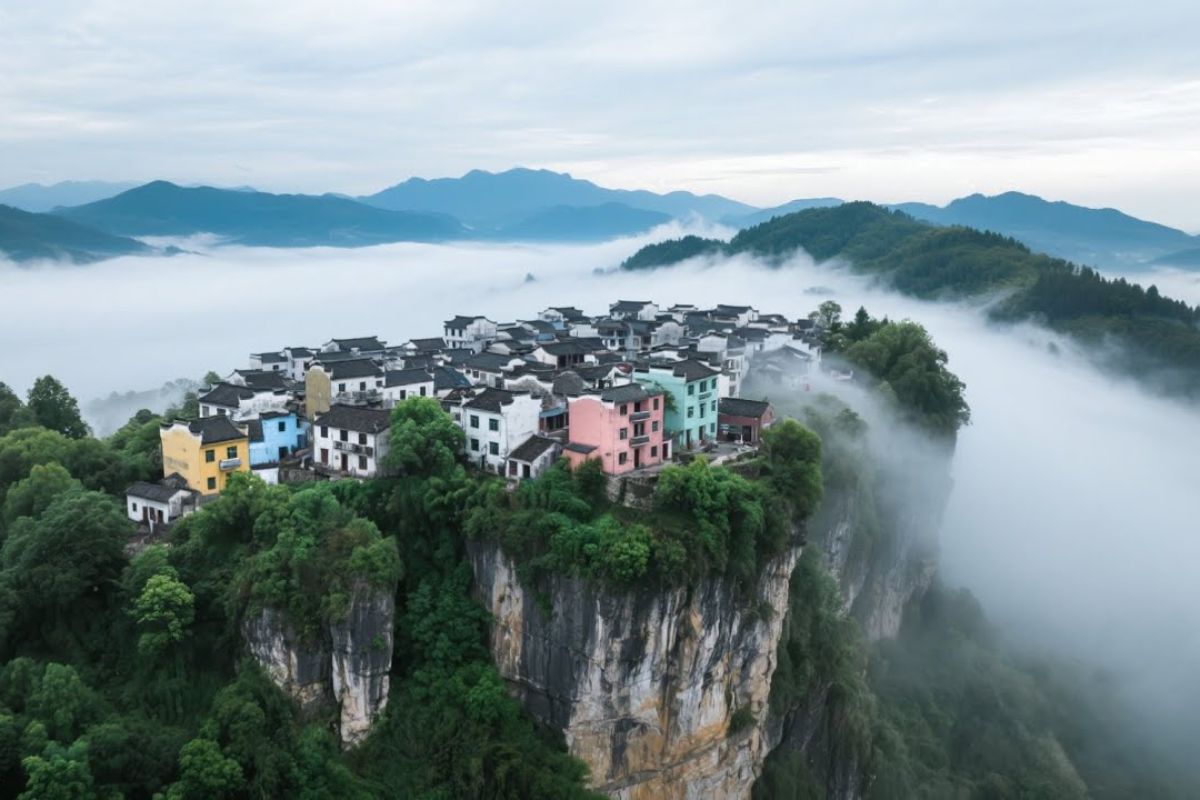
With Houses on the Edge of the Abyss, Taoist Temples, Centenary Steps, and Views That Seem Unreal, the Ancestral Village in China Has Stood for Over 1,000 Years and Today Lives Off Tourism Without Giving Up Its Spiritual Identity.
The village hanging on a cliff in Xiuning County, in the city of Huangshan, Anhui Province, has become one of those places that seem computer-generated but really exist. Built on top of a mountain, on the edge of a gorge, the community can only be reached after a two-hour climb, rewarded by houses literally perched on the edge of the abyss, solitary pavilions on neighboring peaks, and a scenery that mixes vertigo and awe.
With over a thousand years of history, the village has survived dynasties, served as an important center of Taoism, and today tries to balance spiritual tradition and tourism. The ancient community of Taoist priests, who lived far from secular life, has been replaced by residents who host visitors, rent rooms, cultivate food, and preserve ancient stone temples and steps, while the landscape remains the main reason for no one wanting to leave.
Where Is the Village Hanging on the Cliff

The mountain village sits atop a cliff on a peak in the Huangshan region, an area already famous for its dramatic mountains in Anhui Province. To get there, one must face a long, steep hike.
-
The world’s first octopus farm wants to open in the Canary Islands and is already provoking an international reaction: the plan aims to produce 3,000 tons per year.

-
Drought may be creating stronger superbugs in the soil and helping antibiotic resistance reach hospitals, warns a study highlighting a problem that could grow alongside extreme weather.

-
The biggest scam in history: Napoleon’s France deceived the United States by selling them a territory that was Spanish.

-
Why is the Danakil Desert so dangerous? It has unstable terrain and how extreme temperatures and toxic gases turn the region into one of the most hostile environments on Earth.


After approximately two hours of climbing, the visitor finally spots the village on the edge of the cliff. The first impressions mix charm and fear.

Many houses are literally perched on the edge of the abyss, giving the feeling that one wrong step could mean a fall straight into the void.
On another peak, a solitary pavilion reinforces the question many people ask when looking at the place: how did they manage to build all this without modern technology.

The surrounding landscape, with mountains, clouds, and rock walls, helps explain why so many residents have not wanted to leave the area, despite the difficulties of access.
A Millennial Village with Taoist Roots

The village is over a thousand years old and, in past dynasties, was considered a sacred place of Taoism. The people who lived there were Taoist priests, who followed strict rules of retreat from ordinary life, including renouncing marriage and starting a family.

Over time, this way of life led the descendants to become increasingly less numerous.
Today, according to local reports, there are only about 14 Taoist priests left in the village, and the current residents are descendants of these ancient religious figures, although many have changed their faith.
Taoism, a religion of Chinese origin, has different branches and interpretations, some more strict, others more flexible regarding secular life.
Even with the changing profile of the residents, the spiritual legacy remains present in the temples, ceremonies, and in the way the place is treated as a space for inner cultivation.
What Life Is Like in the Village Today

With the popularity of the location in videos and social media, the village hanging on the cliff has started to receive more and more tourists.
This has transformed the ancient isolated community into a kind of mountain attraction that helps generate income for the residents.

Those who arrive there can choose to stay directly in the village. Many residents rent their properties, with daily rates ranging from 150 to 300 RMB, making the place an immersive experience in the cliff’s daily life.
Due to the difficulty of bringing supplies to the top, the residents still grow their own vegetables, maintaining a self-sufficiency routine typical of remote areas.

Walking through the narrow streets, you can observe the traditional Huizhou-style architecture, with white walls, dark roofs, and a house design that contrasts with the void just ahead of the cliff.
At specific viewpoints, visitors can see how the houses are dangerously close to the edge, which reinforces the feeling that the village is an unlikely balance between ancient engineering and courage.
Temples, Rituals, and the Spiritual Heart of the Village
In the center of the village is the Taoist temple, considered the most important spiritual point of the community. It is there that ceremonies, worship, and religious practices are conducted as part of the routine of those who still follow Taoism in the region.
The statues present in the temple are colorful and full of details, with deities in specific poses, each with characteristic hand gestures.
Unlike the common image of Buddhist monks, Taoists do not have to shave their heads, and in some traditions, they can marry, have children, and even eat meat, depending on the lineage and the degree of strictness followed.
One of the priests still living in the village catches attention for his manner of speaking, nicknamed by the residents as “bird speech,” because it is difficult to understand for outsiders. It is a reflection of how geographical isolation has also preserved unique accents and modes of expression.
Centenary Steps, Extreme Views, and the Lonely House on the Cliff

Part of the charm of the village lies in the path. Many stone steps in use today are hundreds of years old, although they have been restored in recent times.
They connect strategic points of the mountain, leading to viewpoints, isolated houses, and spiritual training sites.

One of the most impressive points is the viewpoint considered by many as the best in the village, from where there is a wide view of the cliff, the houses on the edge, and the surrounding mountains.
It is said that residents have received cash offers to leave the area, but they declined, reinforcing the feeling that nothing could be better than living there amid that scenery.

There is also a small solitary cabin on the slope, which can only be reached after climbing hundreds of steep steps, about 70 degrees.

There, residents rest and engage in spiritual practices in an extremely exposed point of the cliff.
House Embedded in the Mountain and Place for Spiritual Cultivation

Behind the village, in another part of the mountain, there is a house literally built inside a crevice in the rock.
The construction resembles certain Taoist temples embedded in cliffs, indicating that the space may have been designed for religious or retreat purposes, even if not all the details are clear to visitors.
Another highlight is the so-called location for spiritual cultivation, an area marked by a structure shaped like a gourd, used by Taoist practitioners as a space for training and meditation.
The combination of architecture embedded in the mountain, the silence of the altitude, and the wide view of the landscape reinforces the idea of the place as a refuge for those seeking to deepen their inner life.
From the highest part of the region, after climbing hundreds of steps carved into the rock, it is possible to see nearly the entire village, the cliff, and the surrounding mountains.
On clear sky days, the strong sun does not overshadow the feeling of being in a scene that seems unreal.
Tourism, Income, and Preservation of the Ancestral Village

Today, the village is experiencing a phase where tourism and tradition walk hand in hand. Visitors can eat at the small local restaurants, where the dishes are usually simple and inexpensive, around 20 yuan, with typical flavors of the region.
Among the specialties mentioned is a local fish with a strong smell, nicknamed stinky tangerine fish, which divides opinions among tourists.
The circulation of people, the production of video content, and drone images showing the village from above have turned the place into a dream for travelers seeking difficult, isolated, and visually impressive destinations.
At the same time, the income brought by visitors helps maintain the houses, the steps, the temples, and the practices that have sustained the identity of the cliff for centuries.
In the end, this ancestral village hanging on the mountain seems like an exception in the human geography of China, where religion, traditional architecture, physical risk, and natural beauty meet in a unique slice of stone and sky.
And you, would you have the courage to climb to this village hanging on the cliff and spend a night there, or just imagining the houses on the edge of the abyss makes you feel a chill in your stomach?








Seja o primeiro a reagir!