





 Portuguese
  English
  Spanish
  5 min of reading
  1 comment


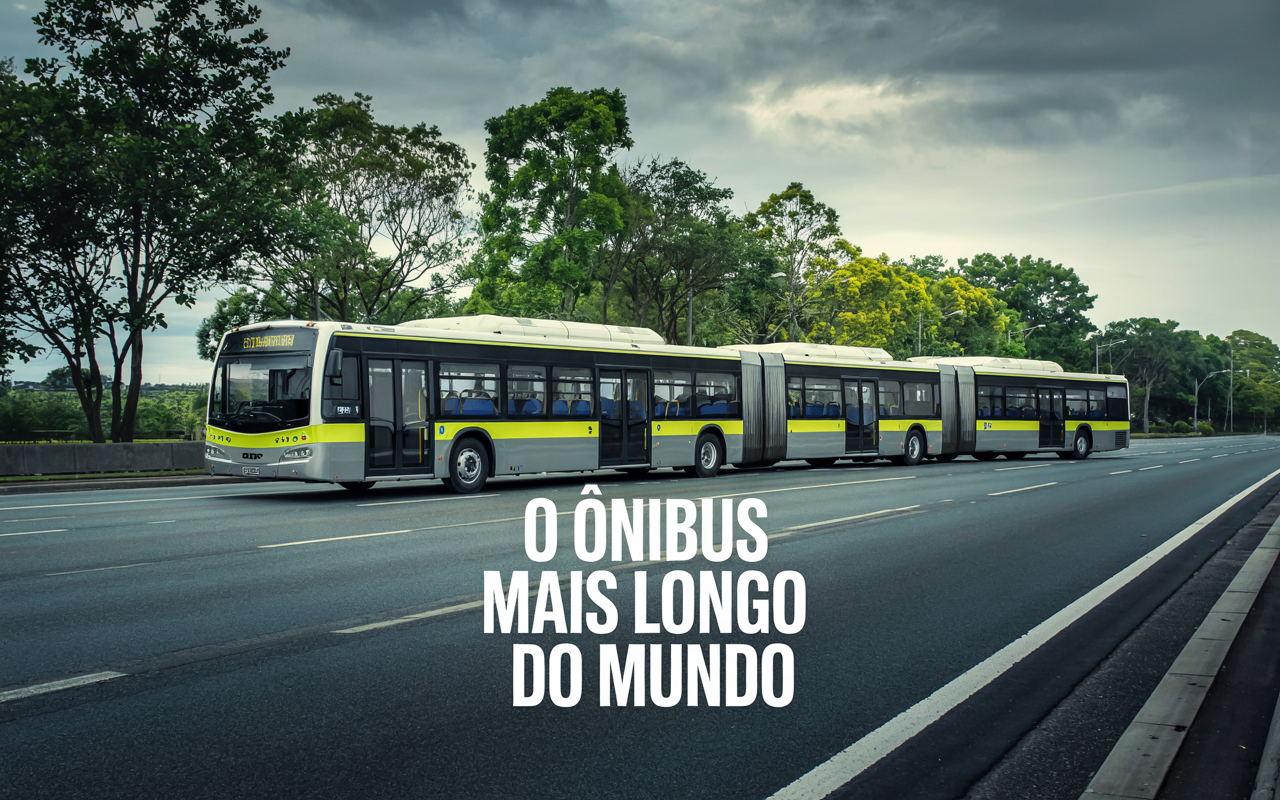


Meet the DAF Super CityTrain, the Longest Bus on the Planet, Measuring 32 Meters in Length and Capable of Carrying 350 People. A Giant That Looks Like a City on Wheels.
In a world where efficiency in urban transport is increasingly necessary, extreme solutions draw attention — and none is as bold as the longest bus on the planet. Called the DAF Super CityTrain, this Dutch giant manufactured in 1989 measures an impressive 32.2 meters in length and has the capacity to carry up to 350 passengers at the same time. Designed to operate on the streets of Kinshasa, the capital of the Democratic Republic of the Congo, this colossal vehicle has become a landmark in the history of public transportation and still features in the Guinness Book as the longest bus in the world ever built.
Understand how this project was conceived, how its operation functioned, what technical challenges were involved in its circulation, and what other models compete for the title of urban transport giant on the planet.
Engineering a Urban Colossus
The Super CityTrain used a DAF FT2600 tractor unit, connected to two articulated passenger modules. The speed was limited to 41 km/h for safety reasons, and the vehicle had a gross weight of approximately 28 tons.
-
After 14 years of waiting, a rammed earth mansion built in 1702 in the North Zone of São Paulo will become a park with leisure facilities and green areas, with a million-dollar investment.
-
With 2 unfinished nuclear reactors, up to 25 billion in costs, and proven fraud, the Nukegate case has left 800,000 consumers still paying today for energy that will never be produced.
-
The household appliance that consumes the most energy in Brazilian homes is not the air conditioner; it is located in the smallest room of the house, is used daily, and can account for up to 25% of the electricity bill, while an alternative in the same outlet can reduce this cost by up to 75%.

-
Son of a seamstress from the rural area of Ceará who did not speak English wins a scholarship of over 2 million reais at Williams College, one of the top 10 universities in the United States, covering everything including dormitory, meals, and annual trips to Brazil.


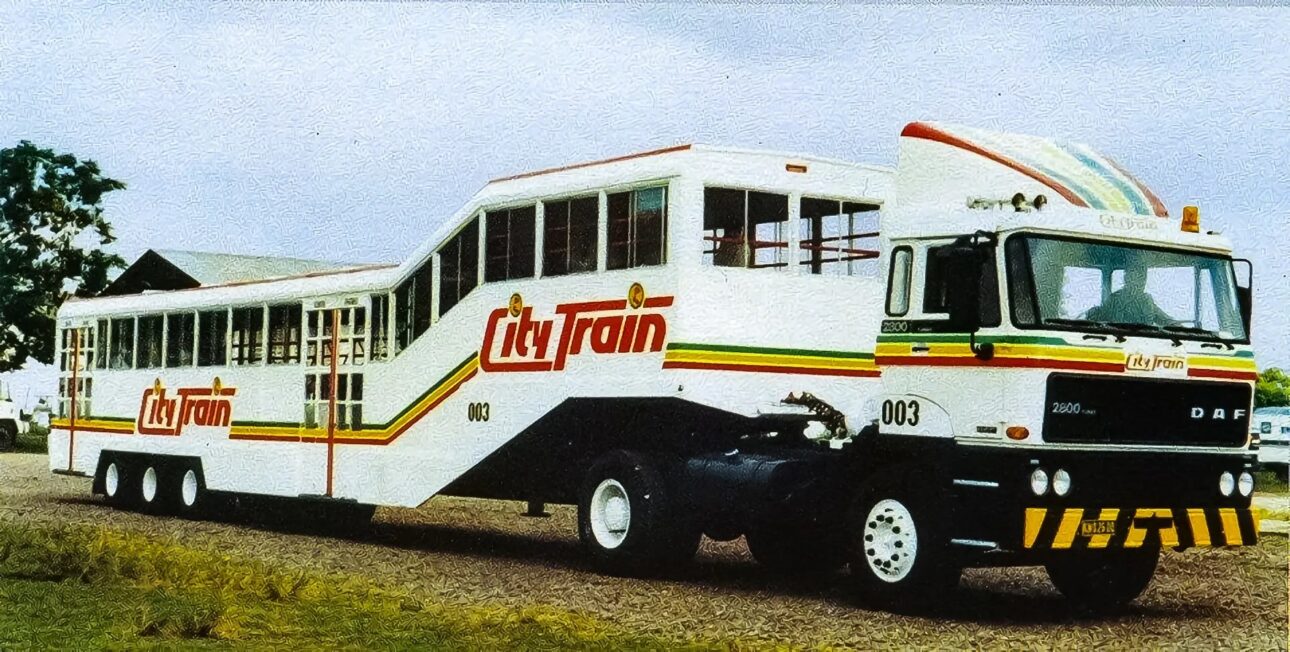
On the inside, the modules offered simple seating and ample space for standing passengers. Ventilation was natural, boarding occurred through multiple side doors, and the articulations allowed some flexibility during turns. Still, maneuvering a vehicle over 30 meters long on the streets of an African city with limited infrastructure was a challenging task. Therefore, the model only operated on wide and relatively flat roads, functioning in a limited manner.
The CityTrain did not last long. The streets of the Congolese capital could not support the weight and length of the vehicle. Maintenance was costly, the transport of parts complicated, and the system required highly specialized drivers. Shortly after its debut, the bus was withdrawn from circulation. Nonetheless, the legacy remains.
Other Giants of Public Transport
Although the DAF Super CityTrain was never replicated on a global scale, it paved the way for other experiments with extralong buses. One of the main ones is the AutoTram Extra Grand, a prototype developed by the Fraunhofer IVI Institute in Germany.
Measuring 30.7 meters in length and capable of accommodating up to 256 passengers, the vehicle consists of three articulated modules and is equipped with electronic power steering, allowing for surprisingly agile turns for a vehicle of its size. However, like the CityTrain, the AutoTram is an experimental project and has never been commercially implemented.
Brazil takes pride in having one of the largest buses in regular operation in the world: the Volvo Gran Artic 300. Developed in 2016, the model measures 30 meters in length, has a capacity for 300 passengers, and was specially designed for BRT (Bus Rapid Transit) systems, such as those in cities like Curitiba and Goiânia. With two articulation points and a raised floor, this giant bus can operate efficiently in exclusive corridors and pre-boarding stations.
In China, the Youngman JNP6250G model, which measures 25 meters in length, also stands out for its use in large urban centers like Beijing. The Chinese advantage lies in scale: dozens of these models circulate daily in exclusive lanes for mass transport.
How Do These Buses Make Turns?
If driving a standard 12-meter bus is already a demanding task, imagine maneuvering a vehicle three times that length.
The answer lies in articulation technology. In the case of the AutoTram and modern buses like the Volvo Gran Artic 300, electronic control systems adjust the angles of the articulations in real-time, allowing the rear axles to follow the trajectory of the front axle. This significantly reduces the turning radius.
Additionally, many of these buses are equipped with active steering systems on the rear wheels, stability sensors, adaptive brakes, and even electronic speed limiters. All of this contributes to ensuring safety and precision in maneuvers, even in dense urban environments.
Benefits and Limitations of Extralong Vehicles
The main advantage of extralong buses is their high transport capacity. A single vehicle can replace two or three conventional buses, reducing the operating fleet, operational costs, and emissions per passenger transported. This model is particularly useful in BRT corridors, where the flow is continuous and the demand is high.
On the other hand, using these giants requires urban adaptations. Roads need to be wider, stopping points larger, and pavement reinforced to withstand the constant weight. Maintenance is also more complex and requires trained professionals. Without these prerequisites, operating a bus over 25 meters becomes unfeasible.
The Future: Sustainability on Giant Wheels
While the DAF CityTrain is a thing of the past, the trend of extralong buses remains alive and evolving. Today, the industry is turning to sustainable solutions, with models powered by electricity or hydrogen. BYD, a Chinese manufacturer, is already producing large-capacity electric buses, and brands like Mercedes-Benz and Volvo are heavily investing in clean mobility for high-demand urban systems.
The focus now is not only on size but on energy efficiency. Buses measuring 24 to 30 meters, with zero carbon emissions, are already being tested in cities across Europe and Asia. Technology has matured, and urban mobility systems are better prepared to accommodate these vehicles.
The longest bus in the world, the DAF Super CityTrain, was an ambitious experiment that marked the history of public transportation. With its 32.2 meters, it pushed the limits of vehicle design and proved that it is possible to transport hundreds of people with a single road vehicle. Although its operation was brief, the concept opened doors for a new generation of giant buses that now operate in various cities around the world.
With growing urbanization and the quest for sustainable transport solutions, extralong vehicles are back at the center of the debate. And the legacy of the CityTrain remains: to show that, with technology and strategic vision, it is possible to reinvent urban mobility on a large scale.







Pretty! This has been a really wonderful post. Many thanks for providing these details.