





 Portuguese
  English
  Spanish
  6 min of reading
  2 comments


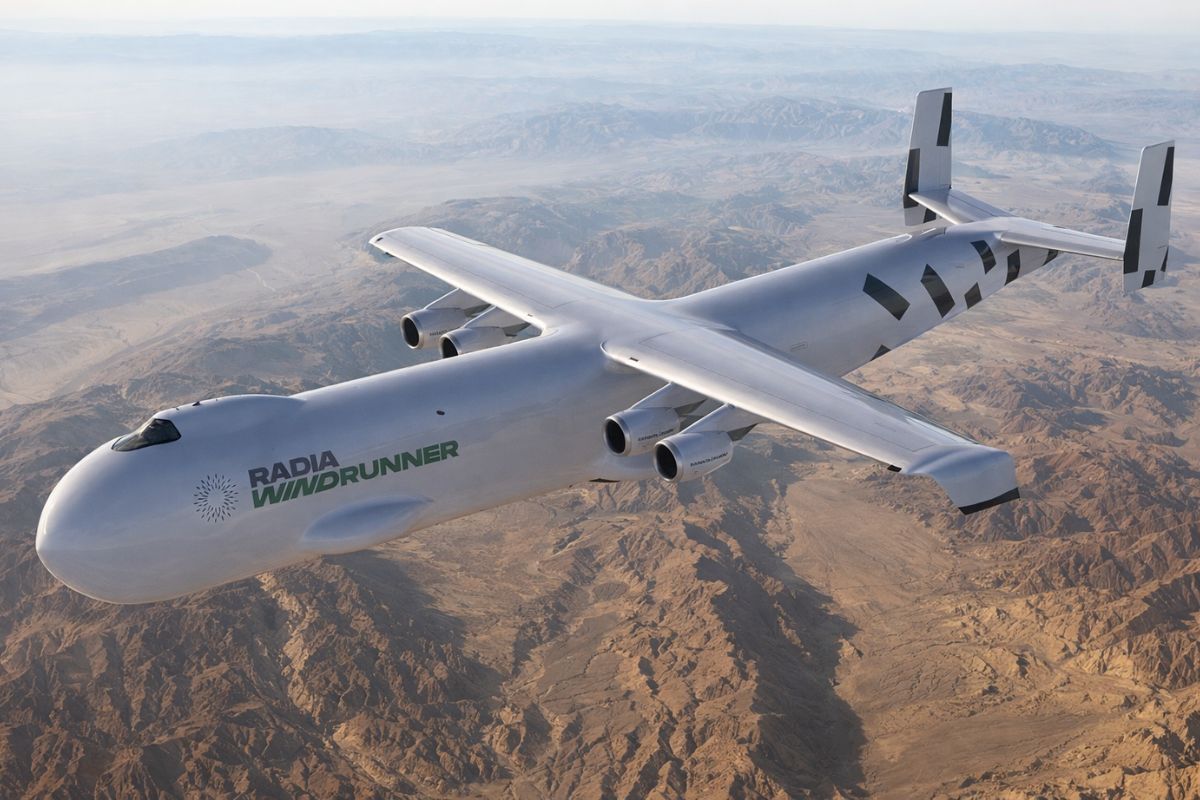


Introduced by Radia at the Singapore Airshow 2026, the largest airplane in the world, WindRunner, is designed to transport entire fuselages, engines, transformers of up to 70 tons, wind turbine blades over 100 meters and space equipment, operating even on unpaved runways of 1,800 meters with less logistical dependence on complex global supply chains.
The largest airplane in the world appears at a time when the global cargo industry is facing an increasingly visible bottleneck: in many projects, the issue is no longer weight, but dimension. When the piece exceeds the physical limits of current freighters, the operation becomes an expensive, slow puzzle full of transshipments.
With the WindRunner, Radia proposes a different logic for commercial air transport: to carry giant items more directly, reducing disassemblies, interim steps and dependence on traditional logistics corridors. The central idea is simple to understand and difficult to execute: to create a platform that accommodates in the air what today almost always needs to go by combined routes of port, road and special storage.
Why The Largest Airplane in the World Is Emerging Now

-
Mercado Livre has started selling medications in Brazil with delivery in up to 3 hours, and the project that launches in São Paulo may expand to the entire country, transforming the way millions of Brazilians buy medicines.

-
While the South begins April with sun and heat, a change in the weather already has a defined scenario in Brazil, and forecasts indicate heavy rain in the North and a sharp drop in temperature in the coming days.

-
Elon Musk wants to place humanoid robots in roles currently occupied by people, leading alongside giants like Amazon, Nvidia, and Figure in a race to replace human labor with machines, and advocates for a future where working would cease to be an obligation and become a choice.

-
A US company creates a facade that looks like stone or wood but generates energy: “invisible” solar panels for walls, easy installation, up to 130 W, and an off-grid YouTuber showcases it and raises funds for a battery.

Supply chains are dealing with increasingly larger, more expensive, and more sensitive systems to delays. In several sectors, the delivery schedule is as critical as the freight cost. In this scenario, the inability to fly oversized cargo has become a strategic bottleneck.

When cargo needs to be disassembled to fit in transport, the deadline grows and the technical risk also increases.
At this point, the largest airplane in the world gains relevance. The WindRunner was presented as a response to a structural limitation of the market: current transport meets many demands well, but encounters hard barriers when the object is long, bulky, or difficult to fraction without loss of efficiency.
Radia’s proposal, therefore, is not just to fly more cargo, but to change the type of cargo that can fly with commercial viability.
What The WindRunner Was Designed To Carry

The project envisions the transport of items that have so far typically been outside the reach of conventional freighters.
This group includes complete sections of widebody aircraft fuselage, large aerospace engines, energy transformers up to 70 tons, wind turbine blades over 100 meters and space hardware, including rockets, satellites and launch systems.
This set shows that the largest airplane in the world was designed with a focus on high-value, high-logistics-complexity cargo.
It’s not just about filling the hold, but preserving the integrity of components that require less handling, less disassembly, and less reconfiguration along the way. The fewer “hands” and steps in the process, the lower the chance of delays and damage to critical components.
Volume Above Weight and Operation on Unpaved Runways
Radia describes the WindRunner as an aircraft prioritized for volume. The project indicates over 6,800 m³ of useful space, a level presented as 10 times greater than the volume of the Boeing 777 for cargo. In practice, this changes the operational reasoning: the main limitation ceases to be how much it weighs and becomes what fits intact.
Another key point of the largest airplane in the world is its ability to operate on semi-prepared or unpaved runways of up to 1,800 meters. This data alters the access map because it reduces dependence on traditional airport infrastructure.
Instead of concentrating operations in a few hubs, the concept opens the possibility of getting closer to the final destination, including in remote areas or with limited infrastructure.
Who Is Behind The Project And What Phase Is It In
Radia, the developer of the WindRunner, took the project to the Singapore Airshow 2026 and is maintaining development in detailed design and supplier integration phase. The first flight is planned for the end of the decade, within a civil certification path using proven and certified components for large-scale repeatable operations.
In the ecosystem of the largest airplane in the world, the Brazilian company Akaer from São José dos Campos is also involved, selected to design the pressurized cabin. This detail is relevant because it connects the program to Brazilian industrial competence in aerospace engineering. When a local company enters the cabin design phase, the impact is not just symbolic; it is technical and strategic.
How The Business Model Can Change The Transport Of Giant Cargo
Radia has stated that it intends to operate the WindRunner in a transport-as-a-service model, rather than selling the aircraft. This means offering capacity to commercial operators, governments, and humanitarian organizations according to mission demand. The focus shifts from owning the airplane to the availability of logistical solutions.
In this format, the largest airplane in the world positions itself as a platform for complex projects, with point-to-point deliveries and less dependence on an intermediate network. Less modal swapping, less temporary storage, and fewer interfaces between agents tend to reduce the total complexity of the project, especially when the cargo requires technical treatment and rigid scheduling.
Integration With Operators And Effect On Strategic Sectors
Radia claims to be working with established cargo operators to integrate the WindRunner into existing commercial flows. In 2025, the company announced collaboration with Maximus Air to explore access and efficiency gains in large-scale missions. This type of partnership tends to be decisive in transforming concepts into real operations.
The potential effects reach energy, aerospace, infrastructure, and humanitarian missions. In energy, the gain lies in moving giant components to hard-to-reach locations. In aerospace, the point is to accelerate the movement of sensitive hardware.
In humanitarian aid, the advantage is the ability to transport large volumes to areas with little infrastructure. The largest airplane in the world, in this context, is not only competing in the market; it is competing for operational time.
Operational Sustainability And Reduction Of Steps
The WindRunner proposal also includes compatibility with sustainable aviation fuel, SAF, and a logistics architecture that seeks to cut transport steps.
When large cargo no longer has to go through multiple modalities and successive handling points, there is a reduction in complementary movements, delays, and rework.
This does not eliminate the challenges of the program, which still depends on design maturation, certification, and complete supplier chain integration. But it establishes a clear direction: the more direct the delivery, the lower the hidden cost of logistical complexity tends to be. And it is precisely in this hidden cost that many projects today lose competitiveness.
The WindRunner enters global debate with an objective promise: to transform the largest airplane in the world into a practical tool for cargo that today is stuck in fragmented solutions.
With over 6,800 m³ of volume, operation on unpaved runways of 1,800 meters and a focus on giant items, the project attempts to solve a problem that is already affecting schedules, costs, and predictability in various sectors.
If this proposal is confirmed in real operation, the impact could go beyond air transport and affect the entire engineering of industrial and energy projects.
In your opinion, which application would have an immediate effect in Brazil: 100-meter wind turbine blades, large energy transformers, or aerospace modules? And in which region do you believe an airplane with this profile would make the most logistical difference?






Se conseguirem esta proeza, parabéns aos construtoras.
Muito interessante, acredito, que este avião, saindo da parte de projeto para a realidade terá muitas utilidades, contudo com as pesquisas de novas Torres de sistemas eólicos sem as pas, da forma como são construídas atualmente, este nao será um cliente em potencial. Os projetistas do avião devem acompanhar a evolução dos sistemas eólicos, para evitar gastos com esta finalidade.