





 Portuguese
  English
  Spanish
  5 min of reading
  1 comment


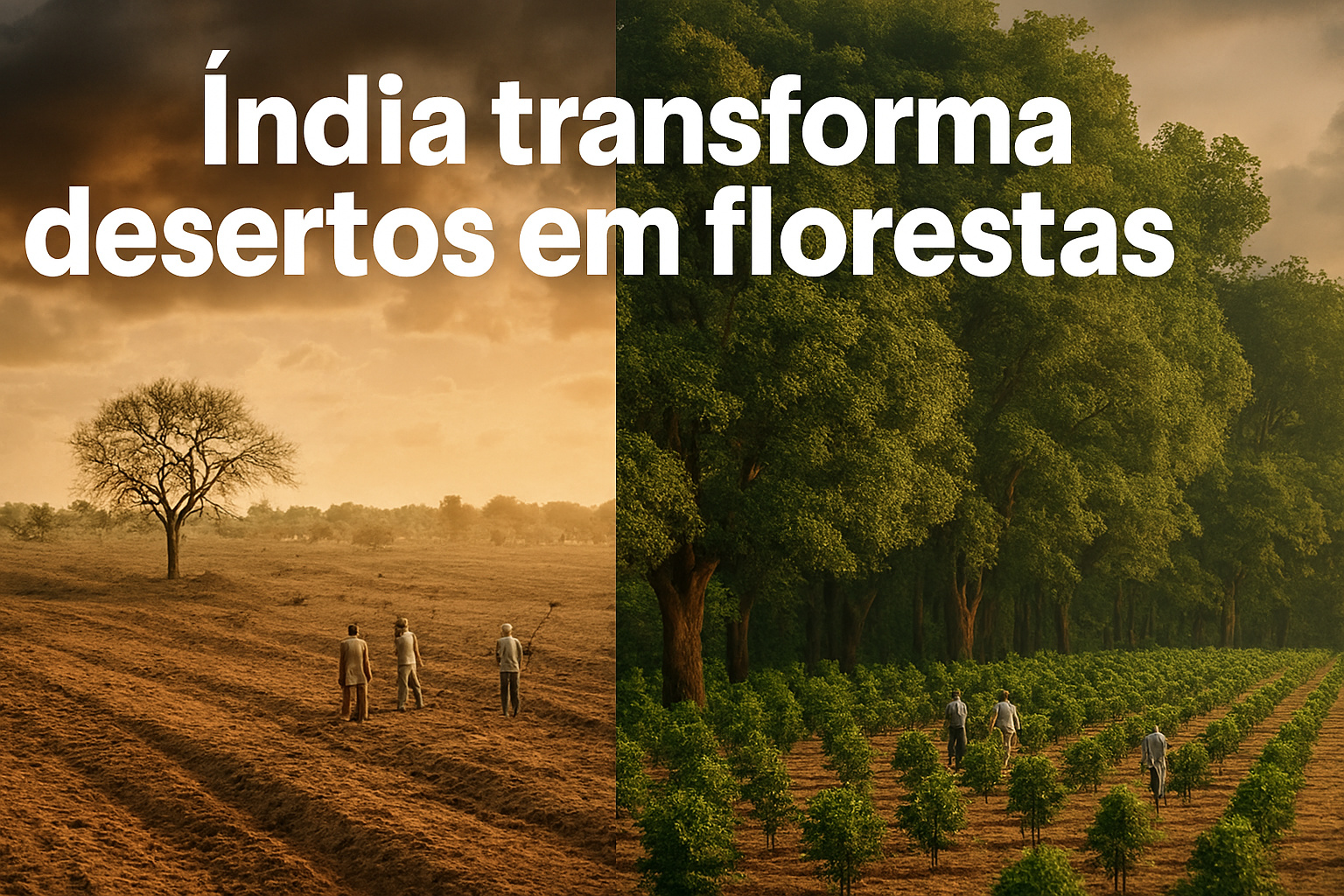


India Advances on the Largest Reforestation Program in South Asia, Aiming to Restore 1 Million Hectares and Combat Desertification in Arid Regions.
India, known for its contrasts between overcrowded megacities and vast rural areas, is quietly conducting one of the largest ongoing reforestation programs on the planet. The country faces a challenge that few nations encounter on such a scale: more than a quarter of its territory shows some level of degradation, according to the Indian Council of Forestry Research and Education. In this scenario, the Indian government has been betting on a long-term strategy that combines massive reforestation, recovery of arid areas, and planting of native species to transform regions threatened by desertification into productive green belts.
The numbers reflect the scale of the effort. In recent years, planting initiatives have mobilized millions of volunteers, state governments, and national forest management programs. In states such as Uttar Pradesh, Madhya Pradesh, and Telangana, annual campaigns manage to plant tens of millions of saplings in a single day, always focusing on species adapted to the local climate. At the same time, national policies like the Green India Mission, part of the National Action Plan on Climate Change launched in 2014, have set the goal of restoring 1 million hectares of degraded areas through regenerated forests. This is an area equivalent to twice the size of the Federal District.
The Advancing Desertification and the Need for an Indian Green Wall
The urgency for initiatives of this magnitude is evident. Studies by the Indian government show that desertification is advancing particularly in regions of Rajasthan, Gujarat, Punjab, and parts of Maharashtra — areas where semi-arid climate, soil salinization, and intensive agricultural use accelerate vegetation loss.
-
Friends have been building a small “town” for 30 years to grow old together, with compact houses, a common area, nature surrounding it, and a collective life project designed for friendship, coexistence, and simplicity.

-
This small town in Germany created its own currency 24 years ago, today it circulates millions per year, is accepted in over 300 stores, and the German government allowed all of this to happen under one condition.

-
Curitiba is shrinking and is expected to lose 97,000 residents by 2050, while inland cities in Paraná such as Sarandi, Araucária, and Toledo are experiencing accelerated growth that is changing the entire state’s map.

-
Tourists were poisoned on Everest in a million-dollar fraud scheme involving helicopters that diverted over $19 million and shocked international authorities.


The phenomenon is particularly intense along the border with Pakistan, where the Thar Desert, one of the largest hot deserts in the world, tends to expand.
This environmental pressure has led India to strengthen its recovery programs, with projects that include watershed management, community reforestation, restoration of pastures, and planting of resilient species such as neem, acacia, and native bamboo.
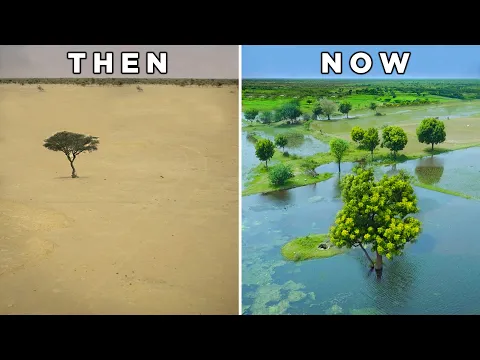

The central idea is to create a kind of “Indian Green Wall,” not as formally defined and monumental as the Chinese initiative, but with a direct impact on soil stabilization, aquifer recharge, and revitalization of local agriculture.
The Crucial Role of Rural Communities in Regeneration
One of the most notable elements of this process is the participation of communities. Unlike purely governmental programs, much of the Indian reforestation is community-driven.
Groups of villagers are responsible for caring for the saplings, building simple irrigation systems, and monitoring the regeneration in areas where there was previously erosion and vegetation loss. These projects integrate with rural development programs that pay families for their direct work in environmental restoration, a model that combines income with ecological regeneration.
The use of community conservation zones, such as the so-called Joint Forest Management Committees, includes more than 20 million hectares under some form of co-management between residents and the state. This approach not only decentralizes the process but also increases the success rate in the long term.
Arid Regions Starting to Change Color
Pioneering projects carried out in districts of Rajasthan show tangible results. Areas that were previously completely whitewashed by salt and dry for years have gained patches of continuous vegetation after soil restoration and planting of resilient species.
In Madhya Pradesh, entire regions of degraded pasture have been converted into ecological corridors that aid local wildlife, including antelopes, jackals, and migratory birds.
In Telangana, the Haritha Haram program, initiated in 2015, created one of the largest sapling banks in Asia and increased by millions the number of trees planted in urban and rural areas, contributing to the improvement of the average temperature in neighborhoods that suffered from extreme heat waves.
These combined initiatives have resulted in real progress in the country’s forest cover. The India State of Forest Report 2021 recorded an increase of approximately 1,540 km² of forest area compared to the previous survey, a sign that actions, although in a vast territory, are generating impact.
The Economic Component: Forests That Generate Income
Unlike reforestation models focused solely on the environmental aspect, India is also betting on the green economy.
The planting of native species with economic value — especially bamboo and fruit trees adapted to the semi-arid climate generates income for farmers and traditional communities. This model reduces pressure on natural forests and creates sustainable economic pathways.
Projects funded by public and international banks also invest in the restoration of degraded watersheds, increasing water access in regions where water scarcity is chronic. In states like Maharashtra, reforested areas have helped to raise local groundwater levels after periods of drought.
Between Challenges and Possibilities: The Future of the Indian Green Wall
Despite the advances, the country still faces significant obstacles: population growth pressures rural areas, extreme weather causes record heat waves, and some of the saplings planted in mass programs face survival difficulties.
To confront this, new guidelines have been prioritizing more technical plantings, community maintenance, and deep ecological restoration instead of simply high numbers of saplings.

Even so, the direction is clear. India is betting on continuous reforestation, soil restoration, watershed recovery, and rural development as pillars to combat the advance of desertification and create productive green belts in areas previously abandoned to aridity.
The transformation is far from over. But when satellite images comparing the present with decades past are observed, it becomes clear that entire regions are beginning to change color. Where there was once dust, now green patches are appearing.
Where there was once erosion, now there is life. It is a slow but irreversible process that shows how a vast country can rebuild its territory tree by tree.








Plantar árvores uma coisa…mas plantar árvores como monocultura não é ideal. Precisamos entender uma floresta natural (várias peças de arvores mix!), aprendemos como funciona uma floresta saudável ⁉️