





 Portuguese
  English
  Spanish
  7 min of reading
  0 comments


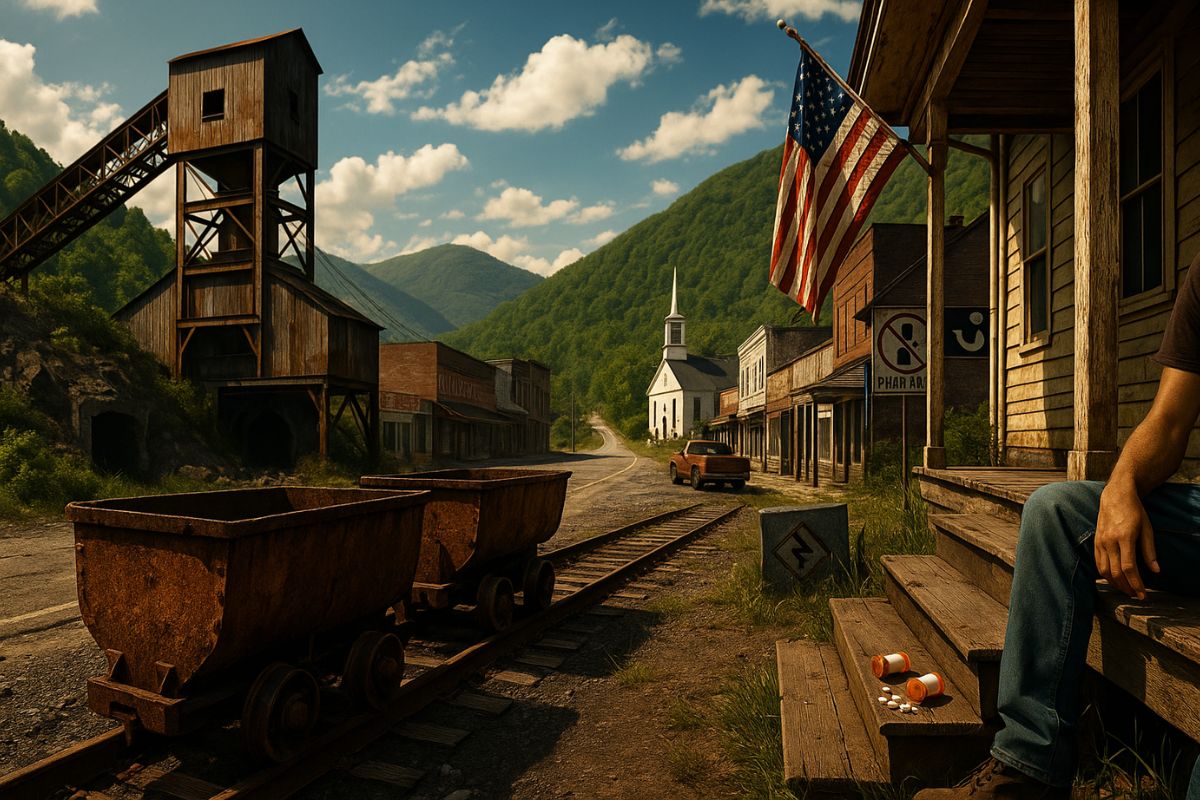
Among Isolated Valleys, Abandoned Coal Mines, and Empty Cities, the Appalachians Expose an America Rarely Depicted, Where Traditions Resist, Youth Fight Drugs, and Communities Struggle to Survive in a Hard and Permanent Reality
The Appalachians form one of the most contradictory regions in the United States: while the country projects an image of prosperity and high technology, the mountainous interior of states like West Virginia, Kentucky, and Virginia concentrates closed mines, declining cities, extreme poverty, and families clinging to old values to face a difficult daily life. Traveling through counties like McDowell, once coal hubs, what stands out is the combination of abandoned houses, empty buildings, sparse commerce, and a silence that contrasts with the past of intense industrial activity.
Behind this landscape, however, there is another side of the Appalachians that does not appear in cold income figures or federal statistics: small communities where everyone knows each other, neighbors who still stop to help someone with a broken car, families who unite in floods, funerals, or crises, and residents who carry a strong memory of the mines, labor struggles, and the old “valleys” paid for by companies. It is in this clash between economic decline, local pride, and the pressure of modern problems such as drugs and dependence on public benefits that the region tries to find a new direction.
Appalachians: The Former Coal Land Left Behind

For decades, part of the Appalachians lived around a single economic axis: coal.
-
Drought may be creating stronger superbugs in the soil and helping antibiotic resistance reach hospitals, warns a study highlighting a problem that could grow alongside extreme weather.

-
The biggest scam in history: Napoleon’s France deceived the United States by selling them a territory that was Spanish.

-
Why is the Danakil Desert so dangerous? It has unstable terrain and how extreme temperatures and toxic gases turn the region into one of the most hostile environments on Earth.

-
With a height of 221 meters and a capacity for trillions of liters, Hoover Dam still holds a trick that makes water defy logic.
Cities like Welch, Bluefield, and several small towns in McDowell County grew with train tracks carrying tons of ore, full schools, open shops, and a steady flow of money coming from the mines.
Managers lived in large houses on the hillside, workers organized themselves into long, exhausting shifts, but there was employment, consumption, and the circulation of people.
With the decline of coal, this structure collapsed.
Household income fell, many residents left, and what remained was a trail of closed buildings, abandoned schools, and towns where one can walk in the middle of the street without seeing almost any cars.
In Welch, for example, reports indicate that stores, grocery stores, beauty salons, and even Walmart closed, transforming what was once a regional center into a scenario of empty storefronts, old signs, and deteriorating facades.
Closed Mines, Isolated Valleys, and a Risky Daily Life

Life in the mines of the Appalachians was not just hard: it was dangerous.
Residents recount collapses, poorly supported pillars, pooled water released all at once, and accidents that killed dozens of workers in a single explosion.
There are records of entire family cemeteries dedicated to miners, with monuments and lists of the names of disaster victims in underground galleries.
Veterans of mining report shifts of 48 to 60 hours a week, often without seeing daylight.
Crawling, carrying coal in tight spaces, dealing with roof failures, and working under constant risk were part of the routine.
Despite this, many describe the mine as a “second home”: an environment where camaraderie was strong, where one miner protected another, and where professional identity was a source of pride.
When these mines were closed or reduced, it was not just the loss of employment.
In many valleys, it was the collapse of an entire way of life, on which local commerce, schools, churches, and basic services depended.
From then on, youth migration, population decline, and abandonment of public structures intensified.
Poverty, Social Benefits, and the New Map of Survival

Without coal as the axis of the economy, many residents of the Appalachians have come to depend directly on the state.
Field reports indicate that a significant portion of the population lives on benefits such as sick leave, food stamps, and pensions, while another part “works themselves to death” in long hours, whether in remnants of mining operations or in low-paying services in small towns.
At the same time, there is a social phenomenon repeated by local residents: young adults who remain in their parents’ homes, receive monthly checks for medical or psychological issues, and do not enter the formal job market.
This division deepens a sense of generational rupture: on one side, those who grew up hauling hay bales, fixing cars, and entering the mines early; on the other, those who were raised in a context of screens, social networks, and less engagement in manual work.
This reality fuels internal tensions: some residents criticize the “laziness” associated with benefits, while others point out that without a substitute industry for coal, there are few real alternatives for stable jobs in the region.
Drug Epidemic and a Youth at a Crossroads
If poverty is a structural axis, the other major critical point of the Appalachians today is the spread of drugs.
In small towns and isolated valleys, residents report the advance of methamphetamine, heroin, fentanyl, and other heavy narcotics, often associated with stories of destroyed families, incarceration, and early deaths.
Young people who could pursue technical jobs or higher education frequently find themselves torn between two extreme paths: either they enter intense work schedules, often in exhausting jobs, or they are consumed by drug use and idleness.
In testimonials, some estimate that half of the youth in the region are involved with some type of substance or are disengaged from the job market.
At the same time, there are examples of resistance: students who graduate in criminal justice, young people who take on leadership roles in local businesses at under 20 years old, diesel mechanics who specialize in heavy vehicles, workers who balance jobs and hours of community service to overcome drug issues.
These trajectories show that the youth of the Appalachians are not homogeneous, but live under the pressure of a weakened social environment.
Tradition, Local Pride, and a Silent Support Network
In the midst of the crisis, community life in the Appalachians preserves traits that rarely appear in large urban centers.
In many valleys, everyone knows everyone, families are interconnected by marriage ties, neighbors share news in real time, and a problem in one house quickly becomes a concern for the entire street.
Situations like floods, serious illnesses, or deaths mobilize spontaneous collections, food donations, financial support, and constant presence from neighbors of different families.
In some places, grandmothers become central figures in the “holler,” following the growth of generations, mediating conflicts, and ensuring community cohesion.
At the same time, religious missionaries from other states circulate through these small towns, reporting warm, humble, and open residents, often ready to offer food, shelter, or conversation, despite their own limited resources.
This social fabric, though pressured by unemployment and drugs, still functions as a kind of buffer in critical moments.
Tourism, Memory, and Disputes Over the Future of the Appalachians
Without the same strength of coal, part of the Appalachians tries to reinvent itself through adventure tourism, off-road trails, and valuing local culture.
Trails like Hatfield McCoy, for example, are beginning to attract visitors in utility vehicles, ATVs, and motorcycles, boosting small businesses, workshops, and lodging services.
Another front is the preservation of memory: former schools converted into homes, old historic buildings repurposed, books and records about mining disasters, and lists of miners who died in accidents.
Monuments, well-kept family cemeteries, and statues of local figures show how the region tends to value veterans, miners, and ancestors, connecting current identities to stories that date back to the Civil War and colonization.
But the debate about the future remains open. On one side, there are residents who firmly defend the continuation of coal as the economic basis, rejecting national policies that point towards alternative energies.
On the other hand, there are those who recognize that the transition is already underway and that it will be necessary to combine new productive sectors, technical education, and consistent drug combat to prevent the definitive collapse of many valleys.
An Invisible America That Is Still Seeking a Voice

The Appalachians reveal a part of the United States that does not typically headline advertising campaigns, TV series, or official future projections.
Instead of skyscrapers, there are simple houses, narrow valleys, and winding roads; instead of large tech hubs, communities oscillate between pride in their roots and fear of disappearing with the end of the mines and the advance of drugs.
Among closed mines, empty cities, extreme poverty, and a resilient community culture, the region synthesizes a central dilemma: how to rebuild a development project in places that were built around a single productive sector and now find themselves on the margins of federal decisions.
The result is a portrait of absolute contrast: young people studying, planning scholarships abroad, and researching local history coexist with peers who have never left the valley, live on benefits, and are trapped in cycles of substance dependence.
In light of this scenario, the Appalachians remain a territory in dispute between past and future, tradition and rupture, institutional abandonment and neighborhood solidarity.
In your opinion, what should be the number one priority to change the reality of the Appalachians: generating new jobs, fighting drugs, or investing heavily in education for the next generations?









Seja o primeiro a reagir!