





 Portuguese
  English
  Spanish
  5 min of reading
  0 comments


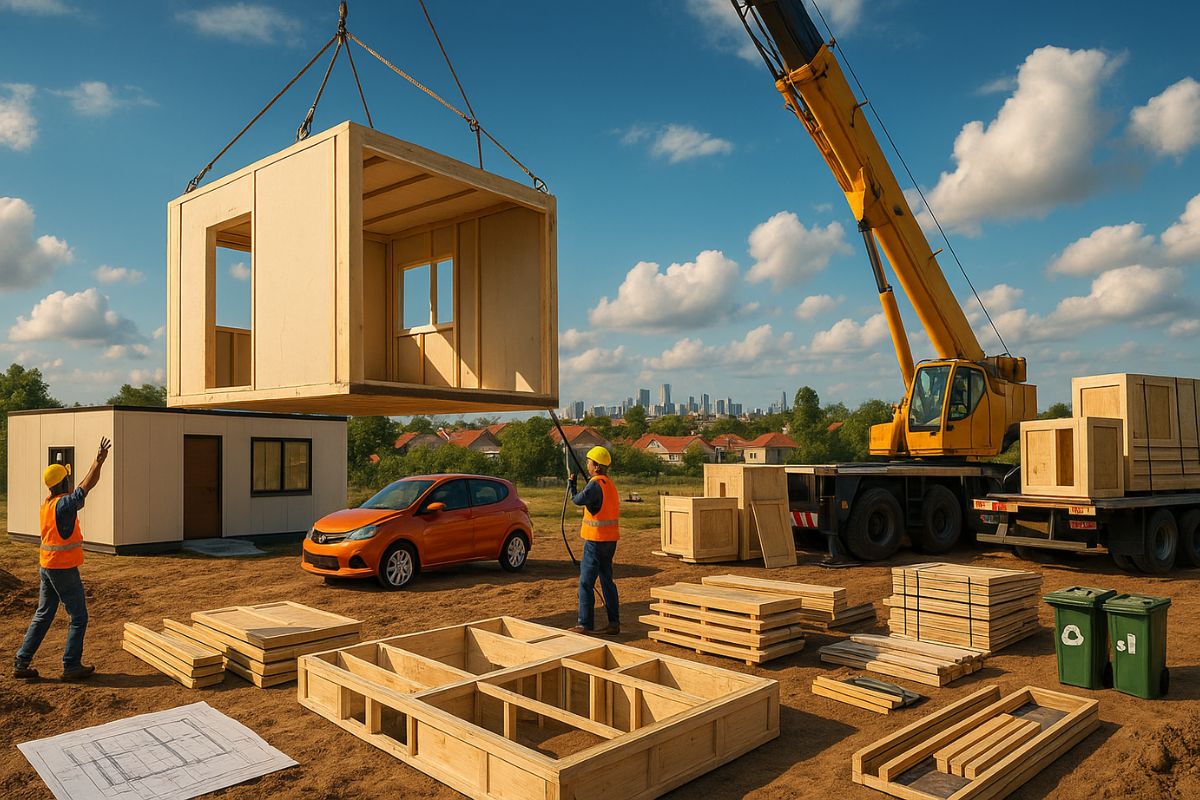
With Rapid Assembly, Price Below a Popular Car and Models of Modular Houses Starting at R$ 55 Thousand, New Housing Option Arrives in Brazil with Focus on Low Cost, Zero Waste and Modern Design
Modular houses are making a strong entry into the Brazilian market and changing the way people think about building their own homes. With assembly in about 90 days and prices lower than those of a popular car, they emerge as an alternative for those who want to move in quickly, spend less, and avoid the delays and improvisations typical of traditional construction.
In this model, the house is not built brick by brick on site but assembled from modules and pre-fabricated panels, already produced in a controlled environment. The result is a faster, cleaner, and more predictable construction, with less waste, more cost control, and the possibility of customization according to the project and the family’s budget.
What Are Modular Houses and Why Are They Gaining Space
The so-called “building house” is, in fact, a modular house, a type of pre-fabricated construction where much of the parts are produced in a factory and brought ready to the site.
-
With more than 635,000 doctors, Brazil sees competition increasing in large cities, and recent graduates are competing for shifts at an accelerated pace while the countryside still faces shortages.

-
The world’s first octopus farm wants to open in the Canary Islands and is already provoking an international reaction: the plan aims to produce 3,000 tons per year.

-
Drought may be creating stronger superbugs in the soil and helping antibiotic resistance reach hospitals, warns a study highlighting a problem that could grow alongside extreme weather.

-
The biggest scam in history: Napoleon’s France deceived the United States by selling them a territory that was Spanish.

These modules fit together like a large structured “puzzle,” which speeds up assembly and reduces construction time.
In this system, construction becomes less dependent on site improvisation and begins to follow an industrial standard, with more precise measurements, lower risk of error, and more uniform finishing.
Since most parts are made in a controlled environment, exposure to rain, sun, and climate variations is also reduced, factors that often delay and increase the costs of conventional constructions.
For those who have always associated construction with months of waiting, dirt, and rework, modular houses offer a completely different path based on planning, standardization, and faster delivery.
How Much Do Modular Houses Cost and Why Can They Be Cheaper
The price of modular houses varies according to size, finishing standard, and project, but the central proposition is clear: to offer a ready property at a competitive value, often below the price of a popular car. In many cases, the final cost of the modular house is lower than that of a traditional construction of the same size.
This happens because the process is more industrialized:
- Less labor per square meter
- Less execution time
- Almost zero material waste since everything is cut and planned beforehand
- Less rework and unforeseen events on the construction site
Check a table with approximate values mentioned in the sector to illustrate this price range:
| Model | Size | Average Assembly Time | Estimated Price |
|---|---|---|---|
| Compact | 25 m² | 60 to 90 days | R$ 55 thousand to R$ 65 thousand |
| Family | 40 m² | 90 days | R$ 70 thousand to R$ 85 thousand |
| Expanded | 60 m² | 90 to 120 days | R$ 100 thousand to R$ 120 thousand |
These numbers show that it is possible to have a functional, planned, and new home for a value often lower than that of conventional construction, especially when considering delays, waste, and extra costs typical of traditional works.
Modular Houses, Fast Construction and Zero Waste
One of the most striking points about modular houses is the execution time. While a conventional house can take many months to be ready, depending on the pace of the team, the rain, and the budget, a modular house can be assembled in about 60 to 120 days, depending on the model and size.
This speed comes from three main factors:
- Much of the work is done in the factory, leaving only the final assembly for the site
- The stages are more predictable, with a defined schedule
- The system uses standardized modules, which accelerates fittings and installations
Along with speed comes another important benefit: the drastic reduction of material waste.
Instead of leftover bricks, wrong cuts of wood, and wasted cement, the pre-fabricated process works with planned cuts and controlled stock.
This makes the construction cleaner, more organized, and sustainable, as well as helping the budget to stay closer to what was agreed upon initially.
Economy, Sustainability and Comfort in Modular Houses
Besides cost and time, modular houses stand out for combining cost savings with sustainability and comfort. Since the materials are better utilized, there is less waste and a lower environmental impact.
Another recurring advantage is thermal comfort: many projects use panels with good insulation performance, helping to keep the house more pleasant in different climates and reducing the need for fans or air conditioning all the time.
In practice, choosing a modular house can mean savings in construction and also in the energy bill over the years.
These factors make the model attractive for both first-time housing and houses in sites, farms, leisure areas, or even properties aimed at seasonal rentals, where speed and standardization are even more valued.
Future Expansion and Design Flexibility
Another strong point of modular houses is the possibility of future expansion. Since the structure is designed in modules, the owner can:
- Start with a smaller size to fit the budget
- Plan from the beginning expansion points
- Add new modules with less destruction than in traditional construction
This flexibility allows the house to grow along with the family and income, something very important for those taking the first step in the dream of owning a home, but who are already thinking of expanding rooms, living rooms, or leisure areas in a few years.
From an architectural standpoint, modular houses also allow for various combinations of layout, modern facades, and different types of finishing, adapting the project to the style of each resident.
Are Modular Houses Worth It for Those Seeking Economy and Predictability?
For those who want to reduce costs without giving up security, durability, and good finishing, modular houses emerge as one of the smartest solutions of the moment. The combination of:
- Competitive price
- Fast assembly
- Less waste
- Clearer financial planning
- Possibility of future expansion
makes many Brazilians see this model as a concrete opportunity to finally achieve their dream of homeownership.
As a large part of the process occurs outside the site, the risk of surprises and unforeseen expenses decreases.
Instead of a construction that drags on, the modular house offers a more clearly defined beginning, middle, and end, which facilitates the planning of the family and budget.
Now tell me: in your current situation, would you consider replacing traditional construction with modular houses if it meant spending less, having less headache, and moving in within a few months?








-

-

-

5 pessoas reagiram a isso.