





 Portuguese
  English
  Spanish
  4 min of reading
  0 comments


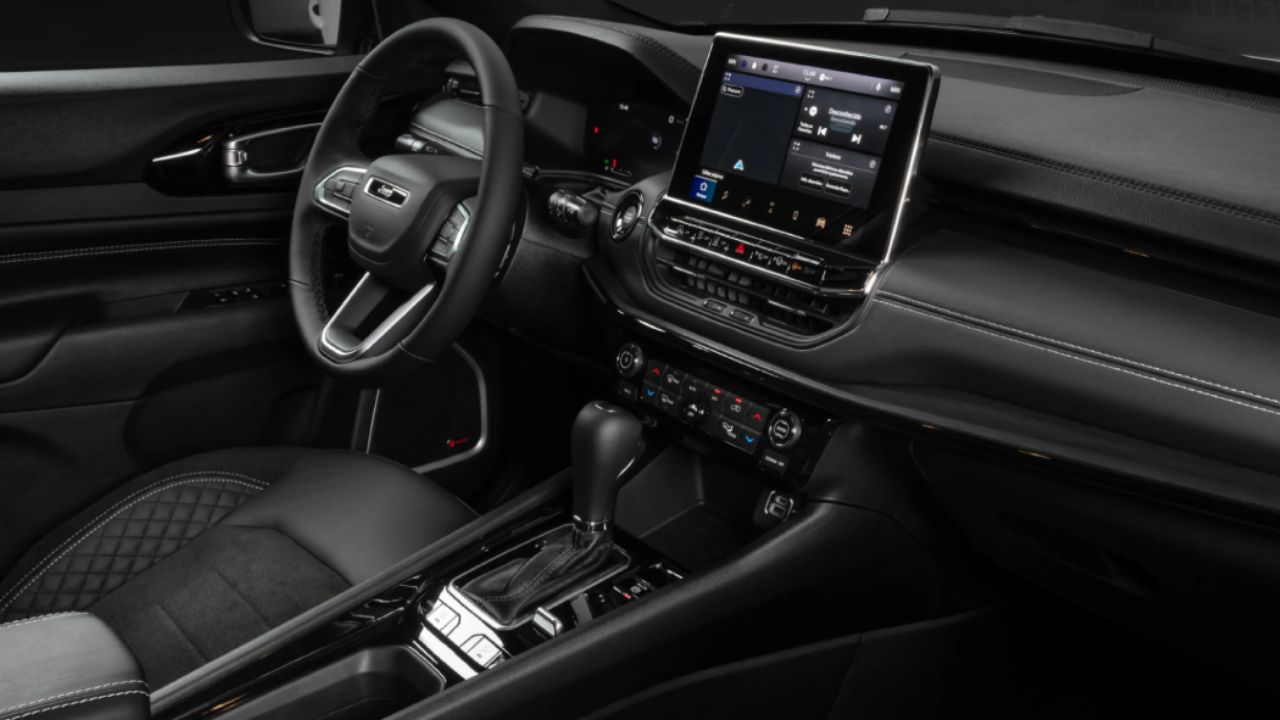
New Compass Blackhawk Launches at R$ 279,990 with Golf GTI Performance; Jeep’s Strategy Aims at Chinese Competition and Repositions Entire 2025 Lineup
Jeep has officially launched the new Compass Blackhawk in Brazil, the top-of-the-line version that redefines performance in the medium SUV segment. Equipped with the powerful 2.0 Turbo Hurricane engine delivering 272 hp and 4×4 traction, the model arrives with the promise of acceleration from 0 to 100 km/h in just 6.3 seconds.
With a price of R$ 279,990, the launch of the Blackhawk is the spearhead of a broad strategic restructuring of the 2025 Compass lineup. This maneuver includes a price reduction for the 1.3T versions to combat traditional competitors (such as Corolla Cross and Taos) and the introduction of the new 2.0T versions (Overland and Blackhawk) to directly face the rise of Chinese hybrid SUVs, like the GWM Haval H6 and the BYD Song Plus.
The New Performance Strategy of the 2025 Compass Lineup
The launch of the Compass Blackhawk is a calculated defensive and offensive maneuver. For years, Jeep enjoyed a “comfortable” position at the top of the segment, but has been compelled to “start moving” due to the disruptive competition from Chinese models, notably the GWM Haval H6 and the BYD Song Plus, which have redefined consumer expectations with hybrid technology and robust packages.
-
The car stored for 38 years: when opening the barn door, what appears is breathtaking and looks like a scene from a movie!

-
Fiat works miracles in the Brazilian market, lowers the price of its 0 km hatch to R$ 69,990, reestablishes the model as the cheapest car in the country, and reignites the battle against Kwid and C3.
-
Chevette with cooking gas: How the gas cylinder ends up being used in cars clandestinely and why this makeshift solution can result in leaks, explosions, damaged engines, and seized vehicles.

-
Fiat launches the new 2027 Toro hybrid with 48V, 176 hp, an electric motor of 15.5 hp, a 0.85 kWh battery, up to 7% fuel savings, 8% fewer emissions, and possible exemption from IPVA.


Jeep’s response was a tactical “pincer movement.” The defensive arm included price reductions in the 1.3T range (such as the Sport, now R$ 179,990, and the Series S, R$ 236,990) to tackle traditional rivals. The offensive arm was the creation of a new performance tier with the 2.0T (Overland and Blackhawk), establishing a “premium performance” subsegment to justify higher prices and directly challenge new competitors in image.
The Hurricane Heart: The Performance of a “Hot SUV”
The core of the Blackhawk’s value proposition is the 2.0 Turbo Hurricane engine, the same that powers the Ram Rampage, delivering 272 hp and 40.8 kgfm of torque with gasoline. Paired with a nine-speed automatic transmission and the 4×4 all-wheel drive system, it transforms the behavior of the medium SUV.


The central marketing metric, confirmed by Autoesporte, is the acceleration time from 0 to 100 km/h in 6.3 seconds. The publication itself highlights the impact of this number: it is exactly the same time as the last Volkswagen Golf GTI sold officially in Brazil. This comparison is crucial, as it elevates the Blackhawk from the “fast SUV” category to the “hot SUV” level, selling the performance of an iconic hot hatch in a family body weighing 1,700 kg.
The “Luxury Package” and the Reality of Equipment
Although the Compass Blackhawk is positioned as the pinnacle of luxury in the lineup, a forensic analysis of the standard equipment package, detailed by the Motor1.com, reveals that most of the technology is, in fact, inherited from lower versions.
The essence of the “luxury package,” which includes the Level 2 ADAS System (driving assistance), the 10.1-inch multimedia center, and the 500 Watts premium Beats sound system, is not exclusive. According to Motor1.com, these items are already present in the Longitude 1.3T version. Similarly, the seven airbags (including the knee airbag for the driver) have been standard since the Limited version.
What justifies the R$ 13,000 difference between the Blackhawk (R$ 279,990) and the Overland 2.0T (R$ 266,990) is primarily aesthetic and convenience items. The Blackhawk adds red-painted brake calipers, darkened exterior and interior trims, power-adjustable front passenger seat, and electronic tailgate opening with a presence sensor.
The Diesel Paradox: Strategic Replacement or Tactical Survival?
The initial premise of the market was that the 2.0T lineup would definitively replace the diesel engine, but the reality of the launch proved to be more complex.
As confirmed by both Autoesporte and Motor1.com, the Limited 2.0 Turbo Diesel TD350 4×4 is still in line. It is officially listed at a price of R$ 249,990. The resolution of this paradox lies in the launch strategy: Motor1.com clarified that Jeep tactically postponed the billing of the diesel until July 2024.
This was a classic marketing maneuver to focus all media efforts and the initial sales flow on the new and more profitable 2.0T versions. The diesel thus survives as a niche product, essential for customers seeking autonomy and low-rev torque (such as agriculture or those needing to tow). The Compass Blackhawk did not replace diesel; it “downgraded” it, stealing its status as the top-of-the-line 4×4 version.
The Jeep Compass Blackhawk does not enter the market with the mission of being a volume sales champion; its price of R$ 280,000 positions it as a niche product. Its true function is to serve as a “halo car.”
Its existence elevates the perception of the entire Compass lineup, lending its sportiness and cutting-edge technology package to the cheaper 1.3T versions. It is a strategic maneuver aimed at defending Jeep’s premium image while entry-level versions compete on price, ensuring that the Compass remains the ultimate aspirational medium SUV in Brazil.
Do you agree with this change? Do you think it impacts the market? Leave your opinion in the comments; we want to hear from those who live this in practice.







-

-

-

5 pessoas reagiram a isso.