





 Portuguese
  English
  Spanish
  6 min of reading
  0 comments


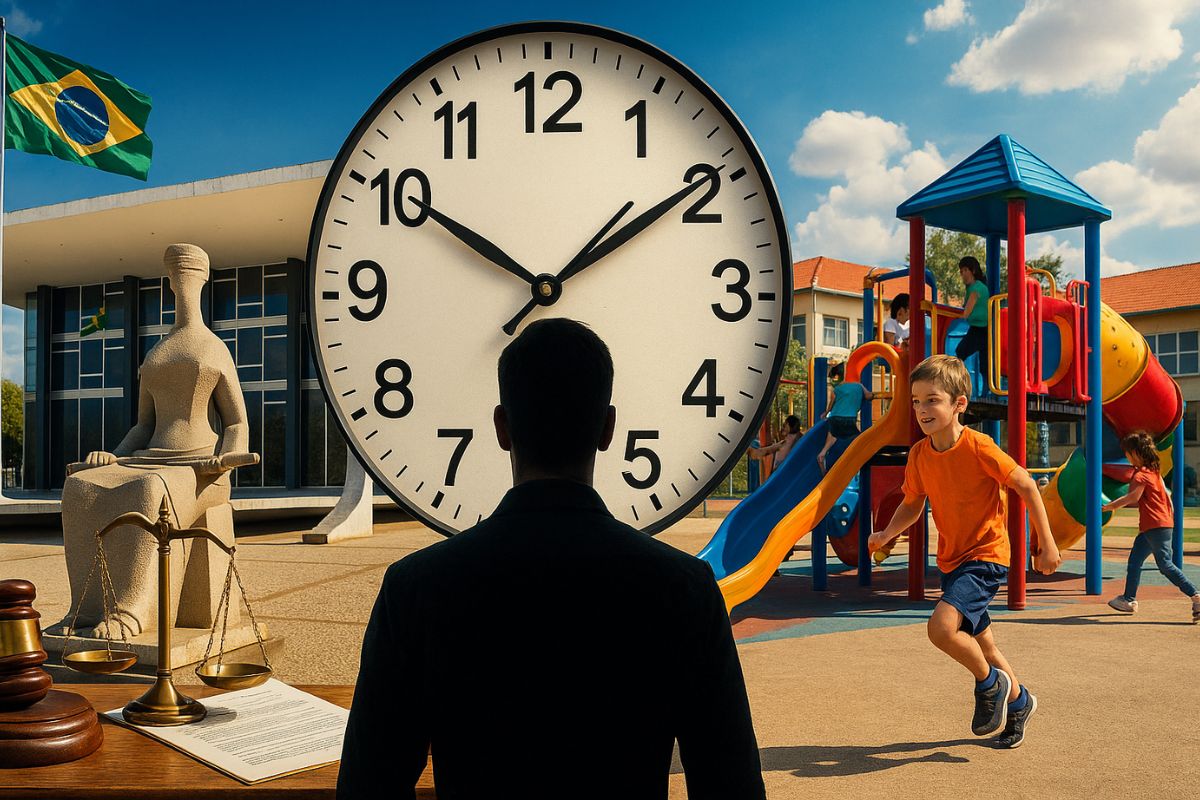
Court Decision Establishes That, As a Rule, Break Time Is Part of the Teacher’s Workday for Compensation Purposes, But Allows Schools to Prove When the Time Was Used Exclusively for the Teacher’s Personal Interest.
The new decision from the STF regarding the teacher’s workday redefines how break time should be treated in the employment relationships between teachers and educational institutions across the country. By a majority, the Court concluded that, as a rule, breaks are considered time available to the employer and therefore must be counted for compensation purposes, aligning the understanding with Article 4 of the CLT.
At the same time, the Tribunal dismissed the idea of absolute and automatic presumption. From now on, it is the employer’s responsibility to demonstrate, on a case-by-case basis, when the break time was used exclusively by the teacher for personal activity. Thus, the STF seeks to balance the protection of the teacher’s workday with the autonomy of schools and universities, reducing the risk of distortions in labor decisions.
What Exactly Did the STF Decide About Break Time
The STF judged an ADPF proposed by Abrafi, an association representing college managers, against decisions from the Labor Court that automatically considered break time as part of the teacher’s workday.
-
The Senate approves a bill that criminalizes misogyny, hatred, or aversion towards women, and includes the crime in the Racism Law with a penalty of up to 5 years.

-
Chamber Approves Bill That Allows Pepper Spray for Women Over 16 and Imposes Strict Rules for Purchase, Possession, and Use as Self-Defense

-
Chamber Approves Law to Combat Leucaena, Fast-Growing Plant That Dominates Land and Threatens Native Species in Various Regions of the Country

-
Asset Division: Know What Cannot Be Divided in Case of Divorce


In the final decision, the Court:
Declared unconstitutional the absolute presumption that breaks and intervals always constitute part of the teaching workday.
Established that, in the absence of a law or collective agreement to the contrary, these periods are, as a rule, time available to the employer, based on Article 4 of the CLT.
Determined that it is the employer’s duty to prove when the teacher used break time for strictly personal activities, excluding that period from the workday.
In practice, break time is now included in the teacher’s workday as a rule, but with room for specific exceptions, provided they are supported by concrete evidence from the educational institution.
Why the Automatic Presumption Was Dismissed
The central point of controversy was the stance of the Labor Court, which had been applying an absolute presumption: the 15-minute break would always be considered time available to the employer, regardless of any evidence of teaching activity or compliance with school orders.
According to the rapporteur, Minister Gilmar Mendes, this understanding created a rule without direct legal support, shifting the focus from an individual analysis of the facts.
He stated that the TST ended up overreaching by transforming into dogma what should be an examination of the teacher’s workday on a case-by-case basis.
With the new thesis, the STF maintains protection for teaching work, but rejects the idea that all breaks, in any context, automatically integrate the teacher’s workday, allowing space for specific evidence to be analyzed in labor actions.
The Role of Article 4 of the CLT in the New Interpretation
The entire discussion centers around the concept of “time available to the employer,” defined in Article 4 of the CLT.
This provision considers not only the period of direct activity in the classroom as part of the workday but also the time the employee remains in the work environment subject to the institution’s directive power.
The faction led by Minister Flávio Dino emphasized that, in the actual routine of schools, teachers often remain on-site during breaks, frequently attending to students, conversing with coordination, organizing materials, or moving between classrooms.
For this reason, the general rule remains that break time is part of the teacher’s workday.
By incorporating part of Dino’s thesis, Gilmar Mendes adjusted the vote to recognize that the presumption is now relative: it is presumed that breaks are time available, but evidence to the contrary is admitted, especially when the teacher can use the break time for personal activities unrelated to school tasks.
How the Ministers Voted and Where There Was Divergence
The decision was for partial approval of the ADPF, forming a majority around an intermediate position.
Gilmar Mendes (rapporteur) reaffirmed the unconstitutionality of the absolute presumption but acknowledged that, as a rule, break time constitutes part of the teacher’s workday, placing the onus on the employer to prove situations of exclusively personal use.
Flávio Dino argued from the outset that breaks and intervals between classes should be considered time available, precisely because the teacher remains subject to the school’s directive power. He only dismissed the absolute presumption and helped consolidate the final thesis.
Ministers such as Cristiano Zanin, Alexandre de Moraes, Cármen Lúcia, André Mendonça, Dias Toffoli, Luiz Fux, and Kassio Nunes Marques supported the adjusted vote of the rapporteur, reinforcing that the teacher’s workday generally includes break time, but with the possibility of evidence to the contrary.
Edson Fachin was in the minority, arguing for the dismissal of the action, claiming that the Labor Court’s understanding was already compatible with Article 4 of the CLT and that the controversy should be treated as an infraconstitutional issue.
The final result consolidated a formula for balance: the teacher’s workday is protected, but without rigid judicial interpretation and ensuring that atypical cases can be analyzed based on concrete evidence.
Practical Impacts for Schools, Colleges, and Teachers
From a practical perspective, the decision reconfigures how contracts and compensation for the teacher’s workday will be discussed in labor actions and collective negotiations.
For teachers, the STF thesis reinforces the argument that break time, under normal conditions, is part of working time.
This tends to strengthen claims for payment of unrecognized hours and for recomposing work hours in situations where the institution disregarded the break as time available.
For schools and colleges, the decision does not eliminate the possibility of discussing specific cases, but raises the burden of proof.
Now, if the institution wishes to exclude break time from the teacher’s workday calculation, it will need to clearly demonstrate that the teacher was free and used the time solely for personal interests, without any submission to the school’s management.
Furthermore, the STF’s decision opens the door for collective agreements and conventions to adjust this topic in greater detail, provided they respect the limits set by the Constitution and the CLT.
Collective negotiation becomes an important tool to bring predictability to private education networks and teachers.
Balance Between Labor Rights and Institutional Autonomy
The STF sought a balance point between two sensitive axes: the protection of the teacher’s workday and the autonomy of educational institutions.
By recognizing break time as working time in principle, the Court aligns jurisprudence with the reality of school routines, where teachers are rarely completely disconnected from their duties during breaks.
At the same time, by dismissing automatic presumption and admitting proven exceptions, the Tribunal avoids rigid situations where a teacher genuinely has real break time, using that time exclusively for themselves.
The logic is now a presumption favoring the worker, but with room for adjustments based on concrete evidence and collective negotiation.
In summary, the decision redefines the legal treatment of break time, consolidating the understanding that it is part of the teacher’s workday, but without making this rule an inflexible dogma, which tends to affect future labor actions and negotiations in the education sector.
For you, did the new interpretation from the STF manage to justly protect the teacher’s workday without stifling the functioning of schools, or does it still leave room for conflicts and insecurity in labor relations?










-

-

-

10 pessoas reagiram a isso.