





 Portuguese
  English
  Spanish
  6 min of reading
  61 comments


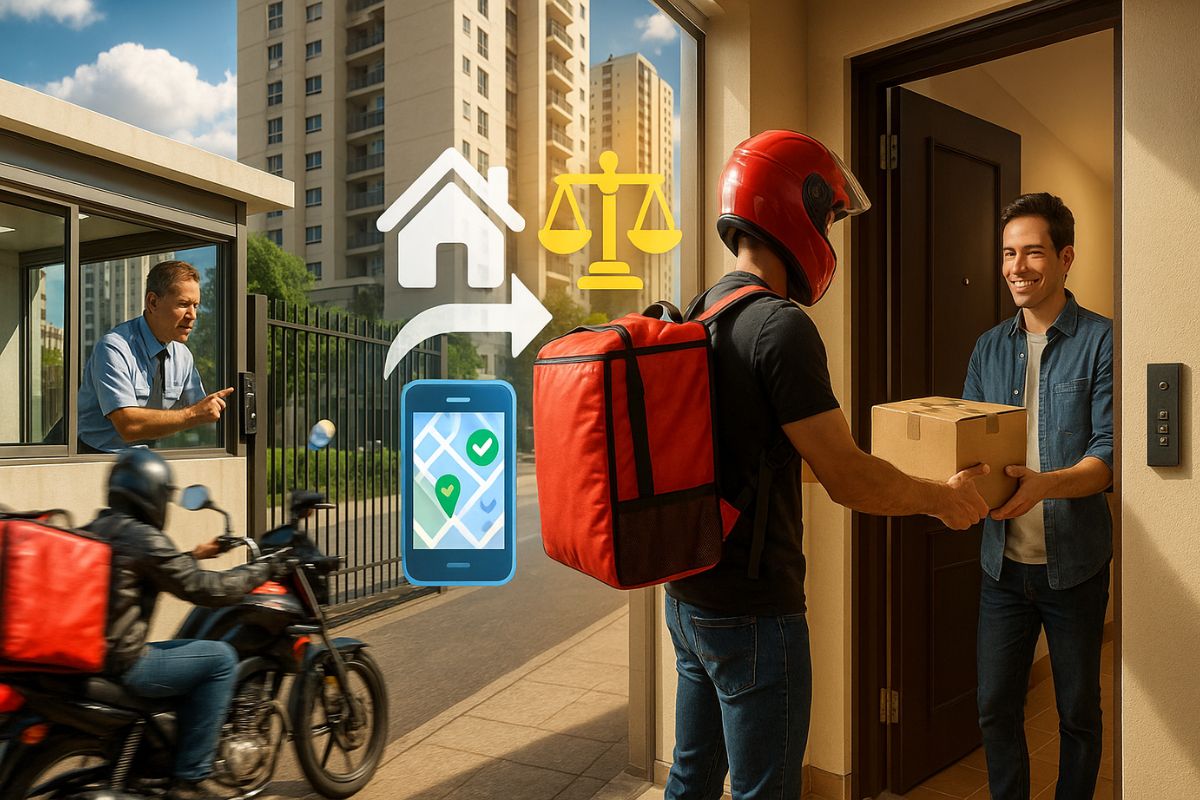


New Law Debated in Congress Outlines When Deliveries May Go to the Resident’s Door, How to Register the Pre-Agreement, and What Rules Apply to Consumers, Deliverers, and Condominiums
The rise of e-commerce has transformed the delivery routine in Brazil and exposed a sensitive point in everyday life in residential and commercial buildings: how far the deliverer can go inside the condominium and who decides the exact receiving location. With Bill No. 4910, currently in the National Congress, a new law will create clear rules for this scenario, allowing deliveries to reach directly at the door of the unit when there is a pre-agreement between consumer and provider, registered on the digital platform itself or an equivalent system.
In practice, the new law aims to provide more convenience to the resident, legal security to companies, and predictability to the work of deliverers, without disregarding the autonomy of condominiums over their common areas. When there is no express arrangement at the time of purchase, deliveries will continue to be concentrated at entrances, receptions, or guardhouses, always respecting the internal rules approved by the condo owners. The goal is to reduce conflicts, avoid improvisation on days with high volumes of orders, and standardize a flow that currently depends on case-by-case decisions.
What the New Law Changes in Deliveries in Condominiums
The heart of the proposal is simple: if the new law is approved as is, delivery to the apartment door or commercial room can only occur when this option is clearly registered at the time of purchase.
-
Banco do Brasil sues famous influencer for million-dollar debt and intensifies debate on delinquency, risks of seizure, and direct impact on Gkay’s credibility.

-
The Senate approves a bill that criminalizes misogyny, hatred, or aversion towards women, and includes the crime in the Racism Law with a penalty of up to 5 years.

-
Chamber Approves Bill That Allows Pepper Spray for Women Over 16 and Imposes Strict Rules for Purchase, Possession, and Use as Self-Defense

-
Chamber Approves Law to Combat Leucaena, Fast-Growing Plant That Dominates Land and Threatens Native Species in Various Regions of the Country


In this scenario, provider, platform, and deliverer will know in advance which route to follow within the condominium.
Without this formal agreement, the general rule applies: the product must be delivered to common areas defined by internal regulations, such as the entrance, reception, or guardhouse.
Thus, the project attempts to reconcile three layers of interest at the same time: the consumer’s right to choose, the organization of the condominium, and the safety of workers circulating in private areas.
By making it explicit in the text of the new law that the condominium can continue to regulate the use of common areas, the bill does not remove the autonomy of the assemblies.
It merely adds a formal channel for the resident to directly negotiate a different delivery model with the provider, as long as it is in line with local rules.
How Platforms Will Have to Adapt to the New Law
For everything to work in practice, the new law requires tangible changes in e-commerce and delivery platforms.
Digital systems will need to integrate specific fields to register the delivery location chosen by the consumer, clearly highlighted during the purchasing flow.
This means:
Creation of a mandatory or optional field for the delivery location
The system will offer options like entrance, reception, guardhouse, or the apartment door, always respecting what the condominium allows.
Auditable record of the consumer’s choice
The new law assumes that the delivery location must be recorded in a traceable manner, which reduces subsequent discussions about responsibility in case of issues.
Training and updating of internal routes
Companies will have to train attendants and deliverers to correctly interpret what was agreed upon on the platform, avoiding that the product is taken to a different place than stated in the order.
Logistics experts remind that these adaptations require investment in technology, application updates, and service flow reviews.
In contrast, the new law tends to reduce operational noise and complaints in support centers, which are very common today in deliveries conflicting with condominium rules.
Does the New Law Require Delivery to the Resident’s Door?
An important point of interpretation is that the new law does not require deliverers to go to the door of all apartments.
The text makes it clear that delivery at the door is only possible when there is a prior agreement between the consumer and the provider, duly registered.
Without this agreement or if the condominium has an explicit rule prohibiting access of deliverers to internal walkways, the delivery must remain restricted to common areas, such as:
- Entrance
- Reception
- Guardhouse or access control point
Thus, the new law does not create an “absolute right” for the resident to demand delivery at the door in any situation, but organizes a legal mechanism for this to happen where it is permitted and previously arranged.
The balance between convenience, security, and internal governance continues to be a central axis of the project.
Impacts of the New Law on Consumers and Deliverers
The discussion surrounding the new law is not limited to the comfort of the resident.
The text works with direct consequences for consumers, deliverers, and the administration of condominiums themselves.
For consumers, the main impacts are:
More autonomy to define the delivery location, within the possibilities offered by the condominium and the platform
Greater predictability and traceability, since the location is recorded in the order
Reduction of conflicts at entrances, especially on busy days or in condominiums with strict restrictions
For deliverers and delivery workers:
Clearer routes, with the delivery location defined at the moment the order enters the system
Less improvisation at entrances and guardhouses, which reduces discussions about how far the professional should enter
Greater legal security in performing their activities, as the new law describes the operating scenario in private areas
At the same time, the project foresees the need for communication campaigns for the general population, so that residents, managers, doormen, and deliverers truly understand what the new law allows and what it does not change.
Without this minimum understanding, the risk is that a good regulation generates unrealistic expectations in daily life.
New Law as a Balancing Point in Condominiums
In the context of condominiums, the proposal is designed as a balancing point between individual and collective interests.
The new law recognizes that the condominium needs to maintain control over internal circulation, security, and organization of common areas, while giving the consumer a formal tool to adjust the service to their needs.
By allowing the delivery agreement at the door to be clearly recorded, the project also reduces the margin for conflicts among residents, managers, and administrators.
Instead of informal decisions made on the fly, there will now be a predictable arrangement linked to the service’s contract and internal rules.
For jurists and consumer rights specialists, the new law fits into a broader movement of regulatory update in light of the growth of e-commerce and delivery apps.
The idea is to align housing rights, data protection, physical security, and contractual freedom in a reality where the flow of deliveries is already part of urban routine.
Why the Proposal is Considered a Modern Solution
Bill No. 4910 is often seen as a modern response to a typical problem of the digital age.
By positioning the new law as an instrument to register delivery choices within private areas, Congress seeks to align technology, freedom of choice, and condominium organization.
In practice, the text:
Recognizes the central role of digital platforms as intermediaries of deliveries
Ensures transparency and legal security by transforming the choice of delivery location into a formal clause
Protects the work of deliverers, limiting actions to the conditions previously agreed upon
Preserves the autonomy of condominiums, which continue to define internal rules for circulation in common areas
If well communicated and correctly applied, the new law has the potential to benefit millions of people receiving orders every month, from large urban centers to smaller condominiums in cities in the countryside.
Ultimately, the discussion about the new law goes far beyond the apartment door: it involves security, logistics, trust, and how Brazil organizes its digital daily life within private spaces.
And you, if you could choose, would you prefer to receive your deliveries at the entrance or directly at the door of your apartment when there was a registered prior agreement under the new law?









Bando de **** o entregador que se dane se a plataforma e o restaurante falar que vai ter que subir o entregador não pode opinar lógico que todos vão pedir pra subir ao invés disso por que não colocam mais um na portaria e essa pessoa entrega prós condôminos já e um absurdo vc chegar no condomínio e a pessoa ainda não está esperando ainda vai sair do apartamento sendo que ela pode ver onde o entregador se encontra por que não deixa o código com o porteiro ele passa o código e deixa na portaria e outro funcionário do condomínio entrega nos locais mais não eles não querem gastar e jogar nas costas do entregador
Aí o prédio não tem lugar para o entregador parar o carro, vai fazer o que?
Deixar na rua correndo o risco de quebrarem o vidro pra roubar as encomendas ou até mesmo levar multa?
Se tiver que subir, eu vou colocar destinatário ausente e o cliente que se ****!
Certo dia fiz uma entrega em um condomínio e logo na portaria perguntaram se eu iria subir , eu disse que não e ao chegar na entrada do bloco a **** logo gritou ” eu acho um absurdo vc não subir ” ,gritei de volta ” vc comprou uma **** de um apartamento no quinto andar sem elevador foi pra vc morar , sendo assim quem tem que subir e descer é vc e não eu ” . Ela se calou , pegou a entrega com o **** entre as pernas e subiu de volta pra caixinha!
Parlamentar e patrão nao quer saber se vc vai subir 600 degraus durante o dia , vão obrigar o entregador subir !