





 Portuguese
  English
  Spanish
  4 min of reading
  0 comments


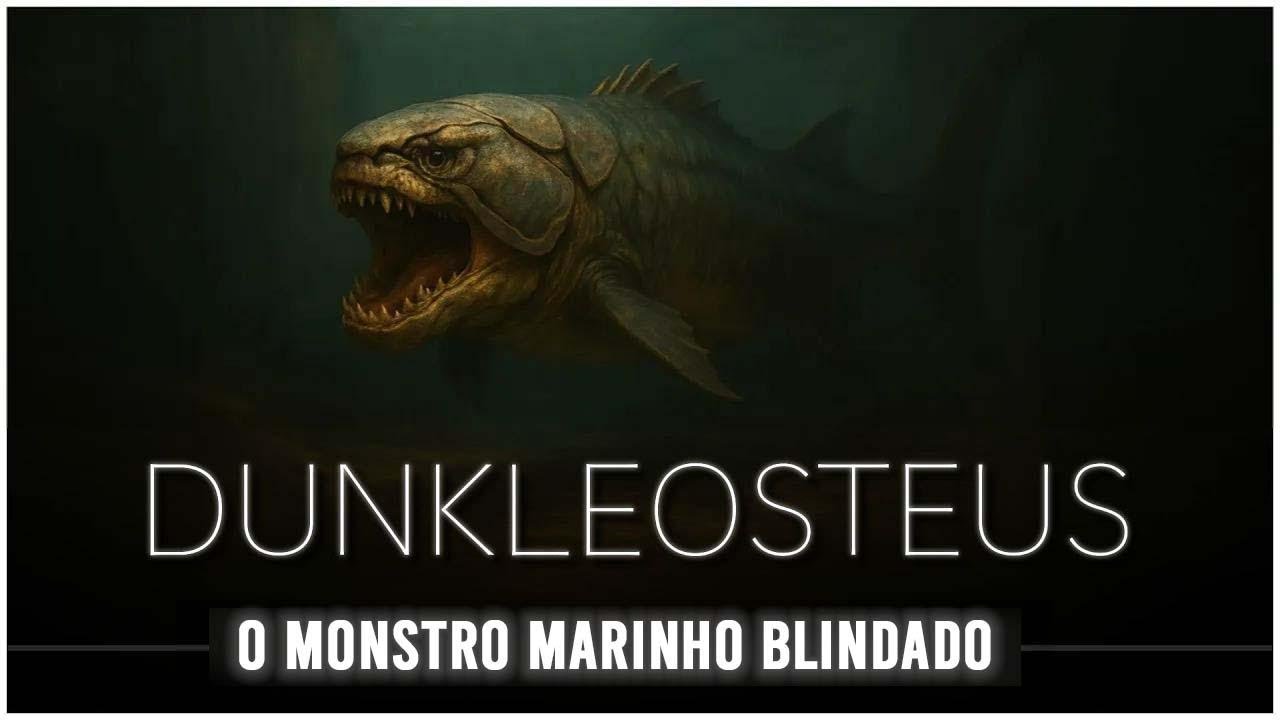
Measuring Up to 4.5 Meters and Over 1 Ton, Dunkleosteus Was an Armored Fish of the Devonian with One of the Most Powerful Bites in Ocean History.
Long before sharks, whales, or large marine reptiles occupied the top of the food chain, the oceans had already produced a predator capable of imposing absolute respect. The Dunkleosteus, especially the species Dunkleosteus terrelli, lived about 382 to 360 million years ago, during the Late Devonian, a period known as the “Age of Fishes.” In this primitive scenario, it stood out as one of the first apex vertebrate predators in Earth’s history.
While many fish were still evolving efficient jaws, Dunkleosteus had developed an extreme combination of bone armor, strike strength, and predatory efficiency, something that put it far ahead of its time.
Real Dimensions of a Prehistoric Giant
For decades, Dunkleosteus was portrayed as a marine monster over 6 or even 8 meters long. More recent studies, based on biomechanical analyses and comparisons with better-preserved placoderms, indicate more conservative numbers—still impressive.
-
What if the Sun disappeared suddenly? Simulation shows Earth in darkness within minutes, extreme cold, and rapid collapse of life on the planet.

-
A 2,400-year-old iron foundry has been discovered in Senegal with 100 tons of slag, 35 furnace bases, and signs of nearly eight centuries of continuous metallurgical activity.

-
Four humans are flying towards the Moon inside the Orion capsule launched by the SLS rocket, and on April 6, Artemis II will disappear behind the far side of the Moon without communication with Earth for nearly an hour.

-
Worlds covered by water, atmospheres filled with hydrogen, and the possibility of life beyond Earth: ocean planets are rewriting the map of cosmic search and forcing scientists to rethink where to look.


The currently most accepted estimates suggest that the largest individuals reached between 3.4 and 4.1 meters in length, with exceptional cases approaching 4.5 meters. The body weight, calculated from the estimated trunk volume and bone density, ranged from 950 kilograms to about 1.7 tons.


Even with these revisions, Dunkleosteus remains one of the largest predatory fish ever documented, especially considering the early stage of marine vertebrate evolution.
Bone Armor That Functioned as a Natural Armor
The nickname “armored fish” is no exaggeration. Dunkleosteus belonged to the group of placoderms, fish characterized by thick bony plates covering the head and front of the body. This armor functioned as a true shield against attacks from other predators and impacts during territorial disputes.
Unlike modern fish, which rely on flexible scales, Dunkleosteus had a rigid structure capable of absorbing significant forces. This armor explains why it could engage in direct confrontations with other large marine animals without suffering fatal damage.
The Most Efficient Toothless Jaw in Prehistory
One of the most fascinating aspects of Dunkleosteus is that it did not have true teeth. Instead, its mouth was equipped with sharp, self-sharpening bony plates, positioned to function as cutting blades.

Biomechanical studies suggest that its jaw could open and close at extremely high speed, creating a suction effect followed by an extremely powerful strike.
Scientific modeling suggests that its bite force was among the highest ever estimated for a fish, sufficient to crush bones, break shells, and cut prey in half.
This system allowed Dunkleosteus to feed on practically any animal that fit in its mouth, including other armored fish, thick-shelled mollusks, and large marine vertebrates.
The First Superpredator of the Oceans
In the Devonian ecosystem, Dunkleosteus occupied the absolute top of the food chain. It is considered by many researchers to be one of the first superpredators in history, inaugurating an ecological model later repeated by giant sharks, mosasaurs, and, millions of years later, large cetaceans.
Its presence directly influenced the evolution of other species. Smaller animals needed to develop better defenses, greater speed, or escape behaviors, while other predators competed for secondary niches to avoid direct confrontation.
Global Distribution and Sea Dominance
Dunkleosteus fossils have been found in various parts of the world, including the United States, Canada, Belgium, Poland, and Morocco, indicating that it had a wide distribution in the shallow, coastal seas of the Devonian.
This global presence reinforces the idea that Dunkleosteus was not a regional predator, but rather a dominator of the primitive oceans, adapted to different marine environments.
Why Did Dunkleosteus Disappear?
The disappearance of Dunkleosteus is linked to the extinction events at the end of the Devonian, which severely impacted marine ecosystems. Climate changes, reduced oxygen in the oceans, and ecological collapses eliminated many dominant groups of the time, including placoderms.
Despite its size, strength, and efficiency, Dunkleosteus could not survive these global transformations. Its end marked the conclusion of an era and opened space for primitive sharks and bony fish to take center stage in the seas.
The Legacy of the Biggest Armored Fish in History
Even after hundreds of millions of years, Dunkleosteus continues to be one of the most impressive animals ever studied by paleontology. It represents a unique moment in evolution when nature experimented with extreme forms of armor, strength, and predation long before the emergence of modern large predators.
Dunkleosteus was not just large. It was a watershed moment in the history of marine life, proving that, since the dawn of the oceans, the planet had already produced true colossi capable of dominating everything around them.









-

-

3 pessoas reagiram a isso.