





 Portuguese
  English
  Spanish
  5 min of reading
  0 comments


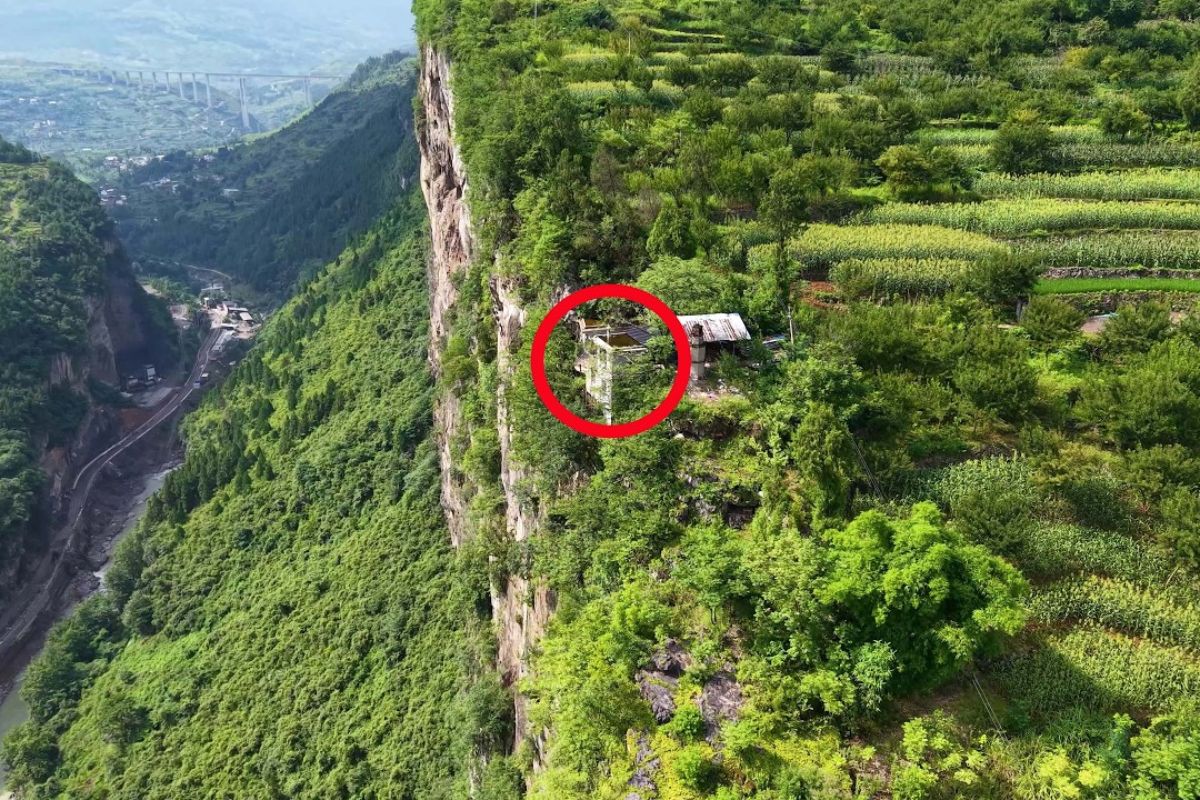
With the House on the Cliff of Guizhou Built on Living Rock and Few Pillars Over a 300-Meter Abyss, Residents and Faithful Live with Storms, Tremors, Constant Vertigo, Silent Fear, Daily Rituals, Unwavering Faith, and the Inevitable Question of Whether It Is Worth It to Stay There in This Extreme Place.
The house on the cliff of Guizhou located in China looks like an optical illusion embedded in the mountain. From below, the building appears stuck to the abyss, with the base supported by few pillars firmly planted in the rock and a vertical drop that easily exceeds 300 meters down to the river valley. Up there, among heavy clouds and strong winds, people still sleep, pray, work, and take care of the temple.
To reach the house on the cliff of Guizhou, one must face a narrow mountain road, successive curves, stretches where the car cannot pass, and the rest of the path must be done on foot, through fields of sorghum, corn, rice, fruit trees, plum trees, and small gardens with tomatoes, scallions, green beans, and peppers. At the end of the trail, instead of a simple rural dwelling, an improbable complex of rock, wood, concrete, sacred statues, and suspended platforms appears in the void.
House on the Cliff of Guizhou Balanced Over a 300-Meter Abyss

Facing the valley, the house on the cliff of Guizhou juts out over the precipice with a concrete and wood platform, supported by few pillars embedded in the slope.
-
A forgotten cord on the floor of a basement in Vienna leads a plumber to a box containing 30 kilograms of gold with Mozart’s face, hidden before World War II. The treasure, worth 2.3 million euros, was just centimeters away from a worker who ignored the sign a day earlier.
-
A couple buys an old chalet, breaks the kitchen floor for renovation, and finds over a thousand coins of gold and silver hidden since the English Civil War over 4 centuries ago.

-
Rigid bags with their days numbered: new trend prioritizes comfort in 2026.

-
YouTuber creates an excavator equipped with a giant 4.5-meter sword to challenge his brother to a rematch, and the invention quickly goes viral on social media.

Down below, a river flows, so far away that the sound of water barely reaches the top. If it weren’t for the trees at the edge of the cliff, the direct view of the drop would make the scenery even more intimidating.

The access goes through a small organized yard, firewood carefully stacked, a water pipe coming down from the mountain, and a simple kitchen with recent signs of use, indicating that someone is still preparing meals there.

The feeling is paradoxical: on one hand, there is a normal life routine; on the other, every step serves as a reminder that one careless move could bring you too close to the edge of the cliff.
Temple in the Rock Transforms the House on the Cliff of Guizhou into a Sacred Place

As you move through the interior, the house on the cliff of Guizhou is also a mountain temple. Above the main platform, there is a devotional space with statues, burned incense, and inscriptions that speak of a “sacred mountain” and a “different world” from what exists down in the valley.
Inside the temple, several figures are consecrated: a Celestial Emperor, Guan Gong with a red face, deities with multiple arms and eyes, some of them seated on sculpted tigers. The statues do not follow an industrial pattern, appearing handmade by locals and artisans, each with unique features.
One detail stands out: almost all images bear a chicken feather attached to the body. The exact meaning is not explained, but the repetition suggests a symbol of protection, sacrifice, or a connection to the rural life surrounding the cliff.
On the benches spread throughout the temple and the central table, everything suggests that collective rituals and moments of prayer are held there, even with the constant risk of the cliff just ahead.
Structure of the House on the Cliff of Guizhou Mixes Ancient Joints and Modern Concrete

The house on the cliff of Guizhou is also an open-air laboratory of hybrid architecture. The beams supporting the roof were assembled using traditional joint and snug techniques, with no visible nails, similar to the old wooden constructions in the region. The lower pillars, embedded at the edge of the rock, are made of reinforced concrete, facing the void.
Above the main area, the rock of the cliff serves as natural wall and ceiling. In some rooms, the bed is directly against the stone, and the visitor needs to take a second look to understand where the house ends and where the mountain begins.
The feeling is that the construction was literally fitted into the slope, taking advantage of every recess to create resting rooms and daily use spaces.
Piles of tiles are stored on one of the landings, indicating plans for renovation or expansion. Everything is clean and relatively organized, reinforcing that this is not an abandoned place, but one in continuous use, despite all the limitations and the inherent risk of its very location.
Daily Life in a House on the Cliff of Guizhou Among Clouds, Fog, and Storms
On humid hot days, the heavy clouds rise from the valley and envelop the house on the cliff of Guizhou, temporarily covering the cliff.
The visual relief disappears quickly when the fog dissipates and the abyss reappears. With the unstable weather typical of the mountains, the possibility of heavy rain and storms makes the location even more dramatic.
Those who live there must get used to thunder echoing in the valley, gusts of wind hitting directly against the suspended walls and roof, and the uncomfortable idea that everything, from the temple to the bedroom, is supported by few pillars at the edge of the rock.
It is not just a matter of faith: it is a daily decision to accept that life unfolds in a place that challenges the basic instinct of self-preservation.
At the same time, the routine shows elements of normality. There are stacked tools, water arriving through piping, signs of food preparation, and corners reserved for resting.
The house on the cliff of Guizhou functions as a residence, a spiritual retreat, and a meeting point, in a combination that only makes sense within that specific community and geography.
House on the Cliff of Guizhou Is a Collision Between Rock, Faith, Concrete, and Extreme Courage

From the outside, the house on the cliff of Guizhou looks like a miscalculation or an act of audacity taken to the limit. But, as you walk through its corridors, understand the temple, see the beds leaning against the rock, and notice the care in every detail, it becomes clear that there exists a life project, not just an architectural eccentricity.
It is a collision between raw rock, reinforced concrete, ancient construction tradition, and religious devotion, piled up on a cliff of hundreds of meters.
The line between the spectacular and the dangerous is thin, and each storm or earthquake reopens the same doubt for those who live there and for those who visit: how far is it worth living with the risk in the name of faith, the landscape, or the history of that place?
With all this in mind, the question remains: would you have the courage to live in a house on the cliff of Guizhou, suspended 300 meters high over the abyss?








-

-

-

-

-

28 pessoas reagiram a isso.